Kirjojen hintavertailu. Mukana 12 595 353 kirjaa ja 12 kauppaa.

Kirjailija

David Aers

Kirjat ja teokset yhdessä paikassa: 15 kirjaa, julkaisuja vuosilta 1996-2022, suosituimpien joukossa Romanticism and Ideology. Vertaile teosten hintoja ja tarkista saatavuus suomalaisista kirjakaupoista.

15 kirjaa

Kirjojen julkaisuhaarukka 1996-2022.

Beyond Reformation?

Beyond Reformation?

David Aers

UNIVERSITY OF NOTRE DAME PRESS
2022
sidottu
In Beyond Reformation? An Essay on William Langland's Piers Plowman and the End of Constantinian Christianity, David Aers presents a sustained and profound close reading of the final version of William Langland's Piers Plowman, the most searching Christian poem of the Middle Ages in English. His reading, most unusually, seeks to explore the relations of Langland's poem to both medieval and early modern reformations together with the ending of Constantinian Christianity. Aers concentrates on Langland's extraordinarily rich ecclesiastic politics and on his account of Christian virtues and the struggles of Conscience to discern how to go on in his often baffling culture. The poem's complex allegory engages with most institutions and forms of life. In doing so, it explores moral languages and their relations to current practices and social tendencies. Langland's vision conveys a strange sense that in his historical moment some moral concepts were being transformed and some traditions the author cherished were becoming unintelligible. Beyond Reformation? seeks to show how Langland grasped subtle shifts that were difficult to discern in the fourteenth century but were to become forces with a powerful future in shaping Western Christianity. The essay form that Aers has chosen for his book contributes to the effectiveness of the argument he develops in tandem with the structure of Langland's poem: he sustains and tests his argument in a series of steps or "passus," a Langlandian mode of proceeding. His essay unfolds an argument about medieval and early modern forms of Constantinian Christianity and reformation, and the way in which Langland's own vision of a secularizing, de-Christianizing late medieval church draws him toward the idea of a church of "fools," beyond papacy, priesthood, hierarchy, and institutions. For Aers, Langland opens up serious diachronic issues concerning Christianity and culture. His essay includes a brief summary of the poem and modern translations alongside the original medieval English. It will challenge specialists on Langland's poem and supply valuable resources of thought for anyone who continues to struggle with the church of today.
Salvation and Sin

Salvation and Sin

David Aers

UNIVERSITY OF NOTRE DAME PRESS
2022
sidottu
In Salvation and Sin, David Aers continues his study of Christian theology in the later Middle Ages. Working at the nexus of theology and literature, he combines formidable theological learning with finely detailed and insightful close readings to explore a cluster of central issues in Christianity as addressed by Saint Augustine and by four fourteenth-century writers of exceptional power. Salvation and Sin explores various modes of displaying the mysterious relations between divine and human agency, together with different accounts of sin and its consequences. Theologies of grace and versions of Christian identity and community are its pervasive concerns. Augustine becomes a major interlocutor in this book: his vocabulary and grammar of divine and human agency are central to Aers' exploration of later writers and their works. After the opening chapter on Augustine, Aers turns to the exploration of these concerns in the work of two major theologians of fourteenth-century England, William of Ockham and Thomas Bradwardine. From their work, Aers moves to his central text, William Langland's Piers Plowman, a long multigeneric poem contributing profoundly to late medieval conversations concerning theology and ecclesiology. In Langland's poem, Aers finds a theology and ethics shaped by Christology where the poem's modes of writing are intrinsic to its doctrine. His thesis will revise the way in which this canonical text is read. Salvation and Sin concludes with a reading of Julian of Norwich's profound, compassionate, and widely admired theology, a reading which brings her Showings into conversation both with Langland and Augustine.
Versions of Election

Versions of Election

David Aers

University of Notre Dame Press
2020
nidottu
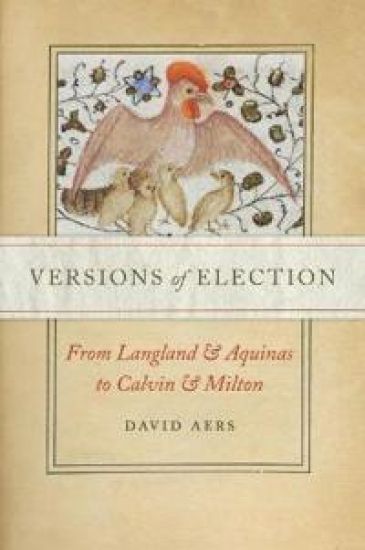
Concepts of predestination and reprobation were central issues in the Protestant Reformation, especially within Calvinist churches, and thus have often been studied primarily in the historical context of the sixteenth and seventeenth centuries. In Versions of Election: From Langland and Aquinas to Calvin and Milton, David Aers takes a longer view of these key issues in Christian theology. With meticulous attention to the texts of medieval and early modern theologians, poets, and popular writers, this book argues that we can understand the full complexity of the history of various teachings on the doctrine of election only through a detailed diachronic study that takes account of multiple periods and disciplines. Throughout this wide-ranging study, Aers examines how various versions of predestination and reprobation emerge and re-emerge in Christian tradition from the Middle Ages through the seventeenth century. Starting with incisive readings of medieval works by figures such as William Langland, Thomas Aquinas, and Robert Holcot, and continuing on to a nuanced consideration of texts by Protestant thinkers and writers, including John Calvin, Arthur Dent, William Twisse, and John Milton (among others), Aers traces the twisting and unpredictable history of prominent versions of predestination and reprobation across the divide of the Reformation and through a wide variety of genres. In so doing, Aers offers not only a detailed study of election but also important insights into how Christian tradition is made, unmade, and remade. Versions of Election is an original, cross-disciplinary study that touches upon the fields of literature, theology, ethics, and politics, and makes important contributions to the study of both medieval and early modern intellectual and literary history. It will appeal to academics in these fields, as well as clergy and other educated readers from a wide variety of denominations.
Versions of Election

Versions of Election

David Aers

University of Notre Dame Press
2020
sidottu
Concepts of predestination and reprobation were central issues in the Protestant Reformation, especially within Calvinist churches, and thus have often been studied primarily in the historical context of the sixteenth and seventeenth centuries. In Versions of Election: From Langland and Aquinas to Calvin and Milton, David Aers takes a longer view of these key issues in Christian theology. With meticulous attention to the texts of medieval and early modern theologians, poets, and popular writers, this book argues that we can understand the full complexity of the history of various teachings on the doctrine of election only through a detailed diachronic study that takes account of multiple periods and disciplines. Throughout this wide-ranging study, Aers examines how various versions of predestination and reprobation emerge and re-emerge in Christian tradition from the Middle Ages through the seventeenth century. Starting with incisive readings of medieval works by figures such as William Langland, Thomas Aquinas, and Robert Holcot, and continuing on to a nuanced consideration of texts by Protestant thinkers and writers, including John Calvin, Arthur Dent, William Twisse, and John Milton (among others), Aers traces the twisting and unpredictable history of prominent versions of predestination and reprobation across the divide of the Reformation and through a wide variety of genres. In so doing, Aers offers not only a detailed study of election but also important insights into how Christian tradition is made, unmade, and remade. Versions of Election is an original, cross-disciplinary study that touches upon the fields of literature, theology, ethics, and politics, and makes important contributions to the study of both medieval and early modern intellectual and literary history. It will appeal to academics in these fields, as well as clergy and other educated readers from a wide variety of denominations.
Routledge Revivals: Community, Gender, and Individual Identity (1988)
First published in 1988, David Aers explores the treatment of community, gender, and individual identity in English writing between 1360 and 1430, focusing on Margery Kempe, Langland, Chaucer, and the poet of Sir Gawain. He shows how these texts deal with questions about gender, the making of individual identity, and competing versions of community in ways which still speak powerfully in contemporary analysis of gender formation, sexuality, and love. Making wide use of recent research on the English economy and communities, and informed by current debates in the theory of culture and gender, the book will be of interest to those concerned with medieval studies, Renaissance studies, and women’s studies.
Routledge Revivals: Chaucer, Langland, and the Creative Imagination (1980)
First published in 1980, this study of two renowned later fourteenth century English poets, Chaucer and Langland, concentrates on some major and representative aspects of their work. Aers shows that, in contrast to the mass conventional writing of the period, which was happy to accept and propagate traditional ideologies, Chaucer and Langland were preoccupied with actual conflicts, strains, and developments in received ideologies and social practices. He demonstrates that they were genuinely exploratory, and created work which actively questioned dominant ideologies, even those which they themselves revered and hoped to affirm. For Chaucer and Langland the imagination was indeed creative, involved in the active construction of meanings, and in their poetry they grasped and explored social commitments, religious developments and many perplexing contradictions which were subverting inherited paradigms.
Routledge Revivals: Community, Gender, and Individual Identity (1988)
First published in 1988, David Aers explores the treatment of community, gender, and individual identity in English writing between 1360 and 1430, focusing on Margery Kempe, Langland, Chaucer, and the poet of Sir Gawain. He shows how these texts deal with questions about gender, the making of individual identity, and competing versions of community in ways which still speak powerfully in contemporary analysis of gender formation, sexuality, and love. Making wide use of recent research on the English economy and communities, and informed by current debates in the theory of culture and gender, the book will be of interest to those concerned with medieval studies, Renaissance studies, and women’s studies.
Routledge Revivals: Chaucer, Langland, and the Creative Imagination (1980)
First published in 1980, this study of two renowned later fourteenth century English poets, Chaucer and Langland, concentrates on some major and representative aspects of their work. Aers shows that, in contrast to the mass conventional writing of the period, which was happy to accept and propagate traditional ideologies, Chaucer and Langland were preoccupied with actual conflicts, strains, and developments in received ideologies and social practices. He demonstrates that they were genuinely exploratory, and created work which actively questioned dominant ideologies, even those which they themselves revered and hoped to affirm. For Chaucer and Langland the imagination was indeed creative, involved in the active construction of meanings, and in their poetry they grasped and explored social commitments, religious developments and many perplexing contradictions which were subverting inherited paradigms.
Romanticism and Ideology

Romanticism and Ideology

David Aers; Jonathan Cook; David Punter

Routledge
2017
nidottu
First published in 1981.The primary purpose of this book is to serve as an introduction to writing in the late eighteenth and early nineteenth centuries. In addition to major Romantic poets – Blake, Wordsworth, Coleridge and Shelly – the authors discuss writers such as Austen, Hazlitt and Burke, who are usually studied in a different context, and genres such as fiction and political writing, which are often cut off from the central body of poetry.An original and highly stimulated study, this book will appeal to all those who are dissatisfied with the conventional categories into which writers and literary movements are usually placed..
Romanticism and Ideology

Romanticism and Ideology

David Aers; Jonathan Cook; David Punter

Routledge
2016
sidottu
First published in 1981.The primary purpose of this book is to serve as an introduction to writing in the late eighteenth and early nineteenth centuries. In addition to major Romantic poets – Blake, Wordsworth, Coleridge and Shelly – the authors discuss writers such as Austen, Hazlitt and Burke, who are usually studied in a different context, and genres such as fiction and political writing, which are often cut off from the central body of poetry.An original and highly stimulated study, this book will appeal to all those who are dissatisfied with the conventional categories into which writers and literary movements are usually placed..
Beyond Reformation?

Beyond Reformation?

David Aers

University of Notre Dame Press
2015
nidottu
In Beyond Reformation? An Essay on William Langland's Piers Plowman and the End of Constantinian Christianity, David Aers presents a sustained and profound close reading of the final version of William Langland's Piers Plowman, the most searching Christian poem of the Middle Ages in English. His reading, most unusually, seeks to explore the relations of Langland's poem to both medieval and early modern reformations together with the ending of Constantinian Christianity. Aers concentrates on Langland's extraordinarily rich ecclesiastic politics and on his account of Christian virtues and the struggles of Conscience to discern how to go on in his often baffling culture. The poem's complex allegory engages with most institutions and forms of life. In doing so, it explores moral languages and their relations to current practices and social tendencies. Langland's vision conveys a strange sense that in his historical moment some moral concepts were being transformed and some traditions the author cherished were becoming unintelligible. Beyond Reformation? seeks to show how Langland grasped subtle shifts that were difficult to discern in the fourteenth century but were to become forces with a powerful future in shaping Western Christianity. The essay form that Aers has chosen for his book contributes to the effectiveness of the argument he develops in tandem with the structure of Langland's poem: he sustains and tests his argument in a series of steps or "passus," a Langlandian mode of proceeding. His essay unfolds an argument about medieval and early modern forms of Constantinian Christianity and reformation, and the way in which Langland's own vision of a secularizing, de-Christianizing late medieval church draws him toward the idea of a church of "fools," beyond papacy, priesthood, hierarchy, and institutions. For Aers, Langland opens up serious diachronic issues concerning Christianity and culture. His essay includes a brief summary of the poem and modern translations alongside the original medieval English. It will challenge specialists on Langland's poem and supply valuable resources of thought for anyone who continues to struggle with the church of today.
Salvation and Sin

Salvation and Sin

David Aers

University of Notre Dame Press
2009
nidottu
In Salvation and Sin, David Aers continues his study of Christian theology in the later Middle Ages. Working at the nexus of theology and literature, he combines formidable theological learning with finely detailed and insightful close readings to explore a cluster of central issues in Christianity as addressed by Saint Augustine and by four fourteenth-century writers of exceptional power. Salvation and Sin explores various modes of displaying the mysterious relations between divine and human agency, together with different accounts of sin and its consequences. Theologies of grace and versions of Christian identity and community are its pervasive concerns. Augustine becomes a major interlocutor in this book: his vocabulary and grammar of divine and human agency are central to Aers' exploration of later writers and their works. After the opening chapter on Augustine, Aers turns to the exploration of these concerns in the work of two major theologians of fourteenth-century England, William of Ockham and Thomas Bradwardine. From their work, Aers moves to his central text, William Langland's Piers Plowman, a long multigeneric poem contributing profoundly to late medieval conversations concerning theology and ecclesiology. In Langland's poem, Aers finds a theology and ethics shaped by Christology where the poem's modes of writing are intrinsic to its doctrine. His thesis will revise the way in which this canonical text is read. Salvation and Sin concludes with a reading of Julian of Norwich's profound, compassionate, and widely admired theology, a reading which brings her Showings into conversation both with Langland and Augustine.
Sanctifying Signs

Sanctifying Signs

David Aers

University of Notre Dame Press
2004
nidottu
Concentrating on the sacrament of the altar, poverty, and conflicting versions of sanctity, Sanctifying Signs presents a critical study of Christian literature, theology, and culture in late medieval England. In this notable book, David Aers considers the diverse ways in which certain late medieval Christians and their Church engaged the immense resources of the Christian tradition in their own historical moment. Using a wide range of texts, Aers explores the complex theological, institutional, and political processes that shape and preserve tradition during changing circumstances. He is particularly interested in why some texts were judged by the late medieval Church to be orthodox and others heretical, and the effect of these judgments on the conversations and debates of the fourteenth and fifteenth centuries. Sanctifying Signs begins with accounts of the sacrament of the altar that were deemed orthodox in the late medieval Church. Aers then shifts his focus to the relationship between sanctification and the sign of poverty. Finally, he reflects on the relationship between some versions of domesticity and sanctification. Texts of William Langland, John Wyclif, Walter Brut, William Thorpe, and others are examined within the context of a broad range of earlier and contemporary writings and events. Through these modes of exploration Aers seeks to understand and reinvigorate a theological, ethical, ecclesiological, and political conversation that has been pursued through a variety of rhetorical forms since the late Middle Ages.
Sanctifying Signs

Sanctifying Signs

David Aers

University of Notre Dame Press
2004
sidottu
Concentrating on the sacrament of the altar, poverty, and conflicting versions of sanctity, Sanctifying Signs presents a critical study of Christian literature, theology, and culture in late medieval England. In this notable book, David Aers considers the diverse ways in which certain late medieval Christians and their Church engaged the immense resources of the Christian tradition in their own historical moment. Using a wide range of texts, Aers explores the complex theological, institutional, and political processes that shape and preserve tradition during changing circumstances. He is particularly interested in why some texts were judged by the late medieval Church to be orthodox and others heretical, and the effect of these judgments on the conversations and debates of the fourteenth and fifteenth centuries. Sanctifying Signs begins with accounts of the sacrament of the altar that were deemed orthodox in the late medieval Church. Aers then shifts his focus to the relationship between sanctification and the sign of poverty. Finally, he reflects on the relationship between some versions of domesticity and sanctification. Texts of William Langland, John Wyclif, Walter Brut, William Thorpe, and others are examined within the context of a broad range of earlier and contemporary writings and events. Through these modes of exploration Aers seeks to understand and reinvigorate a theological, ethical, ecclesiological, and political conversation that has been pursued through a variety of rhetorical forms since the late Middle Ages.
The Powers of the Holy

The Powers of the Holy

David Aers; Lynn Staley

Pennsylvania State University Press
1996
pokkari
The Powers of the Holy explores ways in which the language and images of Christian devotion in late fourteenth-century England were inextricably bound up with a variety of social and political relations. Addressing a wide range of texts, David Aers and Lynn Staley analyze the complex, shifting, and often extremely subtle forms in which writers responded to this situation.Aers concentrates on representations of the humanity of Christ. He unfolds the spiritual and political implications of different versions of the humanity of Christ composed in this period, addressing major issues of gender and power introduced into the field by Caroline Walker Bynum and others. He considers conventional devotional texts, Wycliffite writings, Langland's Piers Plowman, and Julian of Norwich's Revelation. Staley focuses on Julian of Norwich and Geoffrey Chaucer, two very different minds working both within and against dominant conventions of representations and power. Though not usually paired, both writers signal their knowing participation in the contemporary debate about power and authority, a debate that was conducted using the language of sanctity.The Powers of the Holy shows how and why medieval attempts to deal with an emerging crisis in the legitimization of authority (in most domains) interacted with conflicting versions of Christian sanctity. Simultaneously it shows just how, and why, matters that were distinctively spiritual could be politicized. Future readings of the period will undoubtedly follow this book’s cultivation of methodologies that avoid any splitting apart of the study of devotion and devotional texts, the study of the politics of ecclesiastical and secular institutions, and the study of gender.