Kirjojen hintavertailu. Mukana 12 390 323 kirjaa ja 12 kauppaa.

Kirjailija

David B. Fogel

Kirjat ja teokset yhdessä paikassa: 5 kirjaa, julkaisuja vuosilta 2000-2016, suosituimpien joukossa How to Solve It: Modern Heuristics. Vertaile teosten hintoja ja tarkista saatavuus suomalaisista kirjakaupoista.

5 kirjaa

Kirjojen julkaisuhaarukka 2000-2016.

Fundamentals of Computational Intelligence

Fundamentals of Computational Intelligence

James M. Keller; Derong Liu; David B. Fogel

Wiley-Blackwell
2016
sidottu
Provides an in-depth and even treatment of the three pillars of computational intelligence and how they relate to one another This book covers the three fundamental topics that form the basis of computational intelligence: neural networks, fuzzy systems, and evolutionary computation. The text focuses on inspiration, design, theory, and practical aspects of implementing procedures to solve real-world problems. While other books in the three fields that comprise computational intelligence are written by specialists in one discipline, this book is co-written by current former Editor-in-Chief of IEEE Transactions on Neural Networks and Learning Systems, a former Editor-in-Chief of IEEE Transactions on Fuzzy Systems, and the founding Editor-in-Chief of IEEE Transactions on Evolutionary Computation. The coverage across the three topics is both uniform and consistent in style and notation. Discusses single-layer and multilayer neural networks, radial-basis function networks, and recurrent neural networksCovers fuzzy set theory, fuzzy relations, fuzzy logic interference, fuzzy clustering and classification, fuzzy measures and fuzzy integralsExamines evolutionary optimization, evolutionary learning and problem solving, and collective intelligenceIncludes end-of-chapter practice problems that will help readers apply methods and techniques to real-world problems Fundamentals of Computational intelligence is written for advanced undergraduates, graduate students, and practitioners in electrical and computer engineering, computer science, and other engineering disciplines.
How to Solve It: Modern Heuristics

How to Solve It: Modern Heuristics

Zbigniew Michalewicz; David B. Fogel

Springer-Verlag Berlin and Heidelberg GmbH Co. K
2010
nidottu
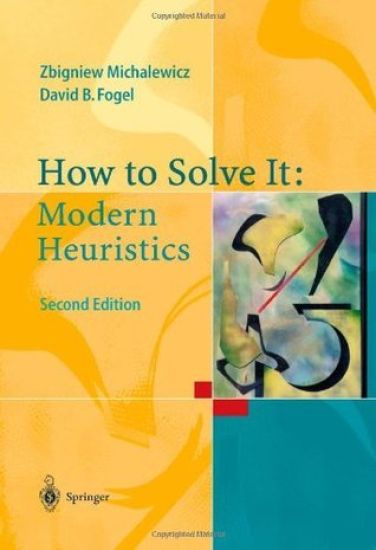
No pleasure lasts long unless there is variety in it. Publilius Syrus, Moral Sayings We've been very fortunate to receive fantastic feedback from our readers during the last four years, since the first edition of How to Solve It: Modern Heuristics was published in 1999. It's heartening to know that so many people appreciated the book and, even more importantly, were using the book to help them solve their problems. One professor, who published a review of the book, said that his students had given the best course reviews he'd seen in 15 years when using our text. There can be hardly any better praise, except to add that one of the book reviews published in a SIAM journal received the best review award as well. We greatly appreciate your kind words and personal comments that you sent, including the few cases where you found some typographical or other errors. Thank you all for this wonderful support.
How to Solve It: Modern Heuristics

How to Solve It: Modern Heuristics

Zbigniew Michalewicz; David B. Fogel

Springer-Verlag Berlin and Heidelberg GmbH Co. K
2004
sidottu
No pleasure lasts long unless there is variety in it. Publilius Syrus, Moral Sayings We've been very fortunate to receive fantastic feedback from our readers during the last four years, since the first edition of How to Solve It: Modern Heuristics was published in 1999. It's heartening to know that so many people appreciated the book and, even more importantly, were using the book to help them solve their problems. One professor, who published a review of the book, said that his students had given the best course reviews he'd seen in 15 years when using our text. There can be hardly any better praise, except to add that one of the book reviews published in a SIAM journal received the best review award as well. We greatly appreciate your kind words and personal comments that you sent, including the few cases where you found some typographical or other errors. Thank you all for this wonderful support.
Evolutionary Computation

Evolutionary Computation

David B. Fogel

SPIE Press
2000
nidottu
Evolutionary cmputation is one of the fastest growing areas of computer science, partly because of its broad applicability to engineering problems. The methods can be applied to problems as diverse as supply-chain optimization, routing and planning, task assignment, pharmaceutical design, interactive gaming, and many others within the signal processing domain. The text is an outgrowth of a series of SPIE short courses taught by the author. The examples span a range of applications and should be useful to a variety of readers of mixed backgrounds and expertise.
Evolutionary Computation

Evolutionary Computation

David B. Fogel

John Wiley Sons Inc
2006
sidottu
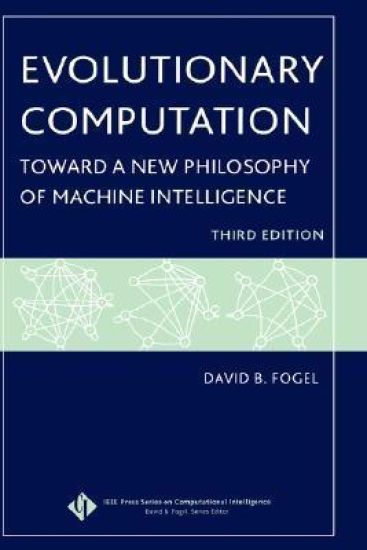
This Third Edition provides the latest tools and techniques that enable computers to learn The Third Edition of this internationally acclaimed publication provides the latest theory and techniques for using simulated evolution to achieve machine intelligence. As a leading advocate for evolutionary computation, the author has successfully challenged the traditional notion of artificial intelligence, which essentially programs human knowledge fact by fact, but does not have the capacity to learn or adapt as evolutionary computation does. Readers gain an understanding of the history of evolutionary computation, which provides a foundation for the author's thorough presentation of the latest theories shaping current research. Balancing theory with practice, the author provides readers with the skills they need to apply evolutionary algorithms that can solve many of today's intransigent problems by adapting to new challenges and learning from experience. Several examples are provided that demonstrate how these evolutionary algorithms learn to solve problems. In particular, the author provides a detailed example of how an algorithm is used to evolve strategies for playing chess and checkers. As readers progress through the publication, they gain an increasing appreciation and understanding of the relationship between learning and intelligence. Readers familiar with the previous editions will discover much new and revised material that brings the publication thoroughly up to date with the latest research, including the latest theories and empirical properties of evolutionary computation. The Third Edition also features new knowledge-building aids. Readers will find a host of new and revised examples. New questions at the end of each chapter enable readers to test their knowledge. Intriguing assignments that prepare readers to manage challenges in industry and research have been added to the end of each chapter as well. This is a must-have reference for professionals in computer and electrical engineering; it provides them with the very latest techniques and applications in machine intelligence. With its question sets and assignments, the publication is also recommended as a graduate-level textbook.