Kirjojen hintavertailu. Mukana 12 390 323 kirjaa ja 12 kauppaa.

Kirjailija

David Barber

Kirjat ja teokset yhdessä paikassa: 8 kirjaa, julkaisuja vuosilta 2006-2019, suosituimpien joukossa Learning and Teaching with Interactive Whiteboards. Vertaile teosten hintoja ja tarkista saatavuus suomalaisista kirjakaupoista.

8 kirjaa

Kirjojen julkaisuhaarukka 2006-2019.

Secret History

Secret History

David Barber

Northwestern University Press
2019
nidottu
In David Barber's third collection of poetry, the past makes its presence felt from first to last. Drawing on a wealth of eclectic sources and crafted in an array of nonce forms, these poems range across vast stretches of cultural and natural history in pursuit of the forsaken, long-gone, and unsung.Here is the stuff of lost time unearthed from all over: ballyhoo and murder ballad, the lacrimarium and the xylotheque, the Game of Robbers and the Indian Rope Trick, the obsolete o'o, the old-school word hoard, sunshowers and beaters and breaker boys. Here, to mark the twilight of print and type, are gleanings and borrowings from a mixed bag of throwback bound volumes: The Magic Moving Picture Book, Mandeville's Travels, The Golden Bough, Franklin Arithmetic, The Millennial Laws of the Shakers, A Conjuror's Confessions.Here too are guiding spirits whose like will not pass this way again: Cab Calloway at the Cotton Club; Henry Walter Bates in darkest Amazon; George Catlin among the Choctaw; Little Nemo in Slumberland; Yogi Berra in all his oracular glory. Reveling in vernacular lingo of every vintage even while brooding on dark ages without end, Secret History chronicles a world of long shadows and distant echoes that bears more than a passing resemblance to our own.
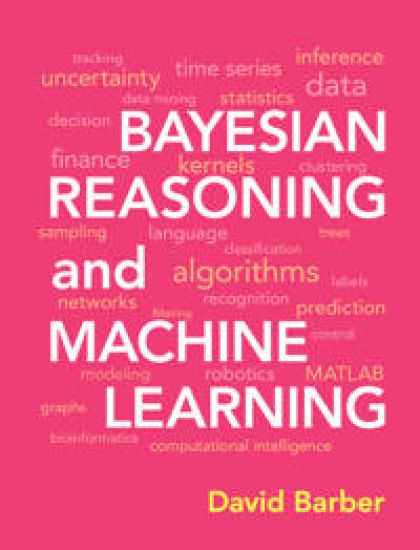
Bayesian Reasoning and Machine Learning

Bayesian Reasoning and Machine Learning

David Barber

Cambridge University Press
2012
sidottu
Machine learning methods extract value from vast data sets quickly and with modest resources. They are established tools in a wide range of industrial applications, including search engines, DNA sequencing, stock market analysis, and robot locomotion, and their use is spreading rapidly. People who know the methods have their choice of rewarding jobs. This hands-on text opens these opportunities to computer science students with modest mathematical backgrounds. It is designed for final-year undergraduates and master's students with limited background in linear algebra and calculus. Comprehensive and coherent, it develops everything from basic reasoning to advanced techniques within the framework of graphical models. Students learn more than a menu of techniques, they develop analytical and problem-solving skills that equip them for the real world. Numerous examples and exercises, both computer based and theoretical, are included in every chapter. Resources for students and instructors, including a MATLAB toolbox, are available online.
Using New Web Tools in the Primary Classroom

Using New Web Tools in the Primary Classroom

David Barber; Linda Cooper

Routledge
2011
sidottu
How can we ensure we use technology effectively with young children? Using New Web Tools in the Primary Classroom is for all teachers interested in the application of new web-based ICTs to primary teaching. It offers a justification for using Web 2.0 tools and explores tangible ways in which technologies such as blogs, wikis, podcasting, media sharing and social networking sites can enhance classroom practice, teaching and learning. Considering key issues such as how children learn, curriculum, policy, and children’s prior experiences of ICT, this book focuses on the expectations and needs of the child and how technology can be unlocked to meet those needs now and in the future. Key ideas considered include: Diverse views of social software in education Using web tools to create and reinforce stimulating learning environments Teacher skills and the availability of suitable technology Competing demands of government policies and curriculum Practical ideas for enriching learning through social software: Children as producers of knowledge, as explorers, and as communicators. Enhanced with reflective questions and tasks to support your own thinking, and with practical ideas for using web-based ICTs in a range of subjects and in topic work, Using New Web Tools in the Primary Classroom is a rich resource for all student and practising primary school teachers. Those on Education Studies courses interested in new internet technologies and their potential to enhance learning within primary schools will also find much food for thought.
Using New Web Tools in the Primary Classroom

Using New Web Tools in the Primary Classroom

David Barber; Linda Cooper

Routledge
2011
nidottu
How can we ensure we use technology effectively with young children? Using New Web Tools in the Primary Classroom is for all teachers interested in the application of new web-based ICTs to primary teaching. It offers a justification for using Web 2.0 tools and explores tangible ways in which technologies such as blogs, wikis, podcasting, media sharing and social networking sites can enhance classroom practice, teaching and learning. Considering key issues such as how children learn, curriculum, policy, and children’s prior experiences of ICT, this book focuses on the expectations and needs of the child and how technology can be unlocked to meet those needs now and in the future. Key ideas considered include: Diverse views of social software in education Using web tools to create and reinforce stimulating learning environments Teacher skills and the availability of suitable technology Competing demands of government policies and curriculum Practical ideas for enriching learning through social software: Children as producers of knowledge, as explorers, and as communicators. Enhanced with reflective questions and tasks to support your own thinking, and with practical ideas for using web-based ICTs in a range of subjects and in topic work, Using New Web Tools in the Primary Classroom is a rich resource for all student and practising primary school teachers. Those on Education Studies courses interested in new internet technologies and their potential to enhance learning within primary schools will also find much food for thought.
A Hard Rain Fell

A Hard Rain Fell

David Barber

University Press of Mississippi
2010
nidottu
By the spring of 1969, Students for a Democratic Society (SDS) had reached its zenith as the largest, most radical movement of white youth in American history-a genuine New Left. Yet less than a year later, SDS splintered into warring factions and ceased to exist.SDS's development and its dissolution grew directly out of the organization's relations with the black freedom movement, the movement against the Vietnam War, and the newly emerging struggle for women's liberation. For a moment, young white people could comprehend their world in new and revolutionary ways. But New Leftists did not respond as a tabula rasa. On the contrary, these young people's consciousnesses, their culture, their identities had arisen out of a history which, for hundreds of years, had privileged white over black, men over women, and America over the rest of the world. Such a history could not help but distort the vision and practice of these activists, good intentions notwithstanding.A Hard Rain Fell: SDS and Why It Failed traces these activists in their relation to other movements and demonstrates that the New Left\'s dissolution flowed directly from SDS's failure to break with traditional American notions of race, sex, and empire.
Learning and Teaching with Interactive Whiteboards

Learning and Teaching with Interactive Whiteboards

David Barber; Linda Cooper; Graham Meeson

Learning Matters Ltd
2007
nidottu
Interactive Whiteboards (IWBs) are becoming increasingly common in schools and early years settings, and it is important for trainees to be equipped with the necessary skills and understanding to use them effectively to enhance learning. This book takes a thematic approach, examining all the key issues required to get the most out of this versatile learning technology. All chapters contain case studies from a range of subject areas and across the key stages, ensuring the text is rooted in the reality of the primary classroom and its curriculum.
Wonder Cabinet

Wonder Cabinet

David Barber

Northwestern University Press
2006
nidottu
Taking its inspiration from the wonder and curiosity cabinets of the late Renaissance, David Barber's second book of poems offers itself up as an eclectic gallery of natural marvels and historical gleanings. Creation is Barber's chief subject and he often concentrates on how human nature is constantly seeking to impose definition and significance upon the natural world. These are poems that meditate on all manner of wondrous phenomena: falconry and funiculars; the knotted quipus of the Inca Empire and the tulip mania of the Dutch Golden Age; the lore and language of field guides, epitaphs, beekeeping, and seafaring; and, the ghostly vestiges of the La Brea tar pits and the ancient library of Alexandria. Then, in an innovative suite of ""New World Sutras"" composed in haiku stanzas, Barber riffs on the American genius for self-invention and epic ambition by calling up landmark figures such as Audubon, Houdini, Babe Ruth, and Buster Keaton. With a formal and verbal precision that is rife with agile music, avid wordplay, and mordant wit, Barber delves deeply into the realms of both natural history and popular culture.
Wonder Cabinet

Wonder Cabinet

David Barber

Northwestern University Press
2006
sidottu
Taking its inspiration from the wonder and curiosity cabinets of the late Renaissance, David Barber's second book of poems offers itself up as an eclectic gallery of natural marvels and historical gleanings. Creation is Barber's chief subject and he often concentrates on how human nature is constantly seeking to impose definition and significance upon the natural world. These are poems that meditate on all manner of wondrous phenomena: falconry and funiculars; the knotted quipus of the Inca Empire and the tulip mania of the Dutch Golden Age; the lore and language of field guides, epitaphs, beekeeping, and seafaring; and, the ghostly vestiges of the La Brea tar pits and the ancient library of Alexandria. Then, in an innovative suite of ""New World Sutras"" composed in haiku stanzas, Barber riffs on the American genius for self-invention and epic ambition by calling up landmark figures such as Audubon, Houdini, Babe Ruth, and Buster Keaton. With a formal and verbal precision that is rife with agile music, avid wordplay, and mordant wit, Barber delves deeply into the realms of both natural history and popular culture.