Kirjojen hintavertailu. Mukana 12 595 353 kirjaa ja 12 kauppaa.

Kirjailija

David Baron

Kirjat ja teokset yhdessä paikassa: 44 kirjaa, julkaisuja vuosilta 1906-2026, suosituimpien joukossa The Martians. Vertaile teosten hintoja ja tarkista saatavuus suomalaisista kirjakaupoista.

44 kirjaa

Kirjojen julkaisuhaarukka 1906-2026.

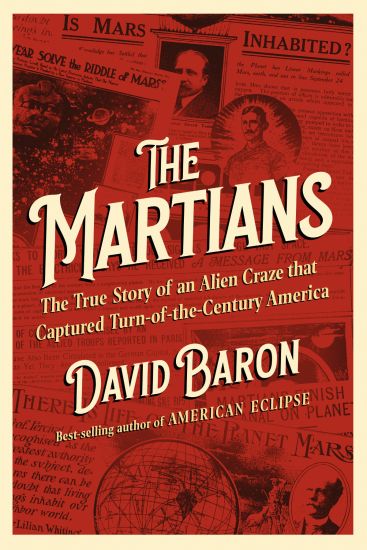
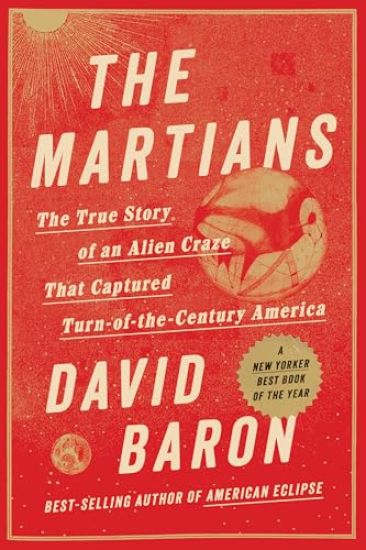
The Martians

The Martians

David Baron

W W NORTON CO LTD
2026
nidottu
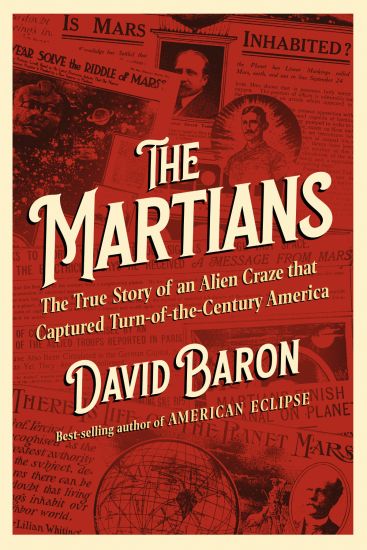
“There is Life on the Planet Mars” —New York Times, December 9, 1906 This New York Times headline was no joke. In the early 1900s, many Americans actually believed we had discovered intelligent life on Mars, as best-selling science writer David Baron chronicles in The Martians, his truly bizarre tale of a nation swept up in Mars mania. At the center of Baron’s historical drama is Percival Lowell, the Boston Brahmin and Harvard scion, who observed “canals” etched into the surface of Mars. Lowell devised a grand theory that the red planet was home to a utopian society that had built gargantuan ditches to funnel precious meltwater from the polar icecaps to desert farms and oasis cities. The public fell in love with the ambitious amateur astronomer who shared his findings in speeches and wildly popular books. While at first people treated the Martians whimsically—Martians headlining Broadway shows, biologists speculating whether they were winged or gilled—the discussion quickly became serious. Inventor Nikola Tesla announced he had received radio signals from Mars; Alexander Graham Bell agreed there was “no escape from the conviction” that intelligent beings inhabited the planet. Martian excitement reached its zenith when Lowell financed an expedition to photograph Mars from Chile’s Atacama Desert, resulting in what newspapers hailed as proof of the Martian canals’ existence. Triumph quickly yielded to tragedy. Those wild claims and highly speculative photographs emboldened Lowell’s critics, whose withering attacks gathered steam and eventually wrecked the man and his theory—but not the fervor he had started. Although Lowell would die discredited and delusional in 1916, the Mars frenzy spurred a nascent literary genre called science fiction, and the world’s sense of its place in the universe would never be the same. Today, the red planet maintains its grip on the public’s imagination. Many see Mars as civilization’s destiny—the first step toward our becoming an interplanetary species—but, as David Baron demonstrates, this tendency to project our hopes onto the world next door is hardly new. The Martians is a scintillating and necessary reminder that while we look to Mars for answers, what we often find are mirrors of ourselves.
The Martians

The Martians

David Baron

WW NORTON CO
2025
sidottu
The New York Times headline was no joke. In the early 1900s, many believed intelligent life had been discovered on Mars. The Martians —a bizarre tale reconstructed through newly discovered clippings, letters and photographs—begins in the 1890s with Percival Lowell, a Harvard scion who was so certain of his Mars discovery that he (almost) convinced a generation of astronomers that grainy photographs of the red planet revealed meltwater and an intricate canal system, declaring “there can be no doubt that living beings inhabit our neighbouring world” (The New York Times ). So frenzied was the reaction that international controversies arose. Tesla announced he had received Martian radio signals, biologists debated whether Martians were winged or gilled and a new genre called science fiction arose. While Lowell’s claims were debunked, his influence sparked a compulsive interest in Mars and life in outer space that continues to this day. David Baron’s American Eclipse was praised as: "suffused with the peculiar magic and sense of awe that have always attended eclipses, those fraught few minutes when day becomes night, time stands still—and anything seems possible.”— Hampton Sides, The New York Times best-selling author of Blood and Thunder
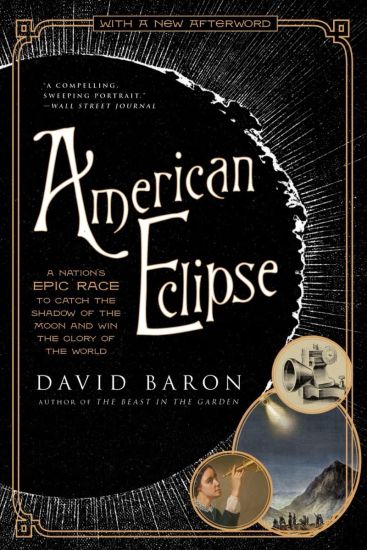
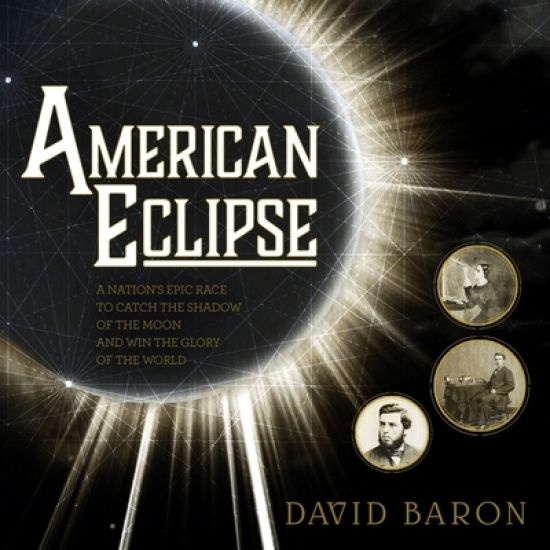
American Eclipse

American Eclipse

David Baron

WW NORTON CO
2024
nidottu
On a scorching July afternoon in 1878, at the dawn of the Gilded Age, the moon’s shadow descended on the American West, darkening skies from Montana Territory to Texas. This rare celestial event—a total solar eclipse—offered a priceless opportunity to solve some of the solar system’s most enduring riddles, and it prompted a clutch of enterprising scientists to brave the wild frontier in a gruelling race to the Rocky Mountains. Acclaimed science journalist David Baron, long fascinated by eclipses, re-creates this epic tale of ambition, failure and glory in a narrative that reveals as much about the historical trajectory of a striving young nation as it does about those scant three minutes when the blue sky blackened and stars appeared in mid-afternoon. In vibrant historical detail, American Eclipse animates the fierce jockeying that came to dominate late nineteenth-century American astronomy, bringing to life the challenges faced by three of the most determined eclipse chasers who participated in this adventure. James Craig Watson, virtually forgotten in the twenty-first century, was in his day a renowned asteroid hunter who fantasised about becoming a Gilded Age Galileo. Hauling a telescope, a star chart, and his long-suffering wife out west, Watson believed that he would discover Vulcan, a hypothesised "intra-Mercurial" planet hidden in the sun’s brilliance. No less determined was Vassar astronomer Maria Mitchell, who—in an era when women’s education came under fierce attack—fought to demonstrate that science and higher learning were not anathema to femininity. Despite obstacles erected by the male-dominated astronomical community, an indifferent government and careless porters, Mitchell courageously charged west with a contingent of female students intent on observing the transcendent phenomenon for themselves. Finally, Thomas Edison—a young inventor and irrepressible showman—braved the wilderness to prove himself to the scientific community. Armed with his newest invention, the tasimeter and pursued at each stop by throngs of reporters, Edison sought to leverage the eclipse to cement his place in history. What he learned on the frontier, in fact, would help him illuminate the world. With memorable accounts of train robberies and Indian skirmishes, David Baron’s page-turning drama refracts nineteenth-century science through the mythologised age of the Wild West, revealing a history no less fierce and fantastical.
The Servant of Jehovah: the Sufferings of the Messiah and the Glory That Should Follow; an Exposition of Isaiah LIII
In this insightful work, Baron explores the prophecy of Isaiah 53 and its fulfillment in Jesus Christ. He dives deep into the meaning of the text and its implications for Christian faith and theology.This work has been selected by scholars as being culturally important, and is part of the knowledge base of civilization as we know it.This work is in the "public domain in the United States of America, and possibly other nations. Within the United States, you may freely copy and distribute this work, as no entity (individual or corporate) has a copyright on the body of the work.Scholars believe, and we concur, that this work is important enough to be preserved, reproduced, and made generally available to the public. We appreciate your support of the preservation process, and thank you for being an important part of keeping this knowledge alive and relevant.
The History of the Ten "Lost" Tribes

The History of the Ten "Lost" Tribes

David Baron

Double 9 Books LLP
2023
nidottu
The ten tribes of Israel that were driven out of their homeland by the Assyrian Empire in 722 BCE are examined in the book "The History of the Ten Lost Tribes" by David Baron. Baron examines different hypotheses and beliefs concerning the fate of the lost tribes, including the assumption that they merged into the cultures of the surrounding countries or were incorporated into the Jewish diaspora. He also takes into account the likelihood that some of the tribes may still survive in other places of the globe as separate ethnic groupings. Baron provides a thorough explanation of the circumstances leading up to the exile of the ten tribes and what happened after they vanished by examining historical data and scriptural scriptures. He contends that there is proof of the extinct tribes' ongoing presence in other locations throughout the globe, including India and Africa. Overall, Baron's book offers a thorough and well-researched examination of the past and present of Israel's ten lost tribes.
Game Development Patterns with Unity 2021

Game Development Patterns with Unity 2021

David Baron

PACKT PUBLISHING LIMITED
2021
nidottu
Solve your programming woes in Unity with practical design propositionsKey FeaturesGain a comprehensive overview of Unity engine architecture and coding modelBuild a complete racing game using software design patterns and understand how to implement them in UnityDownload the source code of the complete prototype demonstrating each of the software patterns usedBook DescriptionThis book is written for every game developer ready to tackle the bigger picture and start working with advanced programming techniques and design patterns in Unity.Game Development Patterns with Unity 2021 is an introduction to the core principles of reusable software patterns and how to employ them to build components efficiently.In this second edition, you'll tackle design patterns with the help of a practical example; a playable racing game prototype where you’ll get to apply all your newfound knowledge. Notable updates also include a game design document (GDD), a Unity programming primer, and the downloadable source code of a complete prototype.Your journey will start by learning about overall design of the core game mechanics and systems. You’ll discover tried-and-tested software patterns to code essential components of a game in a structured manner, and start using classic design patterns to utilize Unity's unique API features.As you progress, you'll also identify the negative impacts of bad architectural decisions and understand how to overcome them with simple but effective practices.By the end of this Unity book, the way you develop Unity games will change – you’ll adapt a more structured, scalable, and optimized process that will help you take the next step in your career.What you will learnStructure professional Unity code using industry-standard development patternsIdentify the right patterns for implementing specific game mechanics or featuresDevelop configurable core game mechanics and ingredients that can be modified without writing a single line of codeReview practical object-oriented programming (OOP) techniques and learn how they're used in the context of a Unity projectBuild unique game development systems such as a level editorExplore ways to adapt traditional design patterns for use with the Unity APIWho this book is forThis book is for Unity game developers who want to learn industry standards for building Unity games. Knowledge of the Unity game engine and programming in the C# language is a must, so if you’re a beginner, try our Learning C# by Developing Games with Unity 2021 handbook instead.
The history of the ten lost tribes; Anglo-Israelism examined
This book has been considered by academicians and scholars of great significance and value to literature. This forms a part of the knowledge base for future generations. So that the book is never forgotten we have represented this book in a print format as the same form as it was originally first published. Hence any marks or annotations seen are left intentionally to preserve its true nature.
The history of the ten lost tribes; Anglo-Israelism examined
This book has been considered by academicians and scholars of great significance and value to literature. This forms a part of the knowledge base for future generations. So that the book is never forgotten we have represented this book in a print format as the same form as it was originally first published. Hence any marks or annotations seen are left intentionally to preserve its true nature.
The Visions and Prophecies of Zechariah
David Baron's exceptional study of the Book of Zechariah analyzes every meaningful passage in the text, provisioning the reader with a comprehensive education on the 'Prophet of Hope and Glory'. Zechariah is categorized as one of the twelve minor prophets of the Old Testament, and David Baron demonstrates his significance. Experiencing eight distinct visions, each of which is analyzed in the text, Zechariah's role in ancient Jewish society were important. Split into two parts, this book is designed for reference - the first part examines the prophetic words, while the second distinguishes and discusses the different prophesies. The author's mission is to clarify the sometimes difficult messages of the Old Testament, and it is a task he takes to with gusto. David Baron combines a scholar's competence with lore with an author's ability to engage a reader and enliven what might otherwise be impenetrable. The reader will emerge from his analysis of Zechariah's life and words with an excellent understanding.
The Visions and Prophecies of Zechariah
David Baron's exceptional study of the Book of Zechariah analyzes every meaningful passage in the text, provisioning the reader with a comprehensive education on the 'Prophet of Hope and Glory'. Zechariah is categorized as one of the twelve minor prophets of the Old Testament, and David Baron demonstrates his significance. Experiencing eight distinct visions, each of which is analyzed in the text, Zechariah's role in ancient Jewish society were important. Split into two parts, this book is designed for reference - the first part examines the prophetic words, while the second distinguishes and discusses the different prophesies. The author's mission is to clarify the sometimes difficult messages of the Old Testament, and it is a task he takes to with gusto. David Baron combines a scholar's competence with lore with an author's ability to engage a reader and enliven what might otherwise be impenetrable. The reader will emerge from his analysis of Zechariah's life and words with an excellent understanding.
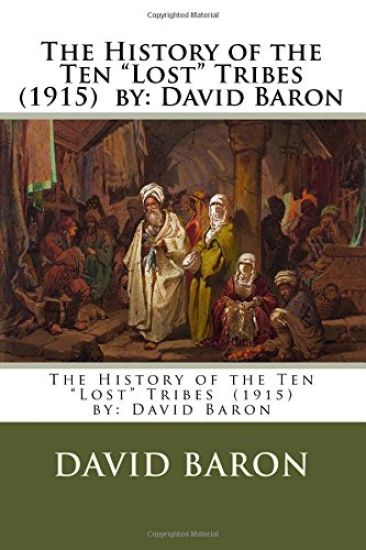
The History of the Ten "Lost" Tribes (1915) by: David Baron

The History of the Ten "Lost" Tribes (1915) by: David Baron

David Baron

Createspace Independent Publishing Platform
2017
nidottu
British Israelism (sometimes called Anglo-Israelism) is a complex set of theories, not necessarily compatible with each other, that have in common the idea that some ancient British people and/or royal lineages were direct lineal descendants of some of the Lost Tribes of Israel. - Excerpted from British Israelism on Wikipedia, the free encyclopedia. This work is intended primarily as a thorough examination and debunking of Anglo-Israelism, the theory that Anglo-Saxons are somehow the actual historical Israel to the exclusion of modern day Jews. The work also tackles to a lesser degree the more common theory of "Replacement Theology" or "Supersessionism" and gives it similar treatment. The author, David Baron, was a Hebrew-Christian, long before that movement, or the often intertwined Messianic Judaism movement, became more widely popularized circa the 1960's.
American Eclipse

American Eclipse

David Baron

WW NORTON CO
2017
sidottu
In the summer of 1878 three ruthless and brilliant scientists raced to Wyoming and Colorado to observe a total solar eclipse. One sought to discover a new planet. Another fought to prove that science was not an anathema to femininity. And a young, megalomaniacal inventor sought to test his bona fides and light the world through his revelations. David Baron brings to life these three competitors—James Craig Watson, Maria Mitchell and Thomas Edison—re-creating the jockeying of nineteenth-century astronomy. With accounts of train robberies and Indian skirmishes, the last days of the Wild West come alive. A magnificent portrayal of America’s dawn as a superpower, American Eclipse depicts a nation looking to the skies to reveal its ambition and expose its genius.
Clinical Psychiatry: Recent Advances and Future Directions, An Issue of Psychiatric Clinics of North America
Recent advances in clinical psychiatry are presented by David Baron and Lawrence Gross in this issue of Psychiatric Clinics. Psychiatrists will find here disorders they deal with daily in patients and topics include Advances in: Addictive disorders; Geriatric and healthy aging; Trauma and violence; PTSD; Schizophrenia; Intellectual disabilities; Neuropsychiatry, Psychopharmacology; Integrated care - psychiatry and primary care; Global and cultural psychiatry; Mood disorders. Also presented are the Future role of psychotherapy in psychiatry; Public mental health in the Affordable Care Act era; Genetics; and Diagnostic classification (DSM criteria) how they are transitioning in future - DSM V and beyond.