Kirjojen hintavertailu. Mukana 12 595 353 kirjaa ja 12 kauppaa.

Kirjailija

David Bromwich

Kirjat ja teokset yhdessä paikassa: 23 kirjaa, julkaisuja vuosilta 1994-2026, suosituimpien joukossa On Democracy. Vertaile teosten hintoja ja tarkista saatavuus suomalaisista kirjakaupoista.

23 kirjaa

Kirjojen julkaisuhaarukka 1994-2026.

On Democracy

On Democracy

Walt Whitman; David Bromwich

THE LIBRARY OF AMERICA
2026
nidottu
Gathered together for the first time, Walt Whitman's urgently needed prose writings on the democratic spirit and the soul of the nation. 12 short works encapsulate the American Bard's fiery passions and timeless wisdom for today. Here for the first time in a convenient pocket edition are all of Walt Whitman's essential prose writings on democracy, including his unforgrettable reflections on the roots on American division, the fearful legacy of the Civil War, and shining example of Abraham Lincoln. Few writers have been as harsh in their condemnation of America's sins and spiritual shortcomings or as abiding in his faith in democratic ideals as Whitman. His clarion voice speaks to us with renewed urgency today. Gathered here are: "The Eighteenth Presidency ," written during the 1856 presidential campaign, in which Whitman expresses his rage over the immediate prospects for American democracy Democratic Vistas (1871), in which he dramatizes his role as poet-prophet of a better America the searing essay "Origins of Attempted Secession" and shorter extracts on democracy from the classic book Specimen Days (1882). In his introduction, acclaimed political observer David Bromwich examines Whitman's political prose writings and highlights why they matter today.
On Lying And Politics

On Lying And Politics

Hannah Arendt; David Bromwich

THE LIBRARY OF AMERICA
2022
nidottu
More urgent than ever, two landmark essays by the legendary political theorist on the greatest threat to democracy, gathered with a new introduction by David Bromwich "No one," Hannah Arendt observed, "has ever counted truthfulness as a political virtue." But why do politicians lie? What is the relationship between political lies and self-delusion? And how much organized deceit can a democracy endure before it ceases to function? Fifty years ago, the century's greatest political theorist turned her focus to these essential questions in two seminal essays, brought together here for the first time. Her conclusions, delivered in searching prose that crackles with insight and intelligence, remain powerfully relevant, perhaps more so today than when they were written. In "Truth and Politics," Arendt explores the affinity between lying and politics, and reminds us that the survival of factual truth depends on the testimony of credible witnesses and on an informed citizenry. She shows how our shared sense of reality--the texture of facts in which we wrap our daily lives--can be torn apart by organized lying, replaced with a fantasy world of airbrushed evidence and doctored documents. In "Lying in Politics," written in response to the release of the Pentagon Papers, Arendt applies these insights to an analysis of American policy in Southeast Asia, arguing that the real goal of the Vietnam War--and of the official lies used to justify it by successive administrations--was nothing other than the burnishing of America's image. In his introduction, David Bromwich (American Breakdown: The Trump Years and How They Befell Us) engages with Arendt's essays in the context of her other writings and underscores their clarion call to take seriously the ever-present threat to democracy posed by lying.
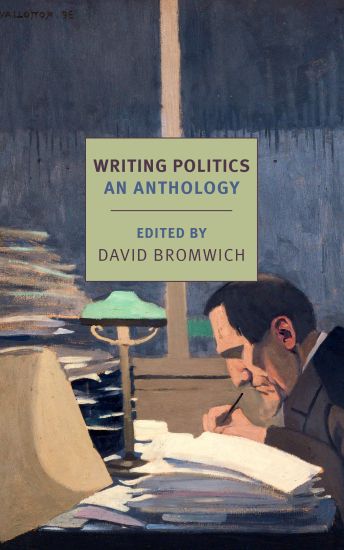
Writing Politics

Writing Politics

David Bromwich

The New York Review of Books, Inc
2020
nidottu
An original anthology exploring the tradition of the political essay--including works by Hannah Arendt, Martin Luther King Jr., Norman Mailer, George Orwell, and Jean-Paul Sartre--edited by the brilliant David Bromwich. David Bromwich is one of the most clear-headed, learned, well-informed, cogent, and uncompromising political writers of our day, a man who is firmly but never dogmatically on the left whose work appears regularly in The New York Review of Books and The London Review of Books. He is also one of our finest intellectual historians and literary critics and the author of an intellectual biography of Edmund Burke that has received glowing reviews. Bromwich's new gathering of political essays dates back to the beginning of the modern political world the better to illuminate some of the central political debates that continue to shape our world but also to bring out some of the finest writing that political passion has given rise to. This is a book not just about political power but about the power of the word. Essays by Edmund Burke, George Orwell, Jean-Paul Sartre, Norman Mailer, and Elizabeth Hardwick are included, along with a wide-ranging introduction by Bromwich.
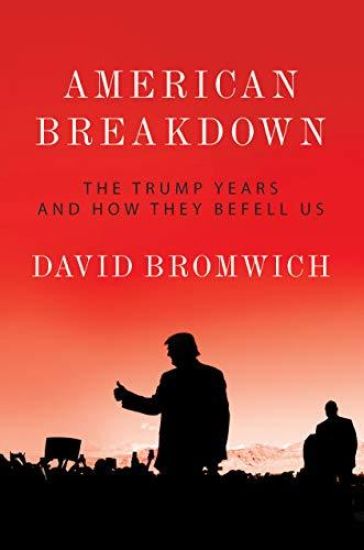
American Breakdown

American Breakdown

David Bromwich

Verso Books
2019
sidottu
American Breakdown is the brilliant political diary of one of America's leading essayists, David Bromwich, whose work has drawn wide appreciation for its incisive portraits and accurate prognosis. From his analysis of the Cheney-Bush co-presidency, in which foreign policy was reduced to permanent war, and Barack Obama's practice of reconciliation without truth, Bromwich chronicles the emergence of Donald Trump-the demagogue of a culture of corruption from which all traces of political interest and candour have dropped away. An unsparing account of the degradation of American democracy, the book leads off with a new introduction on the prospects for change during the new Democratic Congress.
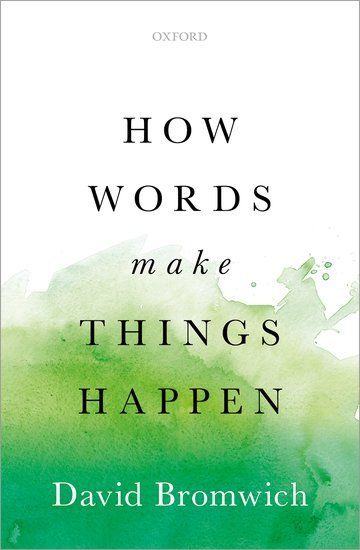
How Words Make Things Happen

How Words Make Things Happen

David Bromwich

Oxford University Press
2019
sidottu
Sooner or later, our words take on meanings other than we intended. How Words Make Things Happen suggests that the conventional idea of persuasive rhetoric (which assumes a speaker's control of calculated effects) and the modern idea of literary autonomy (which assumes that 'poetry makes nothing happen') together have produced a misleading account of the relations between words and human action. Words do make things happen. But they cannot be counted on to produce the result they intend. This volume studies examples from a range of speakers and writers and offers close readings of their words. Chapter 1 considers the theory of speech-acts propounded by J.L. Austin. 'Speakers Who Convince Themselves' is the subject of chapter 2, which interprets two soliloquies by Shakespeare's characters and two by Milton's Satan. The oratory of Burke and Lincoln come in for extended treatment in chapter 3, while chapter 4 looks at the rival tendencies of moral suasion and aestheticism in the poetry of Yeats and Auden. The final chapter, a cause of controversy when first published in the London Review of Books, supports a policy of unrestricted free speech against contemporary proposals of censorship. Since we cannot know what our own words are going to do, we have no standing to justify the banishment of one set of words in favour of another.
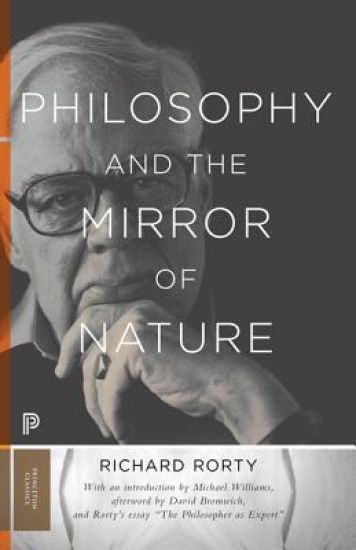
Philosophy and the Mirror of Nature

Philosophy and the Mirror of Nature

Richard Rorty; David Bromwich

Princeton University Press
2017
pokkari
When it first appeared in 1979, Philosophy and the Mirror of Nature hit the philosophical world like a bombshell. In it, Richard Rorty argued that, beginning in the seventeenth century, philosophers developed an unhealthy obsession with the notion of representation: comparing the mind to a mirror that reflects reality. Rorty's book is a powerful critique of this imagery and the tradition of thought that it spawned. Today, the book remains a must-read and stands as a classic of twentieth-century philosophy. Its influence on the academy, both within philosophy and across a wide array of disciplines, continues unabated. This edition includes new essays by philosopher Michael Williams and literary scholar David Bromwich, as well as Rorty's previously unpublished essay "The Philosopher as Expert."
Moral Imagination

Moral Imagination

David Bromwich

Princeton University Press
2016
pokkari
Spanning many historical and literary contexts, Moral Imagination brings together a dozen recent essays by one of America's premier cultural critics. David Bromwich explores the importance of imagination and sympathy to suggest how these faculties may illuminate the motives of human action and the reality of justice. These wide-ranging essays address thinkers and topics from Gandhi and Martin Luther King on nonviolent resistance, to the dangers of identity politics, to the psychology of the heroes of classic American literature. Bromwich demonstrates that moral imagination allows us to judge the right and wrong of actions apart from any benefit to ourselves, and he argues that this ability is an innate individual strength, rather than a socially conditioned habit. Political topics addressed here include Edmund Burke and Richard Price's efforts to define patriotism in the first year of the French Revolution, Abraham Lincoln's principled work of persuasion against slavery in the 1850s, the erosion of privacy in America under the influence of social media, and the use of euphemism to shade and anesthetize reactions to the global war on terror. Throughout, Bromwich considers the relationship between language and power, and the insights language may offer into the corruptions of power. Moral Imagination captures the singular voice of one of the most forceful thinkers working in America today.
The Intellectual Life of Edmund Burke

The Intellectual Life of Edmund Burke

David Bromwich

The Belknap Press
2014
sidottu
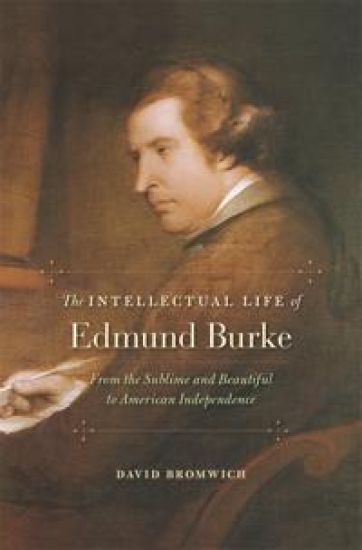
David Bromwich’s portrait of statesman Edmund Burke (1730–1797) is the first biography to attend to the complexity of Burke’s thought as it emerges in both the major writings and private correspondence. The public and private writings cannot be easily dissociated, nor should they be. For Burke—a thinker, writer, and politician—the principles of politics were merely those of morality enlarged. Bromwich reads Burke’s career as an imperfect attempt to organize an honorable life in the dense medium he knew politics to be.This intellectual biography examines the first three decades of Burke’s professional life. His protest against the cruelties of English society and his criticism of all unchecked power laid the groundwork for his later attacks on abuses of government in India, Ireland, and France. Bromwich allows us to see the youthful skeptic, wary of a social contract based on “nature”; the theorist of love and fear in relation to “the sublime and beautiful”; the advocate of civil liberty, even in the face of civil disorder; the architect of economic reform; and the agitator for peace with America. However multiple and various Burke’s campaigns, a single-mindedness of commitment always drove him.Burke is commonly seen as the father of modern conservatism. Bromwich reveals the matter to be far more subtle and interesting. Burke was a defender of the rights of disfranchised minorities and an opponent of militarism. His politics diverge from those of any modern party, but all parties would be wiser for acquaintance with his writing and thoughts.
Moral Imagination

Moral Imagination

David Bromwich

Princeton University Press
2014
sidottu
Spanning many historical and literary contexts, Moral Imagination brings together a dozen recent essays by one of America's premier cultural critics. David Bromwich explores the importance of imagination and sympathy to suggest how these faculties may illuminate the motives of human action and the reality of justice. These wide-ranging essays address thinkers and topics from Gandhi and Martin Luther King on nonviolent resistance, to the dangers of identity politics, to the psychology of the heroes of classic American literature. Bromwich demonstrates that moral imagination allows us to judge the right and wrong of actions apart from any benefit to ourselves, and he argues that this ability is an innate individual strength, rather than a socially conditioned habit. Political topics addressed here include Edmund Burke and Richard Price's efforts to define patriotism in the first year of the French Revolution, Abraham Lincoln's principled work of persuasion against slavery in the 1850s, the erosion of privacy in America under the influence of social media, and the use of euphemism to shade and anesthetize reactions to the global war on terror. Throughout, Bromwich considers the relationship between language and power, and the insights language may offer into the corruptions of power. Moral Imagination captures the singular voice of one of the most forceful thinkers working in America today.
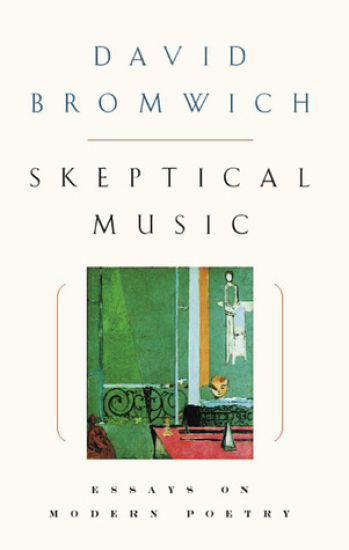
Skeptical Music

Skeptical Music

David Bromwich

University of Chicago Press
2001
sidottu
The poems that are written about, in the essays found in this book, all stake a definitive claim for the modernist style and its intent to capture an audience beyond the present moment. Bromwich's essays offer readings of individual poets, as well as comparisons between poets and their style. Bromwich looks at the link between author and reader that gives language its subtlety and depth and makes the written word adequate to the reality that poetry captures. He also explores the moral and aesthetic considerations of poems, and argues that the excitement that poems draw on is at once primitive and irriducible. There is a look at the relationship between T.S. Eliot and Hart Crane and their work. Another essay takes a revealing look at W.H. Auden and traces the process by which the voice of a generation changed from prophet to domestic ironist. The essays attempt to make the reader think about what poetry is, and why it is still important.
Skeptical Music

Skeptical Music

David Bromwich

University of Chicago Press
2001
nidottu
The poems that are written about, in the essays found in this book, all stake a definitive claim for the modernist style and its intent to capture an audience beyond the present moment. Bromwich's essays offer readings of individual poets, as well as comparisons between poets and their style. Bromwich looks at the link between author and reader that gives language its subtlety and depth and makes the written word adequate to the reality that poetry captures. He also explores the moral and aesthetic considerations of poems, and argues that the excitement that poems draw on is at once primitive and irriducible. There is a look at the relationship between T.S. Eliot and Hart Crane and their work. Another essay takes a revealing look at W.H. Auden and traces the process by which the voice of a generation changed from prophet to domestic ironist. The essays attempt to make the reader think about what poetry is, and why it is still important.
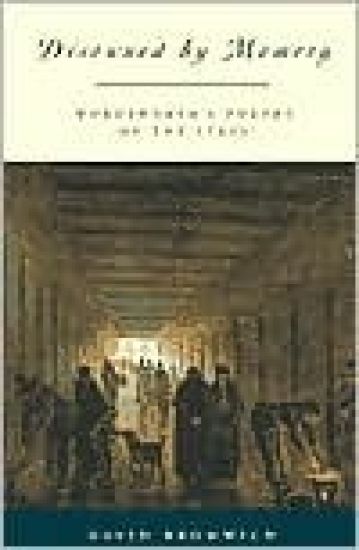
Disowned by Memory

Disowned by Memory

David Bromwich

University of Chicago Press
2000
nidottu
Although we know him as one of the greatest English poets, William Wordsworth might not have become a poet at all without the experience of personal and historical catastrophe in his youth. In Disowned by Memory, David Bromwich connects the accidents of Wordsworth's life with the originality of his writing, showing how the poet's strong sympathy with the political idealism of the age and with the lives of the outcast and the dispossessed formed the deepest motive of his writings of the 1790s."This very Wordsworthian combination of apparently low subjects with extraordinary 'high argument' makes for very rewarding, though often challenging reading."—Kenneth R. Johnston, Washington Times"Wordsworth emerges from this short and finely written book as even stranger than we had thought, and even more urgently our contemporary."—Grevel Lindop, Times Literary Supplement"[Bromwich's] critical interpretations of the poetry itself offer readers unusual insights into Wordworth's life and work."—Library Journal"An added benefit of this book is that it restores our faith that criticism can actually speak to our needs. Bromwich is a rigorous critic, but he is a general one whose insights are broadly applicable. It's an intellectual pleasure to rise to his complexities."—Vijay Seshadri, New York Times Book Review
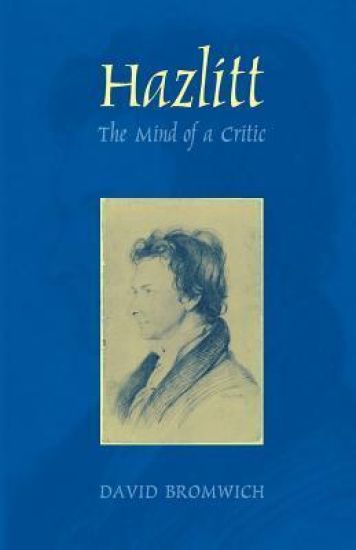
Hazlitt

Hazlitt

David Bromwich

Yale University Press
2000
pokkari
Essayist, lecturer, and radical pamphleteer, William Hazlitt (1778-1830) was the greatest of English critics and a master of the art of prose. This book is a superb appreciation of the man and his works, at once a revaluation of the aesthetics of Romanticism and a sustained intellectual portrait. Nominated for the National Book Critics Circle Award in criticism when it was first published in 1983, it is now reissued with a new preface and bibliography by the author.“Few literary figures in recent decades have seen their reputations rise as securely as Hazlitt’s. Now it will soar. David Bromwich’s book is the most persuasive and ambitious exploration of Hazlitt’s genius hitherto attempted.”—Michael Foot, New Republic“Hazlitt: the Mind of a Critic is an intellectual biography in the best sense of the word, and intellectual biography is the type of writing that shows Hazlitt in his truest light.”—Kenneth R. Johnston, Indiana University“Bromwich’s volume was first published in 1983, and its achievement has never been questioned. All Romanticists recognize that this is one of the great critical works in our field to appear in the post-war era. It aspires to (and achieves) a classical simplicity and elegance.”—Duncan Wu, University of Glasgow