Kirjailija
David Bruce
Kirjat ja teokset yhdessä paikassa: 33 kirjaa, julkaisuja vuosilta 2004-2025, suosituimpien joukossa New South African Review 1. Vertaile teosten hintoja ja tarkista saatavuus suomalaisista kirjakaupoista.
33 kirjaa
Kirjojen julkaisuhaarukka 2004-2025.


Paperback edition. This book is one-half of my previous book "The Funniest People in Books and Music: 500 Anecdotes." It contains 250 anecdotes about music, including this one: British actor Stanley Holloway once mentioned to Jascha Heifetz that he was looking for a school for his son, and he named one school that accepted pupils very early in their life-at two and a half years old. "Two and a half," Mr. Heifetz said. "What's he going to do till then? Just loaf around?"

January 1944. An untouchable German reconnaissance aircraft threatens to reveal the Allied preparations for D-Day; will the RAF stand any chance of dealing with it? Just months to go before D-Day and the Germans are routinely sending a reconnaissance aircraft at stratospheric height over southern England; this time the stripped-down Spitfires and Mosquitos stand no chance of intercepting it. With the preparations for the invasion of France - and the ultimate end of the war - now in jeopardy, ace night-fighter pilot Flight Lieutenant Alec Keats joins a small team that is struggling to get Britain's only hope into a state where it can bring the German machine to earth. Keats throws himself into the technical problems that need to be resolved if the team are to stand any chance of success; his only distraction being the enigmatic WAAF who seems to be unusually close to the unit's commanding officer...

Print edition. Satire and sex scenes. For adults only. A sample: In Westphalia, a gentle youth lived in the beautiful castle of Baron Thunderstormcumlightning. Anyone could look at the youth's face and see that he was both good-natured and weak-minded. This is why he was given the name Candide, although Virginia would have been a good choice if he had been born female. No one knew who his parents were, but that did not keep the servants from guessing, aka gossiping. Their guess, or gossip, was that Candide was the son of the Baron's sister and a nearby nobleman. The two knew each other well enough to sleep together, although they did not know each other well enough to speak to each other in public. After all, in some circles, sleeping together does not constitute an introduction.
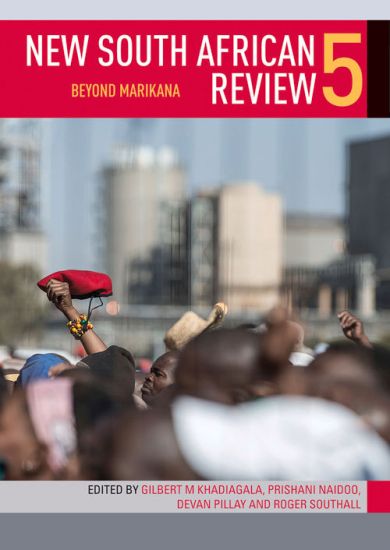
New South African Review 5
Naidoo Prishani; Nieftagodien Noor; Paret Marcel; Pillay Devan; Samantha Ashman; Harvey Ross; Crispen Chinguno; Turton Anthony; Southall Roger; Pierre Vos; Samantha Waterhouse; Ivor Sarakinsky; Marks Monique; David Bruce; David Dickinson; Khadiagala Gilbert M.; Garth le Pere; Smith Karen; Rod Alence
Wits University Press
2015
nidottu
This fifth volume in the New South African Review series takes as its starting point the shock wave emanating from the events at Marikana on 16 August 2012 and how it has reverberated throughout politics and society. some of the chapters in the volume refer directly to Marikana. In others, the influence of that fateful day is pervasive if not direct. Marikana has, for instance, made us look differently at the police and at how order is imposed on society. Monique Marks and David Bruce write that the massacre `has come to hold a central place in the analysis of policing, and broader political events since 2012 …’. The chapters highlight a range of current concerns – political, economic and social. David Dickinson’s chapter looks at the life of the poor in a township from within. in contrast, the chapter on foreign policy by Garth le Pere analyses south Africa’s approach to international relations in the Mandela, Mbeki and Zuma eras. Anthony turton’s account, `When gold mining ends’ is a chilling forecast of an impending environmental catastrophe. Both Devan Pillay and noor nieftagodien focus attention on the left and, in different ways, ascribe its rise to a new politics in the wake of Marikana. The essays in Beyond Marikana present a range of topics and perspectives of interest to general readers, but the book will also be a useful work of reference for students and researchers.
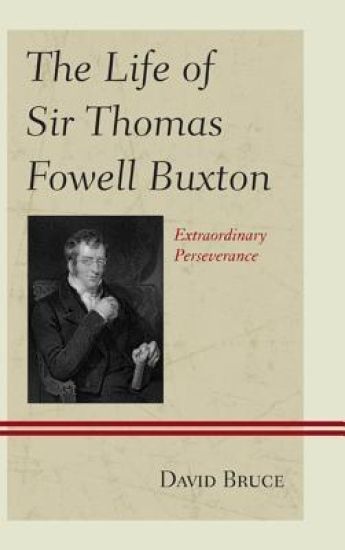
The social conscience of Sir Thomas Fowell Buxton (1786-1845) developed as he operated a brewery in Spitalfields, nineteenth-century London’s poorest parish. His interest and research on penal discipline brought him national prominence and led to a parliamentary career that lasted nearly two decades. Buxton’s association with noted activist William Wilberforce led to his own involvement in the anti-slavery movement, a cause he fiercely championed, resulting in Britain’s abolition of slavery in 1834. Buxton’s involvement in the disastrous 1841 Niger expedition effectively ended his public career and paved the way to British imperialism in Africa. A man of many interests, Buxton also supported Catholic emancipation and ending the Hindu suttee. Few nineteenth-century social reformers have had as much of an impact or have cast as long a shadow as Buxton. At the time of his death, many saw him as the epitome of Christian activism, yet today Buxton remains largely ignored and forgotten. David Bruce examines the life of one of Great Britain’s most prominent social activists. Using his personal papers, and the papers and books of his friends, associates, and contemporaries, The Life of Sir Thomas Fowell Buxton paints a portrait of a unique individual driven to improve his world.
A gripping tale of the air war - at a time when the deadliest skills were needed to survive. Length 127 thousand words June, 1943. Immense German and Russian armies face each other across the fortifications of the Kursk salient. Whoever wins the impending battle will win the war in the east; and the smallest factor could be the one that turns the tide. For the Prime Minister, that small factor could be a German Panzer general visiting France; if he can be eliminated then the Russians might stand a better chance of winning. But removing a high-ranking enemy officer in too obvious a manner could compromise ULTRA, the highly secret code-breaking operation that revealed the officer's location in the first place. Churchill has first to convince MI6 that the result will be worth the risk. With the outcome of a war hanging in the balance, what better plan than to give the mission to a handful of intruder pilots flying near obsolete aircraft?
It was generally believed that once a German night fighter had got on the tail of a Lancaster bomber, the rear gunner had but five seconds to live... 'Finishing School' immerses the reader in the lives of the members of a WWII Lancaster bomber crew in the final stage of their training as they prepare themselves for one of the most dark and dangerous episodes of the war. It deals with the stark technical challenges they had to master - and the accompanying onslaught on their minds - as they prepared to struggle against the odds. It is an intimate, detailed and authentic portrayal of the relationship of a crew and the aircraft that they would take to war. It is March 1944, and while Bomber Command's campaign of attrition bombing against Germany is at its bloody height, Flight Lieutenant Hugh MacKay is allowed to return to operations after a long interval, having sustained serious injuries in a horrific crash the previous year. His first task; to take command of a sprog crew who have just lost their pilot and to guide these young men through their final stage of training at Lancaster Finishing School. His next task; to bring them through their first operation alive - or perish in the attempt. MacKay, for whom nothing but the operational life now exists, has an outlook as bleak as the war-torn skies over Germany, but the sudden arrival of a woman in his life challenges his simple assumptions. Will fate be the final arbiter as he leads his crew on their first main force operation - the RAF's 'Big Chop' night - the disastrous raid on Nuremberg? Length: 155 thousand words What the publishing industry thought... "...fascinating and a wonderful tribute to the aircrew of Bomber Command." "...this is stirring stuff: beautifully paced, evocative, even witty, with unusually appealing characters and some absolutely rip-snorting action sequences..." "...the author's obviously deep knowledge and understanding of the subject matter shines through, and in particular the scenes that take place on the planes are very well described and gripping..." "...the author really captures what it must have been like to have flown bombers during the war..." "...brilliant technical detail..." "...has got a great style..." A filmmaker's view... When reading a novel set in the recent past there are, as a documentary film-maker, two things that I demand of it; credibility as to its historical accuracy and the urge to turn the page. This particular book, Finishing School, set in a WWII Lancaster bomber training station and an operational squadron, satisfies on both counts. I'm of a generation that remembers the atmosphere of the time, and the author has not only captured the authentic spirit of the period but has also transported me back to the way we viewed our enemy across the Channel then; not with the Politically Correct hindsight of today, but with the grim determination of a nation to prevail against seemingly overwhelming odds. Not only did I engage with the rich cast of dramatis personae in the book but I also learned as much about the bureaucracy of a Lancaster bomber crew's training as I did about their dedication to performing as a team under their charismatic skipper. The technical research is both impeccable and convincing. Not for one moment did I doubt the accuracy of the incidents described so vividly by the author. I was also taken by the variety and diversity of characterisation of the many individuals we are introduced to. And did I turn the page? Of course I did Maurice Kanareck