Kirjojen hintavertailu. Mukana 12 508 406 kirjaa ja 12 kauppaa.

Kirjailija

David C Major

Kirjat ja teokset yhdessä paikassa: 2 kirjaa, julkaisuja vuosilta 2007-2021, suosituimpien joukossa A Huguenot on the Hackensack. Vertaile teosten hintoja ja tarkista saatavuus suomalaisista kirjakaupoista.

Mukana myös kirjoitusasut: David C. Major

2 kirjaa

Kirjojen julkaisuhaarukka 2007-2021.

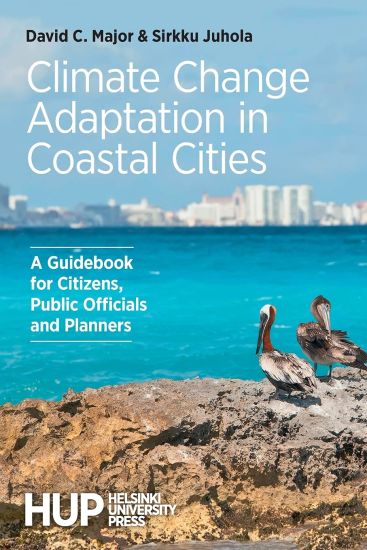
Climate Change Adaptation in Coastal Cities

Climate Change Adaptation in Coastal Cities

David C Major; Sirkku Juhola

Helsinki University Press
2021
pokkari
This guidebook presents a framework for climate adaptation planning for coastal cities, large and small, focused on the central roles of citizens, public officials, and planners. The book is designed to help all stakeholders in coastal cities understand and develop effective adaptation measures in a sustainable way. Within a framework of eight key planning steps, guidance is provided for stakeholders in the adaptation process from initial assessments of climate impacts to final planning. The work sets out general principles and methods of adaptation to climate change for many types of coastal communities. Adaptation is seen throughout the work as a process that should take into account all coastal assets, including economic, environmental, social, cultural and historical assets, with due attention to disadvantaged communities. Among the adaptation elements covered in the book are: a review of the current climate situation; climate impacts and vulnerabilities; climate models and future scenarios; physical, economic, social and other characteristics of coastal cities and towns; the range of available adaptations, including management, infrastructure, and policy adaptations; evaluation of projects and programs; and working together to develop and finance adaptations. Numerous tables are presented to help organize information and guide planning, and examples of adaptation challenges and opportunities are provided from both developed and developing coastal cities and towns. The volume is copiously illustrated, with extensive up-to-date references to provide the reader with additional sources of information.

A Huguenot on the Hackensack

A Huguenot on the Hackensack

David C. Major; JOHN S. MAJOR

Fairleigh Dickinson University Press
2007
sidottu
A Huguenot on the Hackensack is the first full-length study of David Demarest, an early European settler of northeastern New Jersey and progenitor of a large and locally influential family. The book examines Demarest's life, the legacy of his family, and the wider "Jersey Dutch" community in which the family played a prominent part. The book looks beneath accumulated layers of legend and older historical interpretations to formulate a new and more realistic (and more interesting) account of Demarest's life and legacy. Demarest, a Huguenot (French Protestant), was born about 1620 in the French province of Picardy. He first appears in history with the record of his marriage to Marie Sohier in Middleburg, the Netherlands, in 1643. After marriage and the start of a family, his life unfolded in four sojourns of about a decade or a bit more: Middleburg, 1643 to about 1651; Mannheim, Germany, from about 1651 to 1663; Staten Island and New Harlem, 1663-78, and finally the French Patent along the Hackensack River in New Jersey, 1678 to his death in 1693. New evidence and new interpretations provide a picture of Demarest as an ambitious and upwardly mobile entrepreneur with an unusual talent for balancing risk and opportunity, and a dedicated churchman and community leader under both Dutch and English rule. The book next considers the Demarests in the eighteenth century, when the family rose to prominence in Bergen County, played important roles in the Reformed Church in Hackensack and Schraalenburgh, and began to spread out to other parts of the country. Recapitulating Demarest's own career as an entrepreneur and land developer, some of his descendants settled parts of central Pennsylvania, upstate New York, and Kentucky. Many of those who remained in New Jersey were active in public affairs and the Revolutionary War. By the end of the nineteenth century, enormous changes in Bergen County, including the spread of railroads and the transition from a farming economy to a suburban one, spelled the beginning of the end for the cohesiveness and influence of old, locally prominent Jersey Dutch families such as the Demarests. With further economic and demographic changes following World War II, such families were subsumed into the general population. The book concludes with an assessment of the Demarest family's American experience, looks at how pioneer students of Demarest family history shaped and interpreted his life and legacy against the background of changes in American society in the late nineteenth and early twentieth centuries, and suggests what might yet be learned about Demarest through genetic evidence and the increasing availability of digitized records. Demarest's life and legacy are of interest not just to the large number of his descendants and the numerous descendants of other Jersey Dutch families, but more broadly to those interested in regional history, New Netherland, and American social history.