Kirjojen hintavertailu. Mukana 12 595 353 kirjaa ja 12 kauppaa.

Kirjailija

David Card

Kirjat ja teokset yhdessä paikassa: 7 kirjaa, julkaisuja vuosilta 1981-2016, suosituimpien joukossa Wages, School Quality, and Employment Demand. Vertaile teosten hintoja ja tarkista saatavuus suomalaisista kirjakaupoista.

7 kirjaa

Kirjojen julkaisuhaarukka 1981-2016.

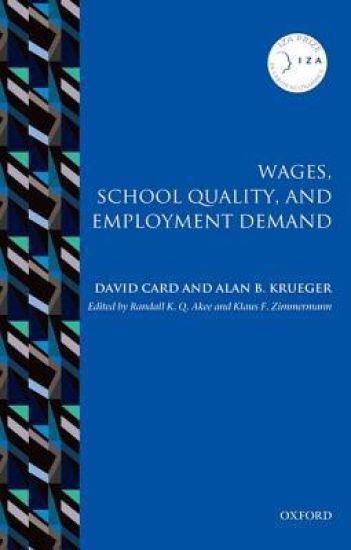
Wages, School Quality, and Employment Demand

Wages, School Quality, and Employment Demand

David Card; Alan B. Krueger

Oxford University Press
2016
nidottu
David Card and Alan B. Krueger have made substantial contributions to the field of Labor Economics. Their influential work focuses on policy-relevant issues and spans vast and important topics, including: unemployment, minimum wage, migration, measurement error, unions, wage differentials among various groups in the US, labor demand, social insurance, and technological change. Card and Krueger have also been extremely influential in econometrics methodology; they were at the forefront of employing an 'experimental' approach in their research design and implementation. Both of these IZA prize winners have made significant methodological contributions on instrumental variable estimation, measurement error, regression discontinuity methods, and the use of 'natural' experiments. This book provides an overview of their most important work and is divided two main parts: the first section focuses on school quality and the differences in wages across groups in the US; the second part concentrates on the effect of changes in the minimum wage on employment and wage setting. In section introductions, Card and Krueger offer their insight into these two areas and discuss the historical context for their research.
Myth and Measurement

Myth and Measurement

David Card; Alan B. Krueger

Princeton University Press
2015
pokkari
David Card and Alan B. Krueger have already made national news with their pathbreaking research on the minimum wage. Here they present a powerful new challenge to the conventional view that higher minimum wages reduce jobs for low-wage workers. In a work that has important implications for public policy as well as for the direction of economic research, the authors put standard economic theory to the test, using data from a series of recent episodes, including the 1992 increase in New Jersey's minimum wage, the 1988 rise in California's minimum wage, and the 1990-91 increases in the federal minimum wage. In each case they present a battery of evidence showing that increases in the minimum wage lead to increases in pay, but no loss in jobs. A distinctive feature of Card and Krueger's research is the use of empirical methods borrowed from the natural sciences, including comparisons between the "treatment" and "control" groups formed when the minimum wage rises for some workers but not for others. In addition, the authors critically reexamine the previous literature on the minimum wage and find that it, too, lacks support for the claim that a higher minimum wage cuts jobs. Finally, the effects of the minimum wage on family earnings, poverty outcomes, and the stock market valuation of low-wage employers are documented. Overall, this book calls into question the standard model of the labor market that has dominated economists' thinking on the minimum wage. In addition, it will shift the terms of the debate on the minimum wage in Washington and in state legislatures throughout the country. With a new preface discussing new data, Myth and Measurement continues to shift the terms of the debate on the minimum wage.
12 Essential Minerals for Cellular Health
This book presents a short, simple and readily-accessible summary of the internal and external therapeutic uses of the 12 essential tissue salts, commonly called "cell salts." The use of cell salts to treat a wide variety of health-related conditions has been extremely popular in Europe (especially in Germany) for many years. Today, there is widespread and growing interest in this branch of homeopathic treatment in the U.S., as evidenced by the inclusion of these twelve cell salts in special displays in health food stores across the country. Cell salts (tissue salts) exist in every human body. They are the inorganic biochemical elements found in the blood and tissues. They are the builders and the catalysts for many essential processes. For example, most people have heard of potassium chloride, but probably few realize that it is first and foremost a tissue salt (cell salt) essential to the digestive process. This salt unites with hydrogen to form HCL (hydrochloric acid), aids in the production of bile, serves as an alkalizer, and helps in digestive enzyme formation. Therefore, it is a dynamic component of health. Twelve cell salts were identified in the 1850s by European scientists, and this knowledge was soon added to the materia medica of physicians and practitioners throughout Europe. Today, homeopathic practitioners and naturopathic doctors in the United States and other countries are beginning to revive the use of cell salt supplementation in successfully treating a spectrum of disease conditions. Much of what has been previously written on cell salts is in somewhat archaic medical language, which is decidedly hard to understand. Mr. Card's new book is different. He explains cell salts in a comprehensive fashion, yet simply, and in modern language; gives clear instruction in how to use cell salts, and supplies extensive lists of various disease- or imbalance-conditions that can be helped by cell salt supplementation. A section on the external uses of cell salts, something seldom revealed in the English language, is also included. Finally, the author makes a correspondence between the twelve signs of the zodiac and the use of each of the twelve different cell salts. The book is clearly indexed for ease of usage.
Wages, School Quality, and Employment Demand

Wages, School Quality, and Employment Demand

David Card; Alan B. Krueger

Oxford University Press
2011
sidottu
David Card and Alan B. Krueger have made substantial contributions to the field of Labor Economics. Their influential work focuses on policy-relevant issues and spans vast and important topics, including: unemployment, minimum wage, migration, measurement error, unions, wage differentials among various groups in the US, labor demand, social insurance, and technological change. Card and Krueger have also been extremely influential in econometrics methodology; they were at the forefront of employing an 'experimental' approach in their research design and implementation. Both of these IZA prize winners have made significant methodological contributions on instrumental variable estimation, measurement error, regression discontinuity methods, and the use of 'natural' experiments. This book provides an overview of their most important work and is divided two main parts: the first section focuses on school quality and the differences in wages across groups in the US; the second part concentrates on the effect of changes in the minimum wage on employment and wage setting. In section introductions, Card and Krueger offer their insight into these two areas and discuss the historical context for their research.
Active Labor Market Policies in Europe

Active Labor Market Policies in Europe

Jochen Kluve; David Card; Michael Fertig; Marek Góra; Lena Jacobi; Peter Jensen; Reelika Leetmaa; Leonhard Nima; Eleonora Patacchini; Sandra Schaffner; Christoph M. Schmidt; Bas van der Klaauw; Andrea Weber

Springer-Verlag Berlin and Heidelberg GmbH Co. K
2010
nidottu
Measures of Active Labor Market Policy - such as training, wage subsidies, public employment measures, and job search assistance - are widely used in European countries to combat unemployment. Little, however, is known about what each country can learn from experiences in other countries. This study provides novel insight on this important policy issue by discussing the role of the European Commission's Employment Strategy, reviewing the experiences made in European states, and giving the first ever quantitative assessment of the existing cross-country evidence, answering the question "what labor market program works for what target group under what (economic and institutional) circumstances?". Using an innovative meta-analytical approach, the authors find that rather than contextual factors such as labor market institutions or the business cycle, it is almost exclusively the program type that matters for program effectiveness: While direct employment programs in the public sector appear detrimental, wage subsidies and "Services and Sanctions" can be effective in increasing participants' employment probability.
Active Labor Market Policies in Europe

Active Labor Market Policies in Europe

Jochen Kluve; David Card; Michael Fertig; Marek Góra; Lena Jacobi; Peter Jensen; Reelika Leetmaa; Leonhard Nima; Eleonora Patacchini; Sandra Schaffner; Christoph M. Schmidt; Bas van der Klaauw; Andrea Weber

Springer-Verlag Berlin and Heidelberg GmbH Co. K
2007
sidottu
Measures of Active Labor Market Policy - such as training, wage subsidies, public employment measures, and job search assistance - are widely used in European countries to combat unemployment. Little, however, is known about what each country can learn from experiences in other countries. This study provides novel insight on this important policy issue by discussing the role of the European Commission's Employment Strategy, reviewing the experiences made in European states, and giving the first ever quantitative assessment of the existing cross-country evidence, answering the question "what labor market program works for what target group under what (economic and institutional) circumstances?". Using an innovative meta-analytical approach, the authors find that rather than contextual factors such as labor market institutions or the business cycle, it is almost exclusively the program type that matters for program effectiveness: While direct employment programs in the public sector appear detrimental, wage subsidies and "Services and Sanctions" can be effective in increasing participants' employment probability.
Distribution of Income and Wealth in Ontario

Distribution of Income and Wealth in Ontario

Charles Beach; Frank Flatters; David Card

University of Toronto Press
1981
pokkari
Distribution analysis has advanced remarkably in recent years, and this is a valuable application of its principles to a Canadian context. The book provides an extensive survey of recent literature and a new source of income and wealth distribution data for Ontario, drawn from newly available microdata sets. It also presents an evaluation of the data as a basis for measuring inequality in the distribution of economic and well-being. The empirical results illustrate how incomes vary significantly with age according to labour market attachment and experience, educational attainment and occupation, transfer receipts, and investment benefits. Similarly, strong age effects on net worth account reflect life-cycle patterns in asset holdings and debts typically associated with family investment in housing and financial adjustments for retirement. Differences in family size and composition have a substantial effect on the structure of family economic well-being. The inequality effects of adjusting for accrued capital gains and net worth holdings can also be quite significant. It is found that the distributional effects of CPP net benefits are considerable, although they are not as equalizing as one may have expected because of marked cohort effects. The detailed findings suggest that the life-cycle framework is a very useful one for evaluating the distributional effects of certain government programs, particularly intertemporal ones, and they underline the need for a range of different types of policies to address low income problems. The study urges greater recognition of the inequality of treatment and opportunity among different groups of the population. It also points out that conventional income distribution figures are only very imperfect estimates of the state of inequality in the underlying distribution of economic well-being.