Kirjojen hintavertailu. Mukana 12 479 817 kirjaa ja 12 kauppaa.
Kirjailija
David Doermann
Kirjat ja teokset yhdessä paikassa: 7 kirjaa, julkaisuja vuosilta 1999-2025, suosituimpien joukossa Handwritten Document Image Processing. Vertaile teosten hintoja ja tarkista saatavuus suomalaisista kirjakaupoista.
In the past five years, the field of electrostatic discharge (ESD) control has under gone some notable changes. Industry standards have multiplied, though not all of these, in our view, are realistic and meaningful. Increasing importance has been ascribed to the Charged Device Model (CDM) versus the Human Body Model (HBM) as a cause of device damage and, presumably, premature (latent) failure. Packaging materials have significantly evolved. Air ionization techniques have improved, and usage has grown. Finally, and importantly, the government has ceased imposing MIL-STD-1686 on all new contracts, leaving companies on their own to formulate an ESD-control policy and write implementing documents. All these changes are dealt with in five new chapters and ten new reprinted papers added to this revised edition of ESD from A to Z. Also, the original chapters have been augmented with new material such as more troubleshooting examples in Chapter 8 and a 20-question multiple-choice test for certifying operators in Chapter 9. More than ever, the book seeks to provide advice, guidance, and practical ex amples, not just a jumble of facts and generalizations. For instance, the added tailored versions of the model specifications for ESD-safe handling and packaging are actually in use at medium-sized corporations and could serve as patterns for many readers.
Deep learning has achieved impressive results in image classification, computer vision, and natural language processing. To achieve better performance, deeper and wider networks have been designed, which increase the demand for computational resources. The number of floatingpoint operations (FLOPs) has increased dramatically with larger networks, and this has become an obstacle for convolutional neural networks (CNNs) being developed for mobile and embedded devices. In this context, Binary Neural Networks: Algorithms, Architectures, and Applications will focus on CNN compression and acceleration, which are important for the research community. We will describe numerous methods, including parameter quantization, network pruning, low-rank decomposition, and knowledge distillation. More recently, to reduce the burden of handcrafted architecture design, neural architecture search (NAS) has been used to automatically build neural networks by searching over a vast architecture space. Our book will also introduce NAS and binary NAS and its superiority and state-of-the-art performance in various applications, such as image classification and object detection. We also describe extensive applications of compressed deep models on image classification, speech recognition, object detection, and tracking. These topics can help researchers better understand the usefulness and the potential of network compression on practical applications. Moreover, interested readers should have basic knowledge of machine learning and deep learning to better understand the methods described in this book.Key FeaturesReviews recent advances in CNN compression and accelerationElaborates recent advances on binary neural network (BNN) technologiesIntroduces applications of BNN in image classification, speech recognition, object detection, and more
More recently, to reduce the burden of handcrafted architecture design, neural architecture search (NAS) has been used to automatically build neural networks by searching over a vast architecture space.
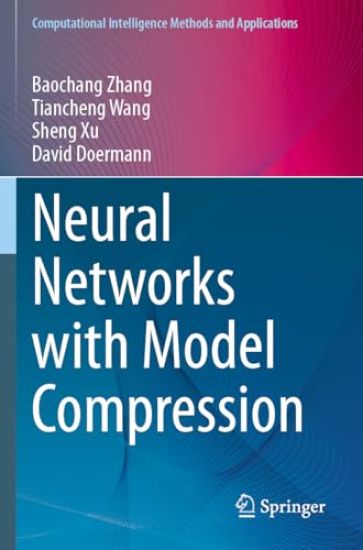
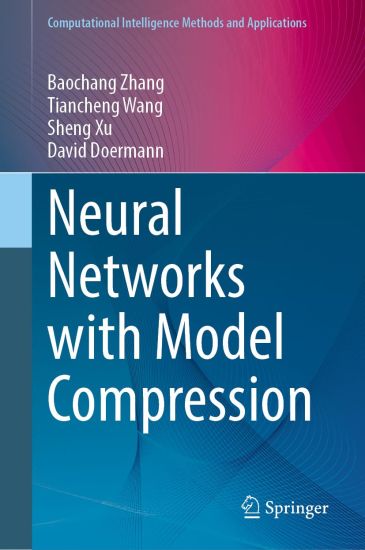
Deep learning has achieved impressive results in image classification, computer vision and natural language processing. To achieve better performance, deeper and wider networks have been designed, which increase the demand for computational resources. The number of floating-point operations (FLOPs) has increased dramatically with larger networks, and this has become an obstacle for convolutional neural networks (CNNs) being developed for mobile and embedded devices. In this context, our book will focus on CNN compression and acceleration, which are important for the research community. We will describe numerous methods, including parameter quantization, network pruning, low-rank decomposition and knowledge distillation. More recently, to reduce the burden of handcrafted architecture design, neural architecture search (NAS) has been used to automatically build neural networks by searching over a vast architecture space. Our book will also introduce NAS due to its superiority and state-of-the-art performance in various applications, such as image classification and object detection. We also describe extensive applications of compressed deep models on image classification, speech recognition, object detection and tracking. These topics can help researchers better understand the usefulness and the potential of network compression on practical applications. Moreover, interested readers should have basic knowledge about machine learning and deep learning to better understand the methods described in this book.
Deep learning has achieved impressive results in image classification, computer vision, and natural language processing. To achieve better performance, deeper and wider networks have been designed, which increase the demand for computational resources. The number of floatingpoint operations (FLOPs) has increased dramatically with larger networks, and this has become an obstacle for convolutional neural networks (CNNs) being developed for mobile and embedded devices. In this context, Binary Neural Networks: Algorithms, Architectures, and Applications will focus on CNN compression and acceleration, which are important for the research community. We will describe numerous methods, including parameter quantization, network pruning, low-rank decomposition, and knowledge distillation. More recently, to reduce the burden of handcrafted architecture design, neural architecture search (NAS) has been used to automatically build neural networks by searching over a vast architecture space. Our book will also introduce NAS and binary NAS and its superiority and state-of-the-art performance in various applications, such as image classification and object detection. We also describe extensive applications of compressed deep models on image classification, speech recognition, object detection, and tracking. These topics can help researchers better understand the usefulness and the potential of network compression on practical applications. Moreover, interested readers should have basic knowledge of machine learning and deep learning to better understand the methods described in this book.Key FeaturesReviews recent advances in CNN compression and accelerationElaborates recent advances on binary neural network (BNN) technologiesIntroduces applications of BNN in image classification, speech recognition, object detection, and more
In the past five years, the field of electrostatic discharge (ESD) control has under gone some notable changes. Industry standards have multiplied, though not all of these, in our view, are realistic and meaningful. Increasing importance has been ascribed to the Charged Device Model (CDM) versus the Human Body Model (HBM) as a cause of device damage and, presumably, premature (latent) failure. Packaging materials have significantly evolved. Air ionization techniques have improved, and usage has grown. Finally, and importantly, the government has ceased imposing MIL-STD-1686 on all new contracts, leaving companies on their own to formulate an ESD-control policy and write implementing documents. All these changes are dealt with in five new chapters and ten new reprinted papers added to this revised edition of ESD from A to Z. Also, the original chapters have been augmented with new material such as more troubleshooting examples in Chapter 8 and a 20-question multiple-choice test for certifying operators in Chapter 9. More than ever, the book seeks to provide advice, guidance, and practical ex amples, not just a jumble of facts and generalizations. For instance, the added tailored versions of the model specifications for ESD-safe handling and packaging are actually in use at medium-sized corporations and could serve as patterns for many readers.