Kirjojen hintavertailu. Mukana 12 595 353 kirjaa ja 12 kauppaa.

Kirjailija

David E. Johnson

Kirjat ja teokset yhdessä paikassa: 34 kirjaa, julkaisuja vuosilta 1995-2026, suosituimpien joukossa Recommended Research Priorities for the Qatar Foundation's Environment and Energy Research Institute. Vertaile teosten hintoja ja tarkista saatavuus suomalaisista kirjakaupoista.

Mukana myös kirjoitusasut: David E Johnson

34 kirjaa

Kirjojen julkaisuhaarukka 1995-2026.

Fast Tanks and Heavy Bombers

Fast Tanks and Heavy Bombers

David E. Johnson

Cornell University Press
1998
sidottu
The U.S. Army entered World War II unprepared. In addition, lacking Germany's blitzkrieg approach of coordinated armor and air power, the army was organized to fight two wars: one on the ground and one in the air. Previous commentators have blamed Congressional funding and public apathy for the army's unprepared state. David E. Johnson believes instead that the principal causes were internal: army culture and bureaucracy, and their combined impact on the development of weapons and doctrine. Johnson examines the U.S. Army's innovations for both armor and aviation between the world wars, arguing that the tank became a captive of the conservative infantry and cavalry branches, while the airplane's development was channeled by air power insurgents bent on creating an independent air force. He maintains that as a consequence, the tank's potential was hindered by the traditional arms, while air power advocates focused mainly on proving the decisiveness of strategic bombing, neglecting the mission of tactical support for ground troops. Minimal interaction between ground and air officers resulted in insufficient cooperation between armored forces and air forces. Fast Tanks and Heavy Bombers makes a major contribution to a new understanding of both the creation of the modern U.S. Army and the Army's performance in World War II. The book also provides important insights for future military innovation.

Electric Circuit Analysis

Electric Circuit Analysis

David E. Johnson; Johnny R. Johnson; John L. Hilburn; Peter D. Scott

John Wiley Sons Inc
1997
sidottu
Covers the fundamentals of circuit theory from both a time-domain and frequency-domain point of view. The operational amplifier is introduced early, and is used as a basic element throughout. This edition is fully updated, and places greater emphasis on design, SPICE, and op-amps.
School Safety

School Safety

David E. Johnson; Glenn G. Norling; Pamela M. VanHorn; Jeffrey Yarbrough; Shaun Hurtado

BLOOMSBURY PUBLISHING PLC
2026
nidottu
School Safety confronts one of the most urgent and unsettling challenges facing American education today: the alarming rise of school rampage shootings. As these once-unthinkable tragedies become tragically common, the need for informed, courageous, and capable leadership has never been greater. This timely and essential book offers a comprehensive exploration of school safety, not merely as a set of protocols but as a complex, dynamic system requiring thoughtful coordination and decisive action. What sets School Safety apart is its unique approach—unpacking the intricate relationships among the many factors that influence safety in schools, and presenting practical, real-world strategies to manage and mitigate these risks. Equally distinctive is the expert team behind the book: a diverse group of professionals whose combined skills, education, and deep experience in education, leadership, crisis response, and mental health create a richly informed and actionable resource. School Safety is a vital guide for school leaders, policymakers, educators, and anyone committed to creating safer, more resilient learning environments for all.
School Safety

School Safety

David E. Johnson; Glenn G. Norling; Pamela M. VanHorn; Jeffrey Yarbrough; Shaun Hurtado

BLOOMSBURY PUBLISHING PLC
2026
sidottu
School Safety confronts one of the most urgent and unsettling challenges facing American education today: the alarming rise of school rampage shootings. As these once-unthinkable tragedies become tragically common, the need for informed, courageous, and capable leadership has never been greater. This timely and essential book offers a comprehensive exploration of school safety, not merely as a set of protocols but as a complex, dynamic system requiring thoughtful coordination and decisive action. What sets School Safety apart is its unique approach—unpacking the intricate relationships among the many factors that influence safety in schools, and presenting practical, real-world strategies to manage and mitigate these risks. Equally distinctive is the expert team behind the book: a diverse group of professionals whose combined skills, education, and deep experience in education, leadership, crisis response, and mental health create a richly informed and actionable resource. School Safety is a vital guide for school leaders, policymakers, educators, and anyone committed to creating safer, more resilient learning environments for all.
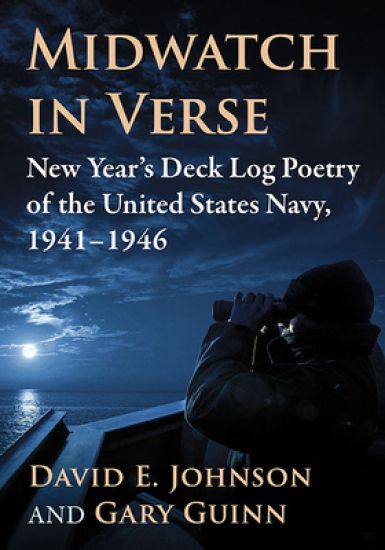
Midwatch in Verse

Midwatch in Verse

David E. Johnson; Gary Guinn

MCFARLAND CO INC
2023
pokkari
Naval deck logs require young officers to record mundane details of a ship's condition every few hours. According to a U.S. Navy tradition, the New Year's midwatch log--covering midnight to early morning of January 1--can be entered as poetry. Each chapter of this first book-length examination of midwatch poems presents verses written 1941-1946 aboard a ship engaged in combat during World War II, including celebrated warships like the USS Enterprise and nameless vessels like PC 1264. Historical overviews of the ships' operations, along with biographical sketches of the author(s), relate each poem to its moment in history.
Violence and Naming

Violence and Naming

David E. Johnson

University of Texas Press
2019
sidottu
Reclaiming the notion of literature as an institution essential for reflecting on the violence of culture, history, and politics, Violence and Naming exposes the tension between the irreducible, constitutive violence of language and the reducible, empirical violation of others. Focusing on an array of literary artifacts, from works by journalists such as Elena Poniatowska and Sergio GonzÁlez RodrÍguez to the Zapatista communiquÉs to Roberto BolaÑo's The Savage Detectives and 2666, this examination demonstrates that Mexican culture takes place as a struggle over naming-with severe implications for the rights and lives of women and indigenous persons.Through rereadings of the Conquest of Mexico, the northern Mexican feminicide, the Zapatista uprising in Chiapas, the disappearance of the forty-three students at Iguala in 2014, and the 1999 abortion-rights scandal centering on “Paulina,” which revealed the tenuousness of women’s constitutionally protected reproductive rights in Mexico, Violence and Naming asks how societies can respond to violence without violating the other. This essential question is relevant not only to contemporary Mexico but to all struggles for democracy that promise equality but instead perpetuate incessant cycles of repression.
The Continued Evolution of U.S. Law of Armed Conflict Implementation
In recent years, U.S. policies implementing the Law of Armed Conflict have increasingly restricted military activities. In this report, RAND researchers identify the ongoing or anticipated strategic, technological, and normative trends that could shift U.S. policies, how these trends might change battlefield and legal or normative dynamics, and the implications for the U.S. military that might result from these possible changes.
2008 Battle of Sadr City

2008 Battle of Sadr City

David E. Johnson; M. Wade Markel; Brian Shannon

RAND
2014
pokkari
In 2008, U.S. and Iraqi forces defeated an uprising in Sadr City, a district of Baghdad with 2.4 million residents. Coalition forces' success in this battle helped consolidate the Government of Iraq's authority, contributing significantly to the attainment of contemporary U.S. operational objectives in Iraq. U.S. forces' conduct of the battle illustrates a new paradigm for urban combat and indicates capabilities the Army will need in the future.
Kant's Dog

Kant's Dog

David E. Johnson

State University of New York Press
2013
pokkari
Situates Borges at the limit of philosophy and literature.Kant's Dog provides fresh insight into Borges's preoccupation with the contradiction of the time that passes and the identity that endures. By developing the implicit logic of the Borgesian archive, which is most often figured as the universal demand for and necessary impossibility of translation, Kant's Dog is able to spell out Borges's responses to the philosophical problems that most concerned him, those of the constitution of time, eternity, and identity; the determination of original and copy; the legitimacy of authority; experience; the nature of language and the possibility of a decision; and the name of God. Kant's Dog offers original interpretations of several of Borges's best known and most important stories and of the works of key figures in the history of philosophy, including Aristotle, Saint Paul, Maimonides, Hume, Locke, Kant, Heidegger, and Derrida. This study outlines Borges's curious relationship to literature and philosophy and, through a reconsideration of the relation between necessity and accident, opens the question of the constitution of philosophy and literature. The afterword develops the logic of translation toward the secret at the heart of every culture in order to posit a Borgesian challenge to anthropology and cultural studies.
Local Constraints Vs. Economy

Local Constraints Vs. Economy

David E. Johnson; Shalom Lappin

Centre for the Study of Language Information
1999
sidottu
The book offers a detailed critique of the economy-of-derivation model of grammar that has emerged within the framework of Chomsky's Minimalist Program. It looks at the conceptual and computational complexity problems as well as the empirical consequences of both global and local economy principles. The book compares the economy-of-derivation model with a local constraint model of grammar that does not invoke conditions on sets of derivations or on possible operations in a derivation. It argues that the pure local constraint model of grammar avoids the complexity problems resulting from economy-of-derivation principles and provides a more satisfactory explanation of the linguistic facts that economy theorists have cited in support of their approach. The local constraint model also allows for a more natural and empirically well-motivated grammatical architecture than the one postulated by the Minimalist Program.