Kirjojen hintavertailu. Mukana 12 135 864 kirjaa ja 12 kauppaa.

Kirjailija

David Edmonds

Kirjat ja teokset yhdessä paikassa: 23 kirjaa, julkaisuja vuosilta 2002-2025, suosituimpien joukossa Bobby Fischer Goes to War: How a Lone American Star Defeated the Soviet Chess Machine. Vertaile teosten hintoja ja tarkista saatavuus suomalaisista kirjakaupoista.

23 kirjaa

Kirjojen julkaisuhaarukka 2002-2025.

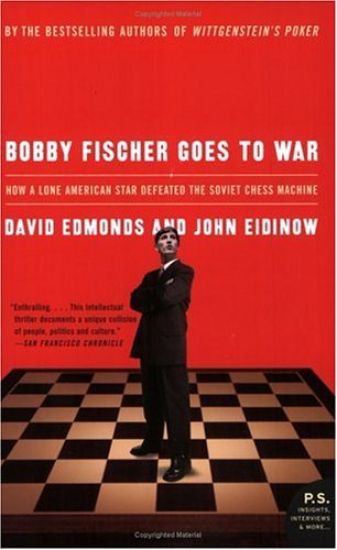
Bobby Fischer Goes to War: How a Lone American Star Defeated the Soviet Chess Machine
By the authors of the national bestseller Wittgenstein's Poker, a riveting account of the legendary 1972 chess match between Boris Spassky, the world champion from the Soviet Union, and the American challenger Bobby Fischer In the summer of 1972, with a presidential crisis stirring in the United States and the cold war at a pivotal point, the Soviet world chess champion Boris Spassky and his American challenger Bobby Fischer met in Reykjavik, Iceland for a chess match that held the world spellbound for two months with reports of psychological warfare, political intrigue, and cliffhangers. Thirty years later, David Edmonds and John Eidinow have set out to reexamine the story we recollect as the quintessential cold war clash between a lone American star and the Soviet chess machine. A mesmerizing narrative of hubris and despair, Bobby Fischer Goes to War is a biting deconstruction of the Bobby Fischer myth, a nuanced study on the art of brinkmanship, and a revelatory cold war tragicomedy.
Death in a Shallow Pond

Death in a Shallow Pond

David Edmonds

PRINCETON UNIVERSITY PRESS
2025
sidottu
From the bestselling coauthor of Wittgenstein’s Poker, a fascinating account of Peter Singer’s controversial “drowning child” thought experiment—and how it changed the way people think about charitable givingImagine this: You’re walking past a shallow pond and spot a toddler thrashing around in the water, in obvious danger of drowning. You look around for her parents, but nobody is there. You’re the only person who can save her and you must act immediately. But as you approach the pond you remember that you’re wearing your most expensive shoes. Wading into the water will ruin them—and might make you late for a meeting. Should you let the child drown? The philosopher Peter Singer published this thought experiment in 1972, arguing that allowing people in the developing world to die, when we could easily help them by giving money to charity, is as morally reprehensible as saving our shoes instead of the drowning child. Can this possibly be true? In Death in a Shallow Pond, David Edmonds tells the remarkable story of Singer and his controversial idea, tracing how it radically changed the way many think about poverty—but also how it has provoked scathing criticisms.Death in a Shallow Pond describes the experiences and world events that led Singer to make his radical case and how it moved some young philosophers to establish the Effective Altruism movement, which tries to optimize philanthropy. The book also explores the reactions of critics who argue that the Shallow Pond and Effective Altruism are unrealistic, misguided, and counterproductive, neglecting the causes of—and therefore perpetuating—poverty. Ultimately, however, Edmonds argues that the Shallow Pond retains the power to shape how we live in a world in which terrible and unnecessary suffering persists.
Parfit

Parfit

David Edmonds

PRINCETON UNIVERSITY PRESS
2024
pokkari
From the bestselling coauthor of Wittgenstein's Poker, an entertaining and illuminating biography of a brilliant philosopher who tried to rescue morality from nihilismDerek Parfit (1942-2017) is the most famous philosopher most people have never heard of. Widely regarded as one of the greatest moral thinkers of the past hundred years, Parfit was anything but a public intellectual. Yet his ideas have shaped the way philosophers think about things that affect us all: equality, altruism, what we owe to future generations, and even what it means to be a person. In Parfit, David Edmonds presents the first biography of an intriguing, obsessive, and eccentric genius.Believing that we should be less concerned with ourselves and more with the common good, Parfit dedicated himself to the pursuit of philosophical progress to an extraordinary degree. He always wore gray trousers and a white shirt so as not to lose precious time picking out clothes, he varied his diet as little as possible, and he had only one serious non-philosophical interest: taking photos of Oxford, Venice, and St. Petersburg. In the latter half of his life, he single-mindedly devoted himself to a desperate attempt to rescue secular morality-morality without God-by arguing that it has an objective, rational basis. For Parfit, the stakes could scarcely have been higher. If he couldn't demonstrate that there are objective facts about right and wrong, he believed, his life was futile and all our lives were meaningless.Connecting Parfit's work and life and offering a clear introduction to his profound and challenging ideas, Parfit is a powerful portrait of an extraordinary thinker who continues to have a remarkable influence on the world of ideas.
Derek Parfit : filosofen som sökte moralens kärna
Trots att han var en av de mest inflytelserika moralfilosoferna under 1900-talet, har han aldrig nått en bredare krets utanför akademin. Med sin originella livsstil och sin glasklara analytiska blick blev Derek Parfit en av de mest legendariska tänkarna i den brittiska universitetsvärlden efter andra världskriget. Genom skarpsinniga tankeexperiment och språklig precision resonerade Parfit om det som angår oss alla: etik och moral, personlig identitet, rationalitet och vilka skyldigheter vi har gentemot framtida generationer.I sin bok beskriver David Edmonds ett excentriskt geni som var osedvanligt hängiven sin strävan att föra den moralfilosofiska utvecklingen framåt och demonstrera moralens objektivitet. För att inte slösa värdefull tid och tankemöda bar Parfit alltid gråa byxor och vit skjorta, åt nästan samma sak varje dag och hade egentligen bara ett intresse utanför filosofin: fotografering av vackra byggnader.
Understanding Humans

Understanding Humans

David Edmonds

SAGE PUBLICATIONS LTD
2023
nidottu
Compiling the best episodes of SAGE's 'Social Science Bites' podcast since its beginning in 2012, this pocket-sized volume is sure to inspire and provoke. With a foreword by David Edmonds, host of the podcast, this book will show you how social science can help to solve problems in today's society. It is structured into sections on identity, learning, human behaviour, social change, and the unexpected, with each chapter offering the perspective of one of the most dynamic thinkers in the social sciences. Taking a multidisciplinary approach, Edmonds' selection of interviews includes topics such as racial inequality, moral psychology, the pandemic, and the prison system. Interviewees include Sam Friedman, Professor of Sociology at LSE, Gurminder K. Bhambra, Professor of Postcolonial and Decolonial Studies at the University of Sussex, and Jennifer Richeson, Professor of Psychology at Yale University. This book will show you the range of voices in the social sciences today, and how this diversity is what is needed to grapple with the complexity of the issues we face.
Parfit

Parfit

David Edmonds

PRINCETON UNIVERSITY PRESS
2023
sidottu
From the bestselling coauthor of Wittgenstein’s Poker, an entertaining and illuminating biography of a brilliant philosopher who tried to rescue morality from nihilismDerek Parfit (1942–2017) is the most famous philosopher most people have never heard of. Widely regarded as one of the greatest moral thinkers of the past hundred years, Parfit was anything but a public intellectual. Yet his ideas have shaped the way philosophers think about things that affect us all: equality, altruism, what we owe to future generations, and even what it means to be a person. In Parfit, David Edmonds presents the first biography of an intriguing, obsessive, and eccentric genius.Believing that we should be less concerned with ourselves and more with the common good, Parfit dedicated himself to the pursuit of philosophical progress to an extraordinary degree. He always wore gray trousers and a white shirt so as not to lose precious time picking out clothes, he varied his diet as little as possible, and he had only one serious non-philosophical interest: taking photos of Oxford, Venice, and St. Petersburg. In the latter half of his life, he single-mindedly devoted himself to a desperate attempt to rescue secular morality—morality without God—by arguing that it has an objective, rational basis. For Parfit, the stakes could scarcely have been higher. If he couldn’t demonstrate that there are objective facts about right and wrong, he believed, his life was futile and all our lives were meaningless.Connecting Parfit’s work and life and offering a clear introduction to his profound and challenging ideas, Parfit is a powerful portrait of an extraordinary thinker who continues to have a remarkable influence on the world of ideas.
The Murder of Professor Schlick

The Murder of Professor Schlick

David Edmonds

PRINCETON UNIVERSITY PRESS
2022
pokkari
From the author of Wittgenstein's Poker and Would You Kill the Fat Man?, the story of an extraordinary group of philosophers during a dark chapter in Europe's historyOn June 22, 1936, the philosopher Moritz Schlick was on his way to deliver a lecture at the University of Vienna when Johann Nelböck, a deranged former student of Schlick's, shot him dead on the university steps. Some Austrian newspapers defended the madman, while Nelböck himself argued in court that his onetime teacher had promoted a treacherous Jewish philosophy. David Edmonds traces the rise and fall of the Vienna Circle—an influential group of brilliant thinkers led by Schlick—and of a philosophical movement that sought to do away with metaphysics and pseudoscience in a city darkened by fascism, anti-Semitism, and unreason.The Vienna Circle's members included Otto Neurath, Rudolf Carnap, and the eccentric logician Kurt Gödel. On its fringes were two other philosophical titans of the twentieth century, Ludwig Wittgenstein and Karl Popper. The Circle championed the philosophy of logical empiricism, which held that only two types of propositions have cognitive meaning, those that can be verified through experience and those that are analytically true. For a time, it was the most fashionable movement in philosophy. Yet by the outbreak of World War II, Schlick's group had disbanded and almost all its members had fled. Edmonds reveals why the Austro-fascists and the Nazis saw their philosophy as such a threat.The Murder of Professor Schlick paints an unforgettable portrait of the Vienna Circle and its members while weaving an enthralling narrative set against the backdrop of economic catastrophe and rising extremism in Hitler's Europe.
The Murder of Professor Schlick

The Murder of Professor Schlick

David Edmonds

PRINCETON UNIVERSITY PRESS
2020
sidottu
From the author of Wittgenstein's Poker and Would You Kill the Fat Man?, the story of an extraordinary group of philosophers during a dark chapter in Europe's historyOn June 22, 1936, the philosopher Moritz Schlick was on his way to deliver a lecture at the University of Vienna when Johann Nelböck, a deranged former student of Schlick's, shot him dead on the university steps. Some Austrian newspapers defended the madman, while Nelböck himself argued in court that his onetime teacher had promoted a treacherous Jewish philosophy. David Edmonds traces the rise and fall of the Vienna Circle—an influential group of brilliant thinkers led by Schlick—and of a philosophical movement that sought to do away with metaphysics and pseudoscience in a city darkened by fascism, anti-Semitism, and unreason.The Vienna Circle's members included Otto Neurath, Rudolf Carnap, and the eccentric logician Kurt Gödel. On its fringes were two other philosophical titans of the twentieth century, Ludwig Wittgenstein and Karl Popper. The Circle championed the philosophy of logical empiricism, which held that only two types of propositions have cognitive meaning, those that can be verified through experience and those that are analytically true. For a time, it was the most fashionable movement in philosophy. Yet by the outbreak of World War II, Schlick's group had disbanded and almost all its members had fled. Edmonds reveals why the Austro-fascists and the Nazis saw their philosophy as such a threat.The Murder of Professor Schlick paints an unforgettable portrait of the Vienna Circle and its members while weaving an enthralling narrative set against the backdrop of economic catastrophe and rising extremism in Hitler's Europe.
Undercover Robot: My First Year as a Human

Undercover Robot: My First Year as a Human

David Edmonds; Bertie Fraser

Walker Books Ltd
2020
nidottu
Watch out, Brussells Academy – this robot will outwit you all!If super-high-tech android Dotty can spend an entire year masquerading as a twelve-year-old schoolgirl, she could win a multi-million-pound prize that will enable her creators to continue their ground-breaking work in the development of AI. Easy-peasy, right? As Dotty navigates the social expectations of Year 7 she gets into a series of hilarious scrapes, and encounters numerous ethical dilemmas both at school and at home. Then a boy in her class discovers there's a reward for outing the robot, and becomes intent on proving that Dotty is not who – or what – she says she is. To prevent herself from being discovered, Dotty needs to put into practice everything she has learned about being human. But will it be enough...?
Would You Kill the Fat Man?

Would You Kill the Fat Man?

David Edmonds

Princeton University Press
2015
pokkari
A runaway train is racing toward five men who are tied to the track. Unless the train is stopped, it will inevitably kill all five men. You are standing on a footbridge looking down on the unfolding disaster. However, a fat man, a stranger, is standing next to you: if you push him off the bridge, he will topple onto the line and, although he will die, his chunky body will stop the train, saving five lives. Would you kill the fat man? The question may seem bizarre. But it's one variation of a puzzle that has baffled moral philosophers for almost half a century and that more recently has come to preoccupy neuroscientists, psychologists, and other thinkers as well. In this book, David Edmonds, coauthor of the best-selling Wittgenstein's Poker, tells the riveting story of why and how philosophers have struggled with this ethical dilemma, sometimes called the trolley problem. In the process, he provides an entertaining and informative tour through the history of moral philosophy. Most people feel it's wrong to kill the fat man. But why? After all, in taking one life you could save five. As Edmonds shows, answering the question is far more complex--and important--than it first appears. In fact, how we answer it tells us a great deal about right and wrong.
Philosophy Bites Again

Philosophy Bites Again

David Edmonds; Nigel Warburton

Oxford University Press
2014
sidottu
Philosophy Bites Again is a brand new selection of interviews from the popular podcast of the same name. It offers engaging and thought-provoking conversations with leading philosophers on a selection of major philosophical issues that affect our lives. Their subjects include pleasure, pain, and humour; consciousness and the self; free will, responsibility, and punishment; the meaning of life and the afterlife. Everyone will find ideas in this book to fascinate, provoke, and inspire them. Philosophy Bites was set up in 2007 by David Edmonds and Nigel Warburton. It has, to date, over 20 million downloads, and is listened to all over the world.
Philosophy Bites Back

Philosophy Bites Back

David Edmonds; Nigel Warburton

Oxford University Press
2014
nidottu
Philosophy Bites Back is the second book to come out of the hugely successful podcast Philosophy Bites. It presents a selection of lively interviews with leading philosophers of our time, who discuss the ideas and works of some of the most important thinkers in history. From the ancient classics of Socrates, Plato, and Aristotle, to the groundbreaking modern thought of Wittgenstein, Rawls, and Derrida, this volume spans over two and a half millennia of western philosophy and illuminates its most fascinating ideas. Philosophy Bites was set up in 2007 by David Edmonds and Nigel Warburton. It has had over 12 million downloads, and is listened to all over the world.
Caste Wars

Caste Wars

David Edmonds

Routledge
2014
nidottu
The central topic for this book is the ethics of treating individuals as though they are members of groups. The book raises many interesting questions, including:Why do we feel so much more strongly about discrimination on certain grounds – e.g. of race and sex - than discrimination on other grounds? Are we right to think that discrimination based on these characteristics is especially invidious? What should we think about ‘rational discrimination’ – ‘discrimination’ which is based on sound statistics?To take just one of dozens of examples from the book. Suppose a landlord turns away a prospective tenant, because this prospective tenant is of a particular ethnicity – arguing that statistics show that one in four of this group have been shown in the past to default on their rent. That seems clearly unfair to people of this ethnicity. But we are routinely being judged in this way – not just on the basis of our ethnicity, but assumptions are made about us and decisions taken about us based on our gender, religion, job, post-code, hobbies, blood-group, nationality, etc. Now suppose that another landlord turns away a convicted criminal, arguing that one in four of convicted criminals have been shown to be unreliable rent payers. Is our intuition the same as before? Should it be?This book is suitable for all students of philosophy, especially those with an interest in applied ethics.
Would You Kill the Fat Man?

Would You Kill the Fat Man?

David Edmonds

Princeton University Press
2013
sidottu
A runaway train is racing toward five men who are tied to the track. Unless the train is stopped, it will inevitably kill all five men. You are standing on a footbridge looking down on the unfolding disaster. However, a fat man, a stranger, is standing next to you: if you push him off the bridge, he will topple onto the line and, although he will die, his chunky body will stop the train, saving five lives. Would you kill the fat man? The question may seem bizarre. But it's one variation of a puzzle that has baffled moral philosophers for almost half a century and that more recently has come to preoccupy neuroscientists, psychologists, and other thinkers as well. In this book, David Edmonds, coauthor of the best-selling Wittgenstein's Poker, tells the riveting story of why and how philosophers have struggled with this ethical dilemma, sometimes called the trolley problem. In the process, he provides an entertaining and informative tour through the history of moral philosophy. Most people feel it's wrong to kill the fat man. But why? After all, in taking one life you could save five. As Edmonds shows, answering the question is far more complex--and important--than it first appears. In fact, how we answer it tells us a great deal about right and wrong.
Philosophy Bites Back

Philosophy Bites Back

David Edmonds; Nigel Warburton

Oxford University Press
2012
sidottu
Philosophy Bites Back is the second book to come out of the hugely successful podcast Philosophy Bites. It presents a selection of lively interviews with leading philosophers of our time, who discuss the ideas and works of some of the most important thinkers in history. From the ancient classics of Socrates, Plato, and Aristotle, to the groundbreaking modern thought of Wittgenstein, Rawls, and Derrida, this volume spans over two and a half millennia of western philosophy and illuminates its most fascinating ideas. Philosophy Bites was set up in 2007 by David Edmonds and Nigel Warburton. It has had over 12 million downloads, and is listened to all over the world.
Philosophy Bites

Philosophy Bites

David Edmonds; Nigel Warburton

Oxford University Press
2012
nidottu
Take 25 of the liveliest philosophers of our time. Talk to each about one of the most intriguing topics you can think of--from ethics to aesthetics to metaphysics. The result is a Philosophy Bite--a lively, informal conversation that brings the subject into focus. First made public on the enormously popular Philosophy Bites podcast, these entertaining, personal, and illuminating conversations are presented in print. The result is a book that is a taster for the whole enterprise of philosophy, and gives unexpected insights into hot topics spanning ethics, politics, metaphysics, aesthetics, and the meaning of life.
Caste Wars

Caste Wars

David Edmonds

Routledge
2006
sidottu
The central topic for this book is the ethics of treating individuals as though they are members of groups. The book raises many interesting questions, including:Why do we feel so much more strongly about discrimination on certain grounds – e.g. of race and sex - than discrimination on other grounds? Are we right to think that discrimination based on these characteristics is especially invidious? What should we think about ‘rational discrimination’ – ‘discrimination’ which is based on sound statistics?To take just one of dozens of examples from the book. Suppose a landlord turns away a prospective tenant, because this prospective tenant is of a particular ethnicity – arguing that statistics show that one in four of this group have been shown in the past to default on their rent. That seems clearly unfair to people of this ethnicity. But we are routinely being judged in this way – not just on the basis of our ethnicity, but assumptions are made about us and decisions taken about us based on our gender, religion, job, post-code, hobbies, blood-group, nationality, etc. Now suppose that another landlord turns away a convicted criminal, arguing that one in four of convicted criminals have been shown to be unreliable rent payers. Is our intuition the same as before? Should it be?This book is suitable for all students of philosophy, especially those with an interest in applied ethics.