Kirjojen hintavertailu. Mukana 12 595 353 kirjaa ja 12 kauppaa.

Kirjailija

David Egan

Kirjat ja teokset yhdessä paikassa: 8 kirjaa, julkaisuja vuosilta 2007-2022, suosituimpien joukossa Creating the Curriculum. Vertaile teosten hintoja ja tarkista saatavuus suomalaisista kirjakaupoista.

8 kirjaa

Kirjojen julkaisuhaarukka 2007-2022.

Creating the Curriculum

Creating the Curriculum

Dominic Wyse; Vivienne Baumfield; David Egan; Louise Hayward; Moira Hulme; Ian Menter; Carmel Gallagher; Ruth Leitch; Kay Livingston; Bob Lingard

Routledge
2012
nidottu
Is there an ‘ideal’ primary school curriculum?Who should decide what the curriculum is?Should teachers have autonomy over how they teach?The curriculum is the heart of what teachers teach and learners learn: effective teaching is only possible with an effective curriculum. Yet in spite of its importance, there has been a crisis in curriculum that has been caused in large part by governments assuming direct control over the curriculum, assessment, and increasingly, pedagogy. Creating the Curriculum tackles this thorny issue head on, challenging student and practising primary school teachers to think critically about past and present issues and to engage with a new wave of curriculum thinking and development. Considering curriculum construction and its impact on teaching and learning in the four countries of the UK, key issues considered include: who should decide the curriculum, its aims and its values the extent to which issues in primary education swing back and forth Subjects versus thematic organisation, stages and phases, progression, breadth and balance prescription versus teacher autonomy the key features of effective classroom practice strategies for assessing the whole curriculum how language in the classroom influences curriculum design understanding curricula in the context of children’s social and personal circumstances creativity, curriculum and the classroom.Illustrated throughout with strategies and case studies from the classroom, Creating the Curriculum accessibly links the latest research and evidence with concrete examples of good practice. It is a timely exploration of what makes an effective and meanginful curriculum and how teachers can bring new relevance, motivation and powerful values to what they teach.
Creating the Curriculum

Creating the Curriculum

Dominic Wyse; Vivienne Baumfield; David Egan; Louise Hayward; Moira Hulme; Ian Menter; Carmel Gallagher; Ruth Leitch; Kay Livingston; Bob Lingard

Routledge
2012
sidottu
Is there an ‘ideal’ primary school curriculum?Who should decide what the curriculum is?Should teachers have autonomy over how they teach?The curriculum is the heart of what teachers teach and learners learn: effective teaching is only possible with an effective curriculum. Yet in spite of its importance, there has been a crisis in curriculum that has been caused in large part by governments assuming direct control over the curriculum, assessment, and increasingly, pedagogy. Creating the Curriculum tackles this thorny issue head on, challenging student and practising primary school teachers to think critically about past and present issues and to engage with a new wave of curriculum thinking and development. Considering curriculum construction and its impact on teaching and learning in the four countries of the UK, key issues considered include: who should decide the curriculum, its aims and its values the extent to which issues in primary education swing back and forth Subjects versus thematic organisation, stages and phases, progression, breadth and balance prescription versus teacher autonomy the key features of effective classroom practice strategies for assessing the whole curriculum how language in the classroom influences curriculum design understanding curricula in the context of children’s social and personal circumstances creativity, curriculum and the classroom.Illustrated throughout with strategies and case studies from the classroom, Creating the Curriculum accessibly links the latest research and evidence with concrete examples of good practice. It is a timely exploration of what makes an effective and meanginful curriculum and how teachers can bring new relevance, motivation and powerful values to what they teach.

U.S. Go Home

U.S. Go Home

David Egan; Jean Egan

Schiffer Publishing Ltd
2022
sidottu
This monumental project is the definitive work on the postwar American military occupation of France. In 1951, Gen. Dwight D. Eisenhower, hero of the liberation of Europe, returned to Paris to command NATO forces. The US Army built a huge infrastructure across France to provide logistical support to the US Seventh Army in Germany during the Cold War. The US Air Force also sent aircraft to France to provide a nuclear deterrent to Soviet aggression. By 1962, the US military had 100,000 troops and family members living in France and employed 22,000 French civilians. This book is built on research in 50 international archives and more than 400 interviews. It is the definitive work on the postwar American military deployment to France and contains authoritative text along with original, professionally made maps, diagrams, and illustrations.
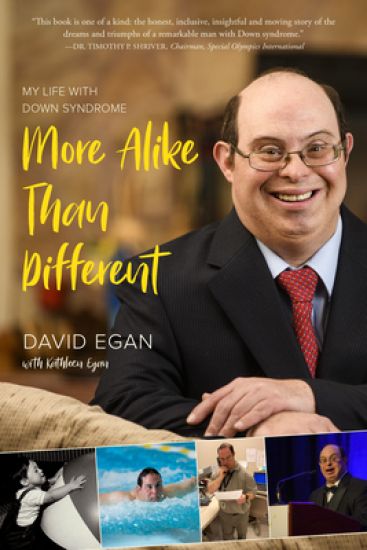
More Alike Than Different

More Alike Than Different

David Egan; Kathleen Egan

Prometheus Books
2020
sidottu
The first memoir written by a person with Down syndrome In this inspiring memoir, David Egan tells his own story, authentically describing a life of maximizing his abilities, as he advocates for himself and for all other people with disabilities. This book is yet another first in a life that has seen many firsts, a life buoyed by an optimistic perspective that refuses to be limited by stereotypes and the low expectations of others. As he says in the introduction, "You see there is an upside to Down. It has made me look at the words 'abilities' and 'disabilities' in a very different way than most of the world. A better way. A more inclusive way. A smarter way. I use the word 'smarter' very deliberately because one of the biggest perceptions of people with intellectual disabilities is that we are not smart." You will be quickly disabused of this faulty notion as you read David's impressive story. He has worked for more than twenty years for prestigious companies; he sits on the boards of two important advocacy organizations; he has addressed thousands of people as an advocate for people with disabilities; and he has competed in the Special Olympics. In describing his personal challenges and goals, he also conveys valuable lessons that apply to all people: the importance of a supporting family and friends; the need for others to see him and other people with disabilities as persons first, not just as examples of a diagnosis; the power of inclusion in school settings and community activities; the encouraging role that sports can play; the need for society to focus on our shared humanity despite differences; how to allow yourself to dream and to imagine possibilities; and much more. Concluding with an action plan detailing how individuals can discover their own abilities and how society can nurture those abilities, this is a book of hope that will encourage everyone to make the most of their lives.
Restoring Power and Democracy Back To The People: Beyond Trump, Brexit, Populism, Manufactured Wars and Terrorism, Economic Bubbles and Crashes, Money
Today's world has become dominated by: - Brexit and EU divisions and fragmentation- The rise of Populism of the left and right worldwide, and the distrust of elites and their policies which serve themselves- Federalism and the desire to centralise power and take it away from nations and peoples- Globalism VS Nationalism and Democracy- Massive bail outs of banks, bondholders, speculators and fraudsters by taxpayers costing trillions of dollars globally which is enforced by government austerity policies and the build up of massive government debt- Banking frauds and money creation frauds and accompanying debt which fuel speculative bubbles and crashes- Failed Economic Policies which worsen deflation and recessions- The build up of excessive private debt, business debt, and government debt which severely limits growth and progress- Globalisation and it's race to the bottom, combined with automation and new technologies replacing humans. Loss of millions of jobs.- Growing levels of unemployment and under-employment, and declining real wages for over 20 years- High and growing concentrations of wealth and income in many countries- Unaffordable housing and the housing crisis. The homeless crisis- Political corruption and Legal system corruption which is destroying freedom and democracy- The healthcare crisis- Wars and 'regime changes' accompanied by whole industries which profit from war, terrorism and destruction. The accompanying refugee and immigration disaster and its effect on many countries. The world in the first decades of the 21st century faces many unique, unprecedented and quite daunting challenges. This book proposes deep and profound changes to economics, politics, government, laws, banking, business, international relations, the press, and societies.This book is very different to other books. It examines: a) What are the problems and what are their causes ? What constitutes causality ? and what are the causal factors involved ? How do we deconstruct causality and the causal factors behind this disorder and chaos ? what are the dynamics, the driving factors, the hidden forces and the relationships ? b)What are the solutions based on causality, the causal factors behind these problems ? what constitutes rights and the responsibilities attached to rights ? and how are these rights and responsibilities linked to causality, and to the problems, disorder and chaos confronting countries and the world ? how do we apply responsibilities and the lessons of causality to create new more effective solutions. This will involve very new and innovative solutions which address the root causes of problems, and include: - Economic Democracy and much wider wealth and income distribution as a means to democratise real power and democratise capitalism- The ending of debt enslavement at private, business and government levels- National sovereignty and freedom- Fairer tax systems which tax economic rents, rentiers, speculation and tackle tax havens. And reduce taxes on productive investment and workers- Democratisation of banking, credit, and money creation and prioritisation of funding for productive investment, infrastructure, employee ownership, and consumption instead of speculation- New regulations & oversights of financial systems to prevent bubbles and crashes, banking corruption- Reforms to end political corruption and police & legal system corruption. Completely new checks and balances to power and new forms of accountability- New housing and land reforms to end homelessness- The provision of affordable healthcare and more efficient and effective health systems- An end to the war and terrorist machine, and refugee disasters- Environmental protection- Measures to overcome artificial divisions, hatreds, discrimination between peoples
The Pursuit of an Authentic Philosophy

The Pursuit of an Authentic Philosophy

David Egan

Oxford University Press
2019
sidottu
Superficially, Wittgenstein and Heidegger seem worlds apart: they worked in different philosophical traditions, seemed mostly ignorant of one another's work, and Wittgenstein's terse aphorisms in plain language could not be farther stylistically from Heidegger's difficult prose. Nevertheless, Wittgenstein's Philosophical Investigations and Heidegger's Being and Time share a number of striking parallels. In particular, this book shows that both authors manifest a similar concern with authenticity. David Egan develops this position in three stages. Part One explores the emphasis both philosophers place on the everyday, and how this emphasis brings with it a methodological focus on recovering what we already know rather than advancing novel theses. Part Two argues that the dynamic of authenticity and inauthenticity in Being and Time finds homologies in Philosophical Investigations. Here Egan particularly articulates and defends a conception of authenticity in Wittgenstein that emphasizes the responsiveness and reciprocity of play. Part Three considers how both philosophers' conceptions of authenticity apply reflexively to their own work: each is concerned not only with the question of what it means to exist authentically but also with the question of what it means to do philosophy authentically. For both authors, the problematic of authenticity is intimately linked to the question of philosophical method.
New World Disorder: Lessons from Brexit, The Trump Factor, Populism, Wars, Terrorism, '1984' and The Matrix, Economic Bubbles and Crashes.
Today's world has become dominated by: - Brexit and EU divisions and fragmentation- The rise of Populism of the left and right worldwide, and the distrust of elites and their policies which serve themselves- Globalism VS Nationalism and Democracy- Federalism and the desire to centralise power and take it away from nations and peoples- Massive bail outs of banks, bondholders, speculators and fraudsters by taxpayers costing trillions of dollars globally which is enforced by government austerity policies and the build up of massive government debt- Banking frauds and money creation frauds and accompanying debt which fuel speculative bubbles and crashes- Failed Economic Policies which worsen deflation and recessions- The build up of excessive private debt, business debt, and government debt which severely limits growth and progress- Globalisation and it's race to the bottom, combined with automation and new technologies replacing humans. Loss of millions of jobs.- Growing levels of unemployment and under-employment, and declining real wages for over 20 years- High and growing concentrations of wealth and income in many countries- Unaffordable housing and the housing crisis. The homeless crisis- Political corruption and Legal system corruption which is destroying freedom and democracy- The healthcare crisis- Wars and 'regime changes' accompanied by whole industries which profit from war, terrorism and destruction. The accompanying refugee and immigration disaster and its effect on many countries. The world in the first decades of the 21st century faces many unique, unprecedented and quite daunting challenges. This book proposes deep and profound changes to economics, politics, government, laws, banking, business, international relations, the press, and societies.This book is very different to other books. It examines: a) What are the problems and what are their causes ? What constitutes causality ? and what are the causal factors involved ? How do we deconstruct causality and the causal factors behind this disorder and chaos ? what are the dynamics, the driving factors, the hidden forces and the relationships ? b)What are the solutions based on causality, the causal factors behind these problems ? what constitutes rights and the responsibilities attached to rights ? and how are these rights and responsibilities linked to causality, and to the problems, disorder and chaos confronting countries and the world ? how do we apply responsibilities and the lessons of causality to create new more effective solutions. This will involve very new and innovative solutions which address the root causes of problems, and include: - Economic Democracy and much wider wealth and income distribution as a means to democratise real power and democratise capitalism- The ending of debt enslavement at private, business and government levels-National sovereignty and freedom- Fairer tax systems which tax economic rents, rentiers, speculation and tackle tax havens. And reduce taxes on productive investment and workers- Democratisation of banking, credit, and money creation and prioritisation of funding for productive investment, infrastructure, employee ownership, and consumption instead of speculation- New regulations & oversights of financial systems to prevent bubbles and crashes, banking corruption- Reforms to end political corruption and police & legal system corruption. Completely new checks and balances to power and new forms of accountability- New housing and land reforms to end homelessness- The provision of affordable healthcare and more efficient and effective health systems- An end to the war and terrorist machine, and refugee disasters- Environmental protection- Measures to overcome artificial divisions, hatreds, discrimination between peoples
Architectural Acoustics

Architectural Acoustics

David Egan

J Ross Publishing
2007
nidottu
The goal of this widely used book is to present in a highly illustrated format the principles of design for good hearing and freedom from noise in and around buildings. The more than 540 illustrations are not merely supplements to the text as with nearly all traditional books. In this book, the illustrations are the core of the coverage of basic principles of sound and hearing, sound absorption and noise reduction, sound isolation and criteria for noise, control of HVAC systems noise and vibrations, auditorium acoustics design, and electronic sound systems.The book is written for architects, interior designers, engineers, and all others concerned with the design and construction of buildings who need to know the basics of architectural acoustics, but who do not have the time to digest wordy presentations. Designers who understand the basic principles of acoustics will possess an important new tool for shaping the built environment. Hopefully, not only better acoustical environments, but also better buildings should result.