Kirjojen hintavertailu. Mukana 12 595 353 kirjaa ja 12 kauppaa.

Kirjailija

David Gottlieb

Kirjat ja teokset yhdessä paikassa: 8 kirjaa, julkaisuja vuosilta 1967-2012, suosituimpien joukossa Mechanism of Action. Vertaile teosten hintoja ja tarkista saatavuus suomalaisista kirjakaupoista.

8 kirjaa

Kirjojen julkaisuhaarukka 1967-2012.

Mechanism of Action

Mechanism of Action

David Gottlieb; Paul D. Shaw

Springer-Verlag Berlin and Heidelberg GmbH Co. K
2012
nidottu
The idea for publishing these books on the mechanism of action and on the biosynthesis of antibiotics was born of frustration in our attempts to keep abreast of the literature. Gone were the years when we were able to keep a biblio­ graphy on antibiotics and feel confident that we could find everything that was being published on this subject. These fields of investigation were moving for­ ward so rapidly and were encompassing so wide a range of specialized areas in microbiology and chemistry that it was almost impossible to keep abreast of developments. In our naivete and enthusiasm, however, we were unaware that we were toying with an idea that might enmesh us, that we were creating an entity with a life of its own, that we were letting loose a Golom who instead of being our servant would be our master. That we set up ideals for these books is obvious; they would be current guides to developments and information in the areas of mechanism of action and bio­ synthesis of antibiotics. For almost every subject, we wished to enlist the aid of an investigator who himself had played a part in determining the nature of the phenomena that were being discussed. One concept for the books was that they include only antibiotics for which a definitive, well-documented mechanism of action or biosynthetic pathway was known.
Biosynthesis

Biosynthesis

David Gottlieb; Paul Dale Shaw

Springer-Verlag Berlin and Heidelberg GmbH Co. K
2012
nidottu
The idea for publishing these books on the mechanism of action and on the biosynthesis of antibiotics was born of frustration in our attempts to keep abreast of the literature. Gone were the years when we were able to keep a biblio­ graphy on antibiotics and feel confident that we could find everything that was being published on this subject. These fields of investigation were moving for­ ward so rapidly and were encompassing so wide a range of specialized areas in microbiology and chemistry that it was almost impossible to keep abreast of developments. In our naivete and enthusiasm, however, we were unaware that we were toying with an idea that might enmesh us, that we were creating an entity with a life of its own, that we were letting loose a Golom who instead of being our servant would be our master. That we set up ideals for these books is obvious; they would be current guides to developments and information in the areas of mechanism of action and bio­ synthesis of antibiotics. For almost every subject, we wished to enlist the aid of an investigator who himself had played a part in determining the nature of the phenomena that were being discussed. One concept for the books was that they include only antibiotics for which a definitive, well-documented mechanism of action or biosynthetic pathway was known.
Spectral Methods for Time-Dependent Problems

Spectral Methods for Time-Dependent Problems

Jan S. Hesthaven; Sigal Gottlieb; David Gottlieb

Cambridge University Press
2007
sidottu
Spectral methods are well-suited to solve problems modeled by time-dependent partial differential equations: they are fast, efficient and accurate and widely used by mathematicians and practitioners. This class-tested 2007 introduction, the first on the subject, is ideal for graduate courses, or self-study. The authors describe the basic theory of spectral methods, allowing the reader to understand the techniques through numerous examples as well as more rigorous developments. They provide a detailed treatment of methods based on Fourier expansions and orthogonal polynomials (including discussions of stability, boundary conditions, filtering, and the extension from the linear to the nonlinear situation). Computational solution techniques for integration in time are dealt with by Runge-Kutta type methods. Several chapters are devoted to material not previously covered in book form, including stability theory for polynomial methods, techniques for problems with discontinuous solutions, round-off errors and the formulation of spectral methods on general grids. These will be especially helpful for practitioners.
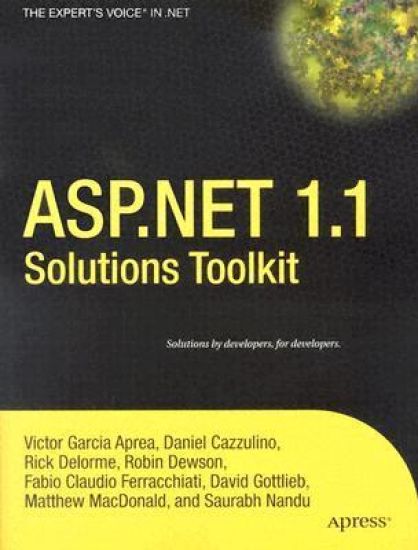
ASP.NET 1.1 Solutions Toolkit

ASP.NET 1.1 Solutions Toolkit

Matthew MacDonald; Victor Garcia Aprea; Robin Dewson; Saurabh Nandu; Richard Delorme; Daniel Cazzulino; Fabio Claudio Ferracchiati; David Gottlieb

APress
2005
nidottu
This collection of reusable ASP.NET components serves two purposes. First, the components are ready to use, so you may add exciting features to your own ASP.NET websites. Second, each component's design and implementation is discussed, and you’ll discover tips and tricks applicable for developing your own controls. Controls can be “cut and pasted” or used as templates for you to build your own controls. And the fifteen included controls (programs) cover a broad range of situations, providing you both working coded solutions to your problem and the rationalization behind those solutions. Overall, this highly anticipated book provides immediate solutions to range of common problems.
Numerical Analysis of Spectral Methods

Numerical Analysis of Spectral Methods

David Gottlieb; Steven A. Orszag

Society for Industrial Applied Mathematics,U.S.
1977
pokkari
A unified discussion of the formulation and analysis of special methods of mixed initial boundary-value problems. The focus is on the development of a new mathematical theory that explains why and how well spectral methods work. Included are interesting extensions of the classical numerical analysis.