Kirjojen hintavertailu. Mukana 12 595 353 kirjaa ja 12 kauppaa.

Kirjailija

David H. Owens

Kirjat ja teokset yhdessä paikassa: 5 kirjaa, julkaisuja vuosilta 1992-2025, suosituimpien joukossa Stability Analysis for Linear Repetitive Processes. Vertaile teosten hintoja ja tarkista saatavuus suomalaisista kirjakaupoista.

5 kirjaa

Kirjojen julkaisuhaarukka 1992-2025.

Control Systems Theory and Applications for Linear Repetitive Processes

Control Systems Theory and Applications for Linear Repetitive Processes

Eric Rogers; Krzysztof Galkowski; David H. Owens

Springer-Verlag Berlin and Heidelberg GmbH Co. K
2007
nidottu
After motivating examples, this monograph gives substantial new results on the analysis and control of linear repetitive processes. These include further applications of the abstract model based stability theory which, in particular, shows the critical importance to the dynamics developed of the structure of the initial conditions at the start of each new pass, the development of stability tests and performance bounds in terms of so-called 1D and 2D Lyapunov equations. It presents the development of a major bank of results on the structure and design of control laws, including the case when there is uncertainty in the process model description, together with numerically reliable computational algorithms. Finally, the application of some of these results in the area of iterative learning control is treated --- including experimental results from a chain conveyor system and a gantry robot system.
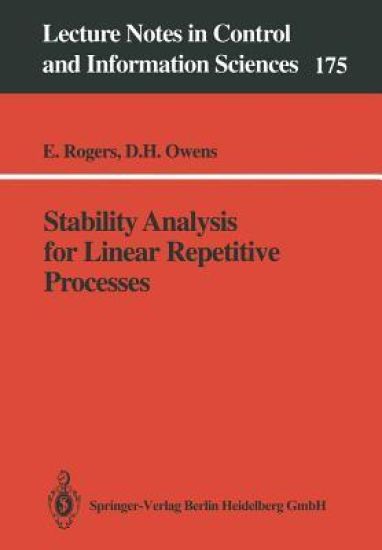
Stability Analysis for Linear Repetitive Processes

Stability Analysis for Linear Repetitive Processes

Eric Rogers; David H. Owens

Springer-Verlag Berlin and Heidelberg GmbH Co. K
1992
nidottu
Industrial processes such as long-wall coal cutting and me- tal rolling, together with certain areas of 2D signal and image processing, exhibit a repetitive, or multipass struc- ture characterized by a series of sweeps of passes through a known set of dynamics. The output, or pass profile, produced on each pass explicitly contributes to that produced on the text. This interpass interaction can lead to the growth of oscillations, and hence a form of instability, in the se- quence of pass profiles which require control strategies that explicitly incorporate the essential repetitive struc- ture of the process in their decision making. This monograph is unique in developing the new techniques necessary for sy- stematic control systems design in the form of a stability theory and computationally feasible stability tests based on finite simulations and polynomial analysis. Its development requires a basic knowledge of linear frequency domain and state-space theory and a knowledge of basic functional ana- lysis would be beneficial. The text is aimed at researchers in the area of control and systems theory and should also be of interest to those working in the related area of signal and image processing.
Optimal Iterative Learning Control

Optimal Iterative Learning Control

Bing Chu; David H. Owens

Springer International Publishing AG
2025
sidottu
This book introduces an optimal iterative learning control (ILC) design framework from the end user's point of view. Its central theme is the understanding of model dynamics, the construction of a procedure for systematic input updating and their contribution to successful algorithm design. The authors discuss the many applications of ILC in industrial systems, applications such as robotics and mechanical testing. The text covers a number of optimal ILC design methods, including gradient-based and norm-optimal ILC. Their convergence properties are described and detailed design guidelines, including performance-improvement mechanisms, are presented. Readers are given a clear picture of the nature of ILC and the benefits of the optimization-based approach from the conceptual and mathematical foundations of the problem of algorithm construction to the impact of available parameters in making acceleration of algorithmic convergence possible. Three case studies on robotic platforms, an electro-mechanical machine, and robot-assisted stroke rehabilitation are included to demonstrate the application of these methods in the real-world. With its emphasis on basic concepts, detailed design guidelines and examples of benefits, Optimal Iterative Learning Control will be of value to practising engineers and academic researchers alike.
Iterative Learning Control

Iterative Learning Control

David H. Owens

Springer London Ltd
2016
nidottu
This book develops a coherent and quite general theoretical approach to algorithm design for iterative learning control based on the use of operator representations and quadratic optimization concepts including the related ideas of inverse model control and gradient-based design.Using detailed examples taken from linear, discrete and continuous-time systems, the author gives the reader access to theories based on either signal or parameter optimization. Although the two approaches are shown to be related in a formal mathematical sense, the text presents them separately as their relevant algorithm design issues are distinct and give rise to different performance capabilities. Together with algorithm design, the text demonstrates the underlying robustness of the paradigm and also includes new control laws that are capable of incorporating input and output constraints, enable the algorithm to reconfigure systematically in order to meet the requirements of different reference and auxiliary signals and also to support new properties such as spectral annihilation. Iterative Learning Control will interest academics and graduate students working in control who will find it a useful reference to the current status of a powerful and increasingly popular method of control. The depth of background theory and links to practical systems will be of use to engineers responsible for precision repetitive processes.
Iterative Learning Control

Iterative Learning Control

David H. Owens

Springer London Ltd
2015
sidottu
This book develops a coherent and quite general theoretical approach to algorithm design for iterative learning control based on the use of operator representations and quadratic optimization concepts including the related ideas of inverse model control and gradient-based design.Using detailed examples taken from linear, discrete and continuous-time systems, the author gives the reader access to theories based on either signal or parameter optimization. Although the two approaches are shown to be related in a formal mathematical sense, the text presents them separately as their relevant algorithm design issues are distinct and give rise to different performance capabilities. Together with algorithm design, the text demonstrates the underlying robustness of the paradigm and also includes new control laws that are capable of incorporating input and output constraints, enable the algorithm to reconfigure systematically in order to meet the requirements of different reference and auxiliary signals and also to support new properties such as spectral annihilation. Iterative Learning Control will interest academics and graduate students working in control who will find it a useful reference to the current status of a powerful and increasingly popular method of control. The depth of background theory and links to practical systems will be of use to engineers responsible for precision repetitive processes.