Kirjojen hintavertailu. Mukana 12 390 323 kirjaa ja 12 kauppaa.

Kirjailija

David Harrison

Kirjat ja teokset yhdessä paikassa: 62 kirjaa, julkaisuja vuosilta 1988-2025, suosituimpien joukossa The Melancholy Narrative of the Distressful Voyage and Miraculous Deliverance. Vertaile teosten hintoja ja tarkista saatavuus suomalaisista kirjakaupoista.

62 kirjaa

Kirjojen julkaisuhaarukka 1988-2025.

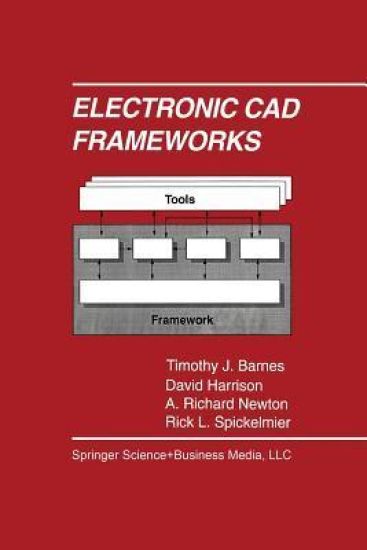
Electronic CAD Frameworks

Electronic CAD Frameworks

Timothy J. Barnes; David Harrison; A. Richard Newton; Rick L. Spickelmier

Springer-Verlag New York Inc.
2012
nidottu
When it comes to frameworks, the familiar story of the elephant and the six blind philosophers seems to apply. As each philoso­ pher encountered a separate part of the elephant, each pronounced his considered, but flawed judgement. One blind philosopher felt a leg and thought it a tree. Another felt the tail and thought he held a rope. Another felt the elephant's flank and thought he stood before a wall. We're supposed to learn about snap judgements from this alle­ gory, but its author might well have been describing design automation frameworks. For in the reality of today's product development requirements, a framework must be many things to many people. xiv CAD Frameworks: Integration Technology for CAD As the authors of this book note, framework design is an optimi­ zation problem. Somehow, it has to be both a superior rope for one and a tremendous tree for another. Somehow it needs to provide a standard environment for exploiting the full potential of computer-aided engineering tools. And, somehow, it has to make real such abstractions as interoperability and interchangeability. For years, we've talked about a framework as something that provides application-oriented services, just as an operating system provides system-level support. And for years, that simple statement has hid the tremendous complexity of actually providing those services.
Children, their World, their Education

Children, their World, their Education

Robin Alexander; Michael Armstrong; Julia Flutter; Linda Hargreaves; David Harrison; Wynne Harlen; Elizabeth Hartley-Brewer; Ruth Kershner; John MacBeath; Berry Mayall; Stephanie Northen; Gillian Pugh; Colin Richards; David Utting

Routledge
2009
sidottu
Children, their World, their Education is the definitive text for students, teachers, researchers, educational leaders and all who are interested in primary education. As the culmination of the Cambridge Primary Review, the most comprehensive enquiry into English primary education for half a century, its publication provoked instant and dramatic headlines. Widespread support from teachers and eminent public figures demonstrated that the book had identified the issues that really mattered. Ministerial unease showed that here were findings that politicians could not ignore.But Children, their World, their Education is much more than a report. It is an unrivalled educational compendium that systematically covers the issues that are central to the daily work of students, teachers and heads. For trainee teachers on undergraduate and postgraduate courses it effectively maps the territory of primary education and provides the context, information and insight which are essential to the development of classroom skill. Its vast range of carefully evaluated evidence makes it a core resource for those undertaking research and advanced study. Its direct engagement with the policy process during a period of unprecedented change makes it an indispensable tool for policy analysis. It places England’s education system in the global context, and combines evidence on recent developments with a vision of how primary education should be.Part 1 sets the scene and tracks primary education policy since the 1960s.Part 2 examines children’s development and learning, their needs and aspirations, and their lives in a diverse society and fragile world.Part 3 explores what goes on in schools, from the vital early years to educational aims and values, the curriculum, pedagogy and classroom practice, assessment, standards and school organisation.Part 4 deals with the system as a whole: educational ages and stages, the work and training of primary teachers, school leadership, local authorities, funding, governance and policy.Part 5 pulls everything together with 78 conclusions and 75 recommendations for policy and practice.Companion volume: The Cambridge Primary Review Research Surveys, edited by Robin Alexander with Christine Doddington, John Gray, Linda Hargreaves and Ruth Kershner. The Cambridge Primary Review is supported by Esmée Fairbairn Foundation: www.primaryreview.org.uk.
Children, their World, their Education

Children, their World, their Education

Robin Alexander; Michael Armstrong; Julia Flutter; Linda Hargreaves; David Harrison; Wynne Harlen; Elizabeth Hartley-Brewer; Ruth Kershner; John MacBeath; Berry Mayall; Stephanie Northen; Gillian Pugh; Colin Richards; David Utting

Routledge
2009
nidottu
Children, their World, their Education is the definitive text for students, teachers, researchers, educational leaders and all who are interested in primary education. As the culmination of the Cambridge Primary Review, the most comprehensive enquiry into English primary education for half a century, its publication provoked instant and dramatic headlines. Widespread support from teachers and eminent public figures demonstrated that the book had identified the issues that really mattered. Ministerial unease showed that here were findings that politicians could not ignore.But Children, their World, their Education is much more than a report. It is an unrivalled educational compendium that systematically covers the issues that are central to the daily work of students, teachers and heads. For trainee teachers on undergraduate and postgraduate courses it effectively maps the territory of primary education and provides the context, information and insight which are essential to the development of classroom skill. Its vast range of carefully evaluated evidence makes it a core resource for those undertaking research and advanced study. Its direct engagement with the policy process during a period of unprecedented change makes it an indispensable tool for policy analysis. It places England’s education system in the global context, and combines evidence on recent developments with a vision of how primary education should be.Part 1 sets the scene and tracks primary education policy since the 1960s.Part 2 examines children’s development and learning, their needs and aspirations, and their lives in a diverse society and fragile world.Part 3 explores what goes on in schools, from the vital early years to educational aims and values, the curriculum, pedagogy and classroom practice, assessment, standards and school organisation.Part 4 deals with the system as a whole: educational ages and stages, the work and training of primary teachers, school leadership, local authorities, funding, governance and policy.Part 5 pulls everything together with 78 conclusions and 75 recommendations for policy and practice.Companion volume: The Cambridge Primary Review Research Surveys, edited by Robin Alexander with Christine Doddington, John Gray, Linda Hargreaves and Ruth Kershner. The Cambridge Primary Review is supported by Esmée Fairbairn Foundation: www.primaryreview.org.uk.
The Bridges of Medieval England

The Bridges of Medieval England

David Harrison

Oxford University Press
2007
nidottu
Medieval bridges are startling achievements of design and engineering comparable with the great cathedrals of the period, and are also proof of the great importance of road transport in the middle ages and of the size and sophistication of the medieval economy. David Harrison rewrites their history from early Anglo-Saxon England right up to the Industrial Revolution, providing new insights into many aspects of the subject. Looking at the role of bridges in the creation of a new road system, which was significantly different from its Roman predecessor and which largely survived until the twentieth century, he examines their design. Often built in the most difficult circumstances: broad flood plains, deep tidal waters, and steep upland valleys, they withstood all but the most catastrophic floods. He also investigates the immense efforts put into their construction and upkeep, ranging from the mobilization of large work forces by the old English state to the role of resident hermits and the charitable donations which produced bridge trusts with huge incomes. The evidence presented in The Bridges of Medieval England shows that the network of bridges, which had been in place since the thirteenth century, was capable of serving the needs of the economy on the eve of the Industrial Revolution. This has profound implications for our understanding of pre-industrial society, challenging accepted accounts of the development of medieval trade and communications, and bringing to the fore the continuities from the late Anglo-Saxon period to the eighteenth century. This book is essential reading for those interested in architecture, engineering, transport, and economics, and any historian sceptical about the achievements of medieval England.
The Bridges of Medieval England

The Bridges of Medieval England

David Harrison

Clarendon Press
2004
sidottu
Medieval bridges are startling achievements of design and engineering comparable with the great cathedrals of the period, and are also proof of the great importance of road transport in the middle ages and of the size and sophistication of the medieval economy. Dr Harrison has undertaken the first thorough study of bridges and in this book he rewrites their history from early Anglo-Saxon England right up to the Industrial Revolution, providing new insights into many aspects of the subject. Dr Harrison looks at the role of bridges in the creation of a new road system, which was significantly different from its Roman predecessor and which largely survived until the twentieth century. He examines the design of bridges, which were built in the most difficult circumstances - broad flood plains, deep tidal waters, and steep upland valleys - and withstood all but the most catastrophic floods. He also investigates the immense efforts put into their construction and upkeep, ranging from the mobilization of large work forces by the old English state to the role of resident hermits and the charitable donations which produced bridge trusts with huge incomes. The evidence presented in The Bridges of Medieval England shows that the network of bridges, which had been in place since the thirteenth century, was capable of serving the needs of the economy on the eve of the Industrial Revolution. This has profound implications for our understanding of pre-industrial society, challenging accepted accounts of the development of medieval trade and communications, and bringing to the fore the continuities from the late Anglo-Saxon period to the eighteenth century. This book is essential reading for those interested in architecture, engineering, transport, and economics, and any historian sceptical about the achievements of medieval England.
"Bristol Times" Revisited

"Bristol Times" Revisited

David Harrison

NPI Media Group
2003
nidottu
This book is part of the Changing Times series, which combines history records with nostalgia, and public accounts with personal reminiscences to show the history of various local places in Great Britain, and how things have changed over the years.
Bristol Remembered

Bristol Remembered

David Harrison

NPI Media Group
2002
nidottu
This book is part of the Changing Times series, which combines history records with nostalgia, and public accounts with personal reminiscences to show the history of various local places in Great Britain, and how things have changed over the years.
Zur Vorteilhaftigkeit Von Aktiensplits

Zur Vorteilhaftigkeit Von Aktiensplits

David Harrison

Peter Lang AG
2000
nidottu
Aktiensplits wurden und werden in grosser Zahl am deutschen Aktienmarkt durchgefuhrt. Es ist unstrittig, dass die Durchfuhrung von Aktiensplits Kosten verursacht. Diese Kosten mussen letztlich von den Aktionaren getragen werden. Es stellt sich daher die Frage: Welche Vorteile stehen diesen Kosten gegenuber? Die Arbeit versucht auf diese Frage theoretisch und empirisch eine Antwort zu geben. Dazu werden die erwarteten Vorteile von Aktiensplits anhand von Befragungen ermittelt. Daruber hinaus werden die tatsachlichen Auswirkungen von Aktiensplits auf die Rendite, das Risiko und die Liquiditat am Aktienmarkt untersucht. Die Ergebnisse dieser Arbeit lassen Aktiensplits in einem anderen Licht erscheinen als bislang in der Literatur vermutet.