Kirjojen hintavertailu. Mukana 12 595 353 kirjaa ja 12 kauppaa.

Kirjailija

David Held

Kirjat ja teokset yhdessä paikassa: 36 kirjaa, julkaisuja vuosilta 1980-2019, suosituimpien joukossa Kosmopolitism : ideal och verklighet. Vertaile teosten hintoja ja tarkista saatavuus suomalaisista kirjakaupoista.

36 kirjaa

Kirjojen julkaisuhaarukka 1980-2019.

Models of Democracy, 3rd Edition

Models of Democracy, 3rd Edition

David Held

Stanford University Press
2006
pokkari
In a succinct and far-reaching analysis, David Held provides an introduction to major theories of democracy from classical Greece to the present, along with a critical discussion of what democracy should mean today. This new edition has been extensively revised and updated to take into account significant transformations in world politics. A new chapter on deliberative democracy has been added, which focuses on how citizen participation can be increased in politics, and how that participation can become more informed. Like its predecessor, the third edition of Models of Democracy combines lucid exposition and clarity of expression with careful scholarship and originality, making it highly attractive to students and experts in the field. The third edition will prove essential reading for all those interested in politics, political theory, and political philosophy. Praise for the second edition: "Held's new book on models of democracy is itself a model of its kind—a meticulously edited, easily accessible, and clearly signposted critical analysis of theories of democracy from classical antiquity to the present day."—Ethics "In this timely and thought-provoking study, Held provides a critical reassessment of major theories of democracy from ancient Greece to the present, along with his own prescription for revitalizing contemporary democratic politics. . . . This volume should be read and pondered by anyone interested in the future of democracy."—The Annals

Models of Democracy

Models of Democracy

David Held

Stanford University Press
2006
sidottu
In a succinct and far-reaching analysis, David Held provides an introduction to major theories of democracy from classical Greece to the present, along with a critical discussion of what democracy should mean today. This new edition has been extensively revised and updated to take into account significant transformations in world politics. A new chapter on deliberative democracy has been added, which focuses on how citizen participation can be increased in politics, and how that participation can become more informed. Like its predecessor, the third edition of "Models of Democracy" combines lucid exposition and clarity of expression with careful scholarship and originality, making it highly attractive to students and experts in the field. The third edition will prove essential reading for all those interested in politics, political theory, and political philosophy.
Models of Democracy

Models of Democracy

David Held

Polity Press
2006
nidottu
The first two editions of Models of Democracy have proven immensely popular among students and specialists worldwide. In a succinct and far-reaching analysis, David Held provides an introduction to central accounts of democracy from classical Greece to the present and a critical discussion of what democracy should mean today. This new edition has been extensively revised and updated to take account of significant transformations in world politics, and a new chapter has been added on deliberative democracy which focuses not only on how citizen participation can be increased in politics, but also on how that participation can become more informed. Like its predecessor, the third edition of Models of Democracy combines lucid exposition and clarity of expression with careful scholarship and originality, making it highly attractive to students and experts in the field. The third edition will prove essential reading for all those interested in politics, political theory and political philosophy. A companion website to Models of Democracy provides lecturer and student resources; including a study guide, an interview with the author and links to develop the reader's understanding of the topics covered.
Models of Democracy

Models of Democracy

David Held

Polity Press
2006
sidottu
The first two editions of Models of Democracy have proven immensely popular among students and specialists worldwide. In a succinct and far-reaching analysis, David Held provides an introduction to central accounts of democracy from classical Greece to the present and a critical discussion of what democracy should mean today. This new edition has been extensively revised and updated to take account of significant transformations in world politics, and a new chapter has been added on deliberative democracy which focuses not only on how citizen participation can be increased in politics, but also on how that participation can become more informed. Like its predecessor, the third edition of Models of Democracy combines lucid exposition and clarity of expression with careful scholarship and originality, making it highly attractive to students and experts in the field. The third edition will prove essential reading for all those interested in politics, political theory and political philosophy. A companion website to Models of Democracy provides lecturer and student resources; including a study guide, an interview with the author and links to develop the reader's understanding of the topics covered.
Global Covenant

Global Covenant

David Held

Polity Press
2004
nidottu
In this pathbreaking book, one of the world’s leading analysts of globalization and global governance confronts the failures of international politics in the aftermath of 9/11 and the war against Iraq. He argues that there were and are alternatives to the way the western coalitions responded to the profound challenges of mass terrorism and political violence - alternatives which can better address the roots of these challenges and deliver political and social justice. In order to grasp this alternative, the changing structure of the global order has to be understood. To this end, the book is divided into three sections: economics, politics and law. In each section contemporary trends are analyzed, problems confronted, and a series of detailed policies set out. The aim of the book is to focus on feasible and effective policy choices which could lead to a progressive transformation of global affairs. Against the ideologues who are wholly in favour or hostile to globalization, this book shows how globalization can be better regulated to deliver human development, equitable economic change, democracy and justice. This is an original book that will appeal to all those - students, policy makers, and the general reader - who confront questions about globalization and global governance. It is an optimistic text that holds that progressive political change is still within our grasp. To read the transcript of an interview with the author on the Global Covenant in democratiya, please click here .
Global Covenant

Global Covenant

David Held

Polity Press
2004
sidottu
In this pathbreaking book, one of the world’s leading analysts of globalization and global governance confronts the failures of international politics in the aftermath of 9/11 and the war against Iraq. He argues that there were and are alternatives to the way the western coalitions responded to the profound challenges of mass terrorism and political violence - alternatives which can better address the roots of these challenges and deliver political and social justice. In order to grasp this alternative, the changing structure of the global order has to be understood. To this end, the book is divided into three sections: economics, politics and law. In each section contemporary trends are analyzed, problems confronted, and a series of detailed policies set out. The aim of the book is to focus on feasible and effective policy choices which could lead to a progressive transformation of global affairs. Against the ideologues who are wholly in favour or hostile to globalization, this book shows how globalization can be better regulated to deliver human development, equitable economic change, democracy and justice. This is an original book that will appeal to all those - students, policy makers, and the general reader - who confront questions about globalization and global governance. It is an optimistic text that holds that progressive political change is still within our grasp. To read the transcript of an interview with the author on the Global Covenant in democratiya, please click here .
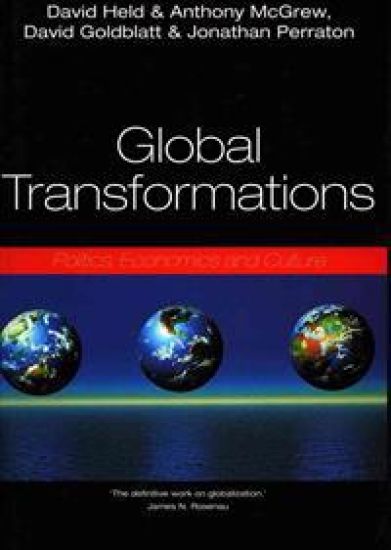
Global Transformations

Global Transformations

David Held; Anthony G. McGrew; David Goldblatt; Jonathan Perraton

Stanford University Press
1999
pokkari
In this book, the authors set forth a new model of globalization that lays claims to supersede existing models, and then use this model to assess the way the processes of globalization have operated in different historic periods in respect to political organization, military globalization, trade, finance, corporate productivity, migration, culture, and the environment. Each of these topics is covered in a chapter which contrasts the contemporary nature of globalization with that of earlier epochs. In mapping the shape and political consequences of globalization, the authors concentrate on six states in advanced capitalist societies (SIACS): the United States, the United Kingdom, Sweden, France, Germany, and Japan. For comparative purposes, other states—particularly those with developing economics—are referred to and discussed where relevant. The book concludes by systematically describing and assessing contemporary globalization, and appraising the implications of globalization for the sovereignty and autonomy of SIACS. It also confronts directly the political fatalism that surrounds much discussion of globalization with a normative agenda that elaborates the possibilities for democratizing and civilizing the unfolding global transformation.
Global Transformations

Global Transformations

David Held; Anthony McGrew; David Goldblatt; Jonathan Perraton

JOHN WILEY AND SONS LTD
1999
nidottu
An introduction to theoretical accounts and empirical descriptions of the global circumstances. The text provides a collection of data on the interrelatedness of "domestic" and "international" affairs, ranging across economics, culture and communications, migration, and environmental issues.
Demokratimodeller : från klassisk demokrati till demokratisk autonomi
Vad är demokrati? Vad innebär det att leva demokratiskt? Vad skulle demokrati kunna betyda för oss idag? I Demokratimodeller utforskar David Held dessa frågor. Han redogör för de olika demokratimodeller som finns och griper sig an ett antal olösta grundproblem för att slutligen utforska alternativa sätt att reflektera över demokrati i vår samtid. Till den nya upplagan har fogats ett nyskrivet kapitel om republikanismen, ett om den inverkan sovjetkommunismens fall haft på demokratin och ett kapitel om den demokratiska nationalstatens framtidsutsikter i ljuset av den snabba globaliseringen. Samtliga återstående kapitel har antingen omarbetats grundligt eller uppdaterats med hänsynstagande till nya teoretiska och historiska arbeten. »Det offentliga Sverige skulle må bra av lite ordentlig demokratidebatt. Därför är David Helds nyöversatta bok Demokratimodeller särskilt välkommen.» /Maria Wendt Höijer, GP
Democracy and the Global Order

Democracy and the Global Order

David Held

STANFORD UNIVERSITY PRESS
1995
sidottu
Democracy is the most potent political idea in the world today, yet the future of democracy is increasingly uncertain. Key assumptions of democratic thinking and practice are being undermined by diverse sites of social economic power on the one hand, and by dense networks of regional and global interconnectedness on the other. States and societies are enmeshed in webs of international conditions and processes as never before. Democracy and the Global Order offers a highly original and systematic account of these issues. Part I assesses the traditional conceptions of democracy. Part II traces the rise and displacement of the modern nation-state in the context of the interstate system and the world economy. Part III explores the theoretical bases of democracy and of the democratic state, and the profound changes these concepts must undergo if they are to retain their relevance in the century ahead. Finally. Part IV champions a "cosmopolitan" model of democracy—a new conception of democracy for a new world order.
Democracy and the Global Order

Democracy and the Global Order

David Held

Polity Press
1995
nidottu
Democracy is the most potent political idea in the world today, yet it is increasingly moribund in its traditional form. Distant localities are now more interlinked, as states and societies are enmeshed in webs of international conditions and processes. This is a systematic account of these issues.
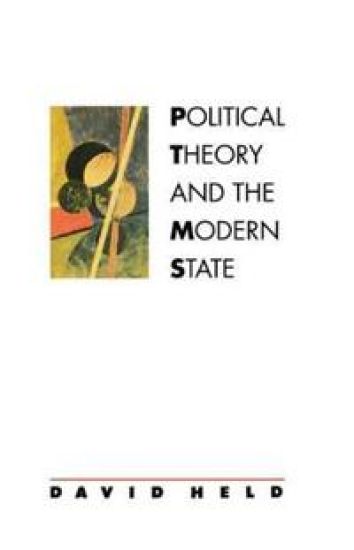
Political Theory and the Modern State
This volume offers an incisive overview of central issues and controversies in political thought and analysis. It includes major discussions of the idea of the modern state, contemporary theories of the state, problems of power and legitimation, new forms of democratic ideal, citizenship and social movements, the direction of public policy and the fate of sovereignty in the modern global system. While analysing these topics, the author critically assesses the thought of many of those who have contributed decisively to political discussion. Among those whose works are discussed are classic figures such as Hobbes, Locke, Mill and Marx, as well as contemporary writers such as Habermas, Offe and Giddens. Political Theory and the Modern State is an ideal resource for students seeking an introduction to modern politics and political sociology. It is also an original statement about the many competing perspectives in political thought today.
Introduction to Critical Theory

Introduction to Critical Theory

David Held

Polity Press
1989
nidottu
The writings of the Frankfurt school, in particular of Horkheimer, Adorno, Marcuse, and Jurgen Habermas, caught the imagination of the radical movements of the 1960s and 1970s and became a key element in the Marxism of the New Left. Partly due to their rise to prominence during the political turmoil of the 1960s, the work of these critical theorists has been the subject of continuing controversy in both political and academic circles. However, their ideas are frequently misunderstood. In this major work, now available from Polity Press, David Held presents a much-needed introduction to, and evaluation of, critical theory. Some of the major themes he considers are critical theory's relation to Marx's critique of political economy, Freudian psychoanalysis, aesthetics and the philosophy of history. There is also an extended discussion of critical theory's substantive contribution to the analysis of capitalism, culture, the family, the individual, as well as its contribution to epistemology and methodology.
Classes, Power and Conflict

Classes, Power and Conflict

Anthony Giddens; David Held

University of California Press
1982
pokkari
In recent years a remarkable range of new work has been produced dealing with class inequalities, the division of labor, and the state. In these writings scholars previously working in isolation from one another in sociology, economics, political science, and history have found common ground. Much of this work has been influenced by Marxist theory, but at the same time it has involved critiques of established Marxist views, and incorporated ideas drawn from other sources. These developments have until now not been reflected in existing course texts which are often diffusely concerned with 'social stratification' and lack reference to contemporary theory. "Classes, Power, and Conflict" breaks new ground in providing a comprehensive introduction to current debates and contemporary research. In also connects these to the classical sources, concentrating particularly on Marx, Lenin and Weber. The book therefore offers a comprehensive coverage of materials for students who have little or no prior acquaintance with the field. Each section of the book contains a substantial introduction, explaining and expanding on the themes of the selections contained within that section."Classes, Power, and Conflict" can be expected to become the standard text for courses in sociology and political science.
Introduction to Critical Theory

Introduction to Critical Theory

David Held

University of California Press
1980
pokkari
The writings of the critical theorists caught the imagination of students and intellectuals in the 1960s and 1970s. They became a key element in the formation and self-understanding of the New Left, and have been the subject of continuing controversy. Partly because of their rise to prominence during the political turmoil of the sixties, and partly because they draw on traditions rarely studied in the Anglo-American world, the works of these authors are often misunderstood. In this book David Held provides a much-needed introduction to, and evaluation of, critical theory. He is concerned mainly with the thought of the Frankfurt school - Horkheimer, Adorno, Marcuse, in particular - and with Habermas, one of Europe's leading contemporary thinkers.Several of the major themes considered are critical theory's relation to Marx's critique of the political economy, Freudian psychoanalysis, aesthetics, and the philosophy of history. There is also a discussion of critical theory's substantive contribution to the analysis of capitalism, culture, the family, and the individual, as well as its contribution to epistemology and methodology.Held's book will be necessary reading for all concerned with understanding and evaluating one of the most influential intellectual movements of our time.