
Kirjailija
David Hilbert
Kirjat ja teokset yhdessä paikassa: 53 kirjaa, julkaisuja vuosilta 1922-2025, suosituimpien joukossa Grundlagen der Mathematik I. Vertaile teosten hintoja ja tarkista saatavuus suomalaisista kirjakaupoista.
53 kirjaa
Kirjojen julkaisuhaarukka 1922-2025.

Stranded In Chicken: Backpacking The Americas By Bus, Prudhoe Bay To Antarctica
David Hilbert; David Rice
Soft Seat Travel Publications
2014
nidottu

Three Dialogues between Hylas and Philonous
George Berkeley; David Hilbert; John Perry
Arete Press
2013
nidottu
George Berkeley's philosophy of immaterialism is still influential three hundred years after the publication of his most widely read book, "Three Dialogues Between Hylas and Philonous". Berkeley published the "Dialogues" because of the unenthusiastic reception of his "Principles of Human Knowledge" in 1710. He hoped the use of the dialogue format would win a more favorable hearing, but unfortunately for Berkeley, the response was every bit as scathing as the reception of his previous work. In recent decades, however, Berkeley's work has been recognized as an excellent introduction to the English philosophy of the eighteenth century, and to philosophy in general. This edition of the dialogues is accessibly organized by David Hilbert and John Perry.
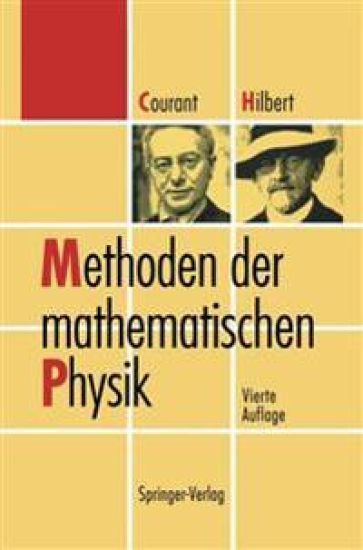
Methoden der mathematischen Physik
Richard Courant; David Hilbert
Springer-Verlag Berlin and Heidelberg GmbH Co. K
2012
nidottu
In diesem Buch, erstmals 1924 bzw. 1937 erschienen, spürt man noch wie am ersten Tag die Frische und Inspiration zweier großer Mathematiker und Lehrer. Hilbert kann man mit Fug und Recht als den letzten Mathematiker bezeichnen, der in allen Gebieten seiner Wissenschaft zu Hause war und in den verschiedensten Bereichen der Mathematik grundlegende neue Erkenntnisse gewann. Seine Resultate haben entscheidend die moderne Auffassung vom Wesen der Mathematik geprägt. Sein Schüler Courant galt und gilt auch heute noch als ein ausgezeichneter Lehrer, der auch schwierigste Materien verständlich darstellen konnte. Das bei Springer erschienene Buch von Courant/Robbins: Was ist Mathematik, kann in diesem Zusammenhang als beispielhaft genannt werden. Alles in allem eine großartige Zusammenfassung der mathematischen Hilfsmittel des Physikers, die auch heute noch viele enthusiastische Leser finden wird.

Grundzüge der Theoretischen Logik
David Hilbert; Wilhelm Ackermann
Springer-Verlag Berlin and Heidelberg GmbH Co. K
2011
nidottu
Die theoretische Logik, auch mathematische oder symbolische Logik genannt, ist eine Ausdehnung der fonnalen Methode der Mathematik auf das Gebiet der Logik. Sie wendet fUr die Logik eine ahnliche Fonnel- sprache an, wie sie zum Ausdruck mathematischer Beziehungen schon seit langem gebrauchlich ist. In der Mathematik wurde es heute als eine Utopie gelten, wollte man beim Aufbau einer mathematischen Disziplin sich nur der gewohnlichen Sprache bedienen. Die groBen Fortschritte, die in der Mathematik seit der Antike gemacht worden sind, sind zum wesentlichen Teil mit dadurch bedingt, daB es gelang, einen brauchbaren und leistungsfahigen Fonnalismus zu finden. - Was durch die Formel- sprache in der Mathematik erreicht wird, das solI auch in der theoretischen Logik durch diese erzielt werden, namlich eine exakte, wissenschaftliche Behandlung ihres Gegenstandes. Die logischen Sachverhalte, die zwischen Urteilen, Begriffen usw. bestehen, finden ihre Darstellung durch Formeln, deren Interpretation frei ist von den Unklarheiten, die beim sprachlichen Ausdruck leicht auftreten konnen. Der Dbergang zu logischen Folgerungen, wie er durch das SchlieBen geschieht, wird in seine letzten Elemente zerlegt und erscheint als fonnale Umgestaltung der Ausgangsfonneln nach gewissen Regeln, die den Rechenregeln in der Algebra analog sind; das logische Denken findet sein Abbild in einem LogikkalkUl. Dieser Kalkiil macht die erfolgreiche Inangriffnahme von Problemen moglich, bei denen das rein inhaltliche Denken prinzipiell versagt. Zu diesen gehort z. B.
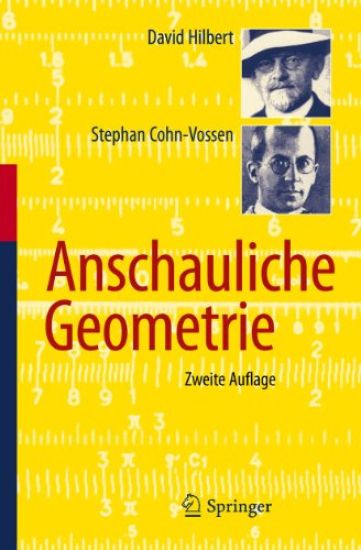
Anschauliche Geometrie
David Hilbert; Stephan Cohn-Vossen
Springer-Verlag Berlin and Heidelberg GmbH Co. K
2011
nidottu
Anschauliche Geometrie - wohl selten ist ein Mathematikbuch seinem Titel so gerecht geworden wie dieses außergewöhnliche Werk von Hilbert und Cohn-Vossen. Zuerst 1932 erschienen, hat das Buch nichts von seiner Frische und Kraft verloren. Hilbert hat sein erklärtes Ziel, die Faszination der Geometrie zu vermitteln, bei Generationen von Mathematikern erreicht. Aus Hilberts Vorwort: "Das Buch soll dazu dienen, die Freude an der Mathematik zu mehren, indem es dem Leser erleichtert, in das Wesen der Mathematik einzudringen, ohne sich einem beschwerlichen Studium zu unterziehen".

The Theory of Algebraic Number Fields
David Hilbert
Springer-Verlag Berlin and Heidelberg GmbH Co. K
2010
nidottu
Constance Reid, in Chapter VII of her book Hilbert, tells the story of the writing of the Zahlbericht, as his report entitled Die Theorie der algebra is chen Zahlkorper has always been known. At its annual meeting in 1893 the Deutsche Mathematiker-Vereinigung (the German Mathematical Society) invited Hilbert and Minkowski to prepare a report on the current state of affairs in the theory of numbers, to be completed in two years. The two mathematicians agreed that Minkowski should write about rational number theory and Hilbert about algebraic number theory. Although Hilbert had almost completed his share of the report by the beginning of 1896 Minkowski had made much less progress and it was agreed that he should withdraw from his part of the project. Shortly afterwards Hilbert finished writing his report on algebraic number fields and the manuscript, carefully copied by his wife, was sent to the printers. The proofs were read by Minkowski, aided in part by Hurwitz, slowly and carefully, with close attention to the mathematical exposition as well as to the type-setting; at Minkowski's insistence Hilbert included a note of thanks to his wife. As Constance Reid writes, "The report on algebraic number fields exceeded in every way the expectation of the members of the Mathemati cal Society. They had asked for a summary of the current state of affairs in the theory. They received a masterpiece, which simply and clearly fitted all the difficult developments of recent times into an elegantly integrated theory.

Mathematische Annalen, Volume 31
Albert Einstein; Alfred Clebsch; David Hilbert
Nabu Press
2010
pokkari

Mathematische Annalen, Volume 65
Albert Einstein; Alfred Clebsch; David Hilbert
Nabu Press
2010
pokkari


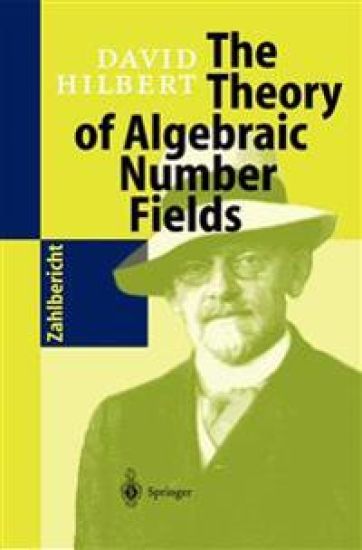
The Theory of Algebraic Number Fields
David Hilbert
Springer-Verlag Berlin and Heidelberg GmbH Co. K
1998
sidottu
Constance Reid, in Chapter VII of her book Hilbert, tells the story of the writing of the Zahlbericht, as his report entitled Die Theorie der algebra is chen Zahlkorper has always been known. At its annual meeting in 1893 the Deutsche Mathematiker-Vereinigung (the German Mathematical Society) invited Hilbert and Minkowski to prepare a report on the current state of affairs in the theory of numbers, to be completed in two years. The two mathematicians agreed that Minkowski should write about rational number theory and Hilbert about algebraic number theory. Although Hilbert had almost completed his share of the report by the beginning of 1896 Minkowski had made much less progress and it was agreed that he should withdraw from his part of the project. Shortly afterwards Hilbert finished writing his report on algebraic number fields and the manuscript, carefully copied by his wife, was sent to the printers. The proofs were read by Minkowski, aided in part by Hurwitz, slowly and carefully, with close attention to the mathematical exposition as well as to the type-setting; at Minkowski's insistence Hilbert included a note of thanks to his wife. As Constance Reid writes, "The report on algebraic number fields exceeded in every way the expectation of the members of the Mathemati cal Society. They had asked for a summary of the current state of affairs in the theory. They received a masterpiece, which simply and clearly fitted all the difficult developments of recent times into an elegantly integrated theory.
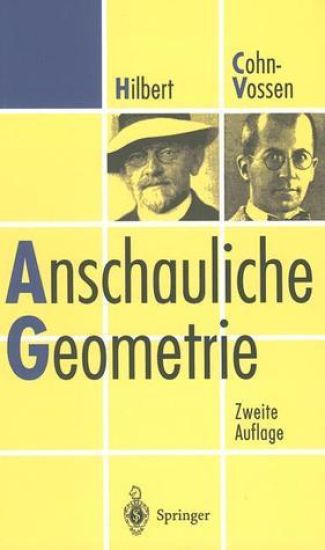
Anschauliche Geometrie
David Hilbert; Stephan Cohn-Vossen
Springer-Verlag Berlin and Heidelberg GmbH Co. KG
1996
sidottu
Anschauliche Geometrie - wohl selten ist ein Mathematikbuch seinem Titel so gerecht geworden wie dieses außergewöhnliche Werk von Hilbert und Cohn-Vossen. Zuerst 1932 erschienen, hat das Buch nichts von seiner Frische und Kraft verloren. Hilbert hat sein erklärtes Ziel, die Faszination der Geometrie zu vermitteln, bei Generationen von Mathematikern erreicht. Aus Hilberts Vorwort: "Das Buch soll dazu dienen, die Freude an der Mathematik zu mehren, indem es dem Leser erleichtert, in das Wesen der Mathematik einzudringen, ohne sich einem beschwerlichen Studium zu unterziehen".

In the summer semester of 1897 David Hilbert (1862–1943) gave an introductory course in Invariant Theory at the University of Gottingen. This book is an English translation of the handwritten notes taken from this course by Hilbert’s student Sophus Marxen. The year 1897 was the perfect time for Hilbert to present such an introduction to invariant theory. His research in the subject had been completed. His famous finiteness theorem had been proved and published in two papers that changed the course of invariant theory dramatically and that laid the foundation for modern commutative algebra. Thus these lectures take into account both the old approach of his predecessors and his new ideas. This bridge from nineteenth- to twentieth-century mathematics makes these lecture notes a special and fascinating account of invariant theory. Hilbert’s course was given at a level accessible to graduate students in mathematics, requiring only a familiarity with linear algebra and the basics of ring and group theory. The text will be useful as a self-contained introduction to invariant theory. But it will also be invaluable as a historical source for anyone interested in the foundations of twentieth-century mathematics.
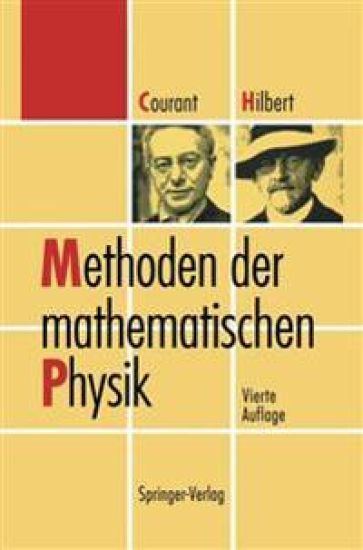
Methoden der mathematischen Physik
Richard Courant; David Hilbert
Springer-Verlag Berlin and Heidelberg GmbH Co. K
1993
sidottu
In diesem Buch, erstmals 1924 bzw. 1937 erschienen, spürt man noch wie am ersten Tag die Frische und Inspiration zweier großer Mathematiker und Lehrer. Hilbert kann man mit Fug und Recht als den letzten Mathematiker bezeichnen, der in allen Gebieten seiner Wissenschaft zu Hause war und in den verschiedensten Bereichen der Mathematik grundlegende neue Erkenntnisse gewann. Seine Resultate haben entscheidend die moderne Auffassung vom Wesen der Mathematik geprägt. Sein Schüler Courant galt und gilt auch heute noch als ein ausgezeichneter Lehrer, der auch schwierigste Materien verständlich darstellen konnte. Das bei Springer erschienene Buch von Courant/Robbins: Was ist Mathematik, kann in diesem Zusammenhang als beispielhaft genannt werden. Alles in allem eine großartige Zusammenfassung der mathematischen Hilfsmittel des Physikers, die auch heute noch viele enthusiastische Leser finden wird.
Differential and Integral Calculus, 2 Volume Set (Volume I Paper Edition; Volume II Cloth Edition)
Richard Courant; David Hilbert
John Wiley Sons Inc
1993
nidottu