Kirjojen hintavertailu. Mukana 12 595 353 kirjaa ja 12 kauppaa.
Kirjailija
David J. Bartholomew
Kirjat ja teokset yhdessä paikassa: 11 kirjaa, julkaisuja vuosilta 1996-2017, suosituimpien joukossa Analysis of Multivariate Social Science Data. Vertaile teosten hintoja ja tarkista saatavuus suomalaisista kirjakaupoista.
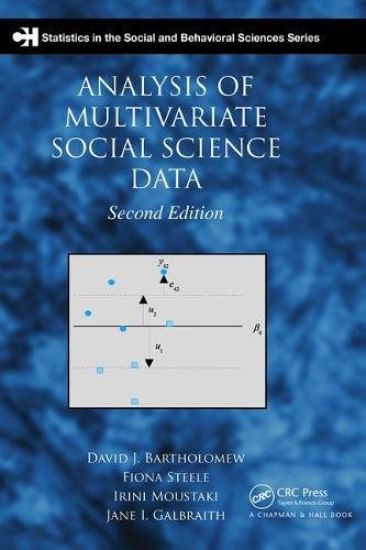
Drawing on the authors varied experiences working and teaching in the field, Analysis of Multivariate Social Science Data, Second Editionenables a basic understanding of how to use key multivariate methods in the social sciences. With updates in every chapter, this edition expands its topics to include regression analysis, confirmatory factor analysis, structural equation models, and multilevel models.After emphasizing the summarization of data in the first several chapters, the authors focus on regression analysis. This chapter provides a link between the two halves of the book, signaling the move from descriptive to inferential methods and from interdependence to dependence. The remainder of the text deals with model-based methods that primarily make inferences about processes that generate data. Relying heavily on numerical examples, the authors provide insight into the purpose and working of the methods as well as the interpretation of data. Many of the same examples are used throughout to illustrate connections between the methods. In most chapters, the authors present suggestions for further work that go beyond conventional exercises, encouraging readers to explore new ground in social science research. Requiring minimal mathematical and statistical knowledge, this book shows how various multivariate methods reveal different aspects of data and thus help answer substantive research questions.

This is a book about the ideas that drive statistics. It is an ideal primer for students who need an introduction to the concepts of statistics without the added confusion of technical jargon and mathematical language. It introduces the intuitive thinking behind standard procedures, explores the process of informal reasoning, and uses conceptual frameworks to provide a foundation for students new to statistics. It showcases the expertise we have all developed from living in a data saturated society, increases our statistical literacy and gives us the tools needed to approach statistical mathematics with confidence. Key topics include: VariabilityStandard DistributionsCorrelationRelationshipSamplingInference An engaging, informal introduction this book sets out the conceptual tools required by anyone undertaking statistical procedures for the first time or for anyone needing a fresh perspective whilst studying the work of others.
?The classical statistical problem typically involves a probability distribution which depends on a number of unknown parameters. The form of the distribution may be known, partially or completely, and inferences have to be made on the basis of a sample of observations drawn from the distribution; often, but not necessarily, a random sample. This brief deals with problems where some of the sample members are either unobserved or hypothetical, the latter category being introduced as a means of better explaining the data. Sometimes we are interested in these kinds of variable themselves and sometimes in the parameters of the distribution. Many problems that can be cast into this form are treated. These include: missing data, mixtures, latent variables, time series and social measurement problems. Although all can be accommodated within a Bayesian framework, most are best treated from first principles.
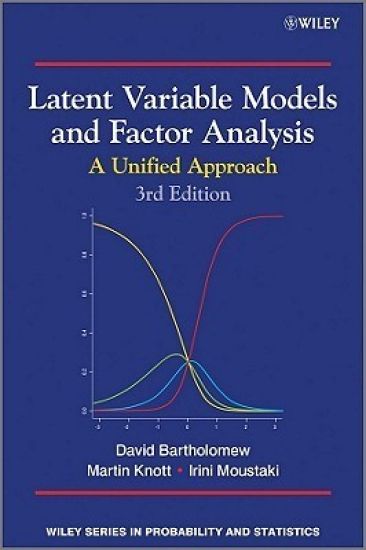
Latent Variable Models and Factor Analysis provides a comprehensive and unified approach to factor analysis and latent variable modeling from a statistical perspective. This book presents a general framework to enable the derivation of the commonly used models, along with updated numerical examples. Nature and interpretation of a latent variable is also introduced along with related techniques for investigating dependency. This book: Provides a unified approach showing how such apparently diverse methods as Latent Class Analysis and Factor Analysis are actually members of the same family.Presents new material on ordered manifest variables, MCMC methods, non-linear models as well as a new chapter on related techniques for investigating dependency.Includes new sections on structural equation models (SEM) and Markov Chain Monte Carlo methods for parameter estimation, along with new illustrative examples.Looks at recent developments on goodness-of-fit test statistics and on non-linear models and models with mixed latent variables, both categorical and continuous. No prior acquaintance with latent variable modelling is pre-supposed but a broad understanding of statistical theory will make it easier to see the approach in its proper perspective. Applied statisticians, psychometricians, medical statisticians, biostatisticians, economists and social science researchers will benefit from this book.
Drawing on the authors’ varied experiences working and teaching in the field, Analysis of Multivariate Social Science Data, Second Editionenables a basic understanding of how to use key multivariate methods in the social sciences. With updates in every chapter, this edition expands its topics to include regression analysis, confirmatory factor analysis, structural equation models, and multilevel models.After emphasizing the summarization of data in the first several chapters, the authors focus on regression analysis. This chapter provides a link between the two halves of the book, signaling the move from descriptive to inferential methods and from interdependence to dependence. The remainder of the text deals with model-based methods that primarily make inferences about processes that generate data. Relying heavily on numerical examples, the authors provide insight into the purpose and working of the methods as well as the interpretation of data. Many of the same examples are used throughout to illustrate connections between the methods. In most chapters, the authors present suggestions for further work that go beyond conventional exercises, encouraging readers to explore new ground in social science research. Requiring minimal mathematical and statistical knowledge, this book shows how various multivariate methods reveal different aspects of data and thus help answer substantive research questions.

Scientific accounts of existence give chance a central role. At the smallest level, quantum theory involves uncertainty and evolution is driven by chance and necessity. These ideas do not fit easily with theology in which chance has been seen as the enemy of purpose. One option is to argue, as proponents of Intelligent Design do, that chance is not real and can be replaced by the work of a Designer. Others adhere to a deterministic theology in which God is in total control. Neither of these views, it is argued, does justice to the complexity of nature or the greatness of God. The thesis of this book is that chance is neither unreal nor non-existent but an integral part of God's creation. This view is expounded, illustrated and defended by drawing on the resources of probability theory and numerous examples from the natural and social worlds.
The testing of intelligence has a long and controversial history. Claims that it is a pseudo-science or a weapon of ideological warfare have been commonplace and there is not even a consensus as to whether intelligence exists and, if it does, whether it can be measured. As a result the debate about it has centred on the nurture versus nature controversy and especially on alleged racial differences and the heritability of intelligence - all of which have major policy implications. This book aims to penetrate the mists of controversy, ideology and prejudice by providing a clear non-mathematical framework for the definition and measurement of intelligence derived from modern factor analysis. Building on this framework and drawing on everyday ideas the author address key controversies in a clear and accessible style and explores some of the claims made by well known writers in the field such as Stephen Jay Gould and Michael Howe.
The certainties which underpinned Christian belief have crumbled in a world where science sets the standard of what is true. A rational case for belief must therefore be constructed out of uncertainties. Probability theory provides the tools for measuring and combining uncertainties and is thus the key to progress. This book examines four much debated topics where the logic of uncertain reference can be brought to bear. These are: miracles, the paranormal, God's existence, and the Bible. Given the great diversity of evidence, it is not surprising that opposite conclusions have been drawn by supposedly rational people. An assessment of the state of the argument from a probabilistic perspective is overdue. In this book Professor Bartholomew examines and refutes some of the more extravagant claims, evaluates the weight of some of the quantitative evidence, and provides an answer to the fundamental question: can a rational person be a Christian?
The certainties which once underpinned Christian belief have crumbled in a world where science sets the standard for what is true. A rational case for belief must therefore be constructed out of uncertainties. Probability theory provides the tools for measuring and combining uncertainties and is thus the key to progress. This book examines four much debated topics where the logic of uncertain inference can be brought to bear. These are: miracles, the paranormal, God's existence, and the Bible. Given the great diversity of evidence, it is not surprising that opposite conclusions have been drawn by supposedly rational people. An assessment of the state of argument from a probabilistic perspective is overdue. In this book Professor Bartholomew examines and refutes some of the more extravagent claims, evaluates the weight of some of the quantitive evidence, and provides an answer to the fundamental question: is it rational to be a Christian?