Kirjojen hintavertailu. Mukana 12 390 323 kirjaa ja 12 kauppaa.

Kirjailija

David J. Benson

Kirjat ja teokset yhdessä paikassa: 4 kirjaa, julkaisuja vuosilta 2008-2024, suosituimpien joukossa Representations of Elementary Abelian p-Groups and Vector Bundles. Vertaile teosten hintoja ja tarkista saatavuus suomalaisista kirjakaupoista.

4 kirjaa

Kirjojen julkaisuhaarukka 2008-2024.

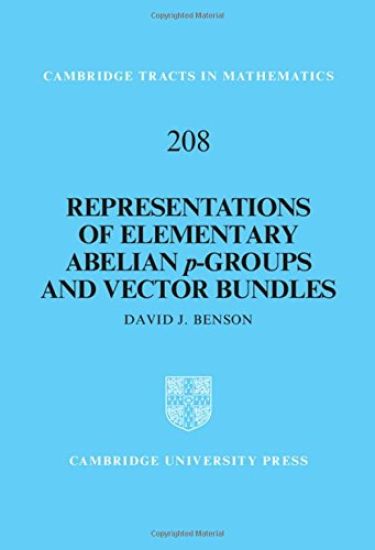
Representations of Elementary Abelian p-Groups and Vector Bundles
Questions about modular representation theory of finite groups can often be reduced to elementary abelian subgroups. This is the first book to offer a detailed study of the representation theory of elementary abelian groups, bringing together information from many papers and journals, as well as unpublished research. Special attention is given to recent work on modules of constant Jordan type, and the methods involve producing and examining vector bundles on projective space and their Chern classes. Extensive background material is provided, which will help the reader to understand vector bundles and their Chern classes from an algebraic point of view, and to apply this to modular representation theory of elementary abelian groups. The final section, addressing problems and directions for future research, will also help to stimulate further developments in the subject. With no similar books on the market, this will be an invaluable resource for graduate students and researchers working in representation theory.
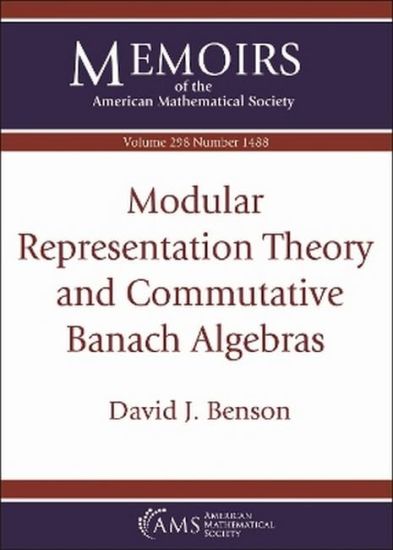
Modular Representation Theory and Commutative Banach Algebras

Modular Representation Theory and Commutative Banach Algebras

David J. Benson

AMERICAN MATHEMATICAL SOCIETY
2024
nidottu
The Memoirs of the AMS is devoted to the publication of new research in all areas of pure and applied mathematics. The Memoirs is designed particularly to publish long papers of groups of cognate papers in book form, and is under the supervision of the Editorial Committee of the AMS journal Transactions of the American Mathematical Society. All papers are peer-reviewed.
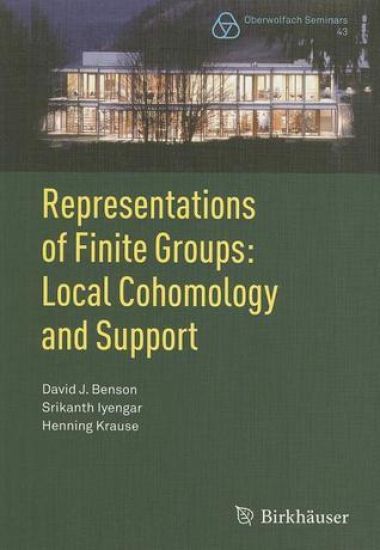
Representations of Finite Groups: Local Cohomology and Support

Representations of Finite Groups: Local Cohomology and Support

David J. Benson; Srikanth Iyengar; Henning Krause

Birkhauser Verlag AG
2011
nidottu
The seminar focuses on a recent solution, by the authors, of a long standing problem concerning the stable module category (of not necessarily finite dimensional representations) of a finite group. The proof draws on ideas from commutative algebra, cohomology of groups, and stable homotopy theory. The unifying theme is a notion of support which provides a geometric approach for studying various algebraic structures. The prototype for this has been Daniel Quillen’s description of the algebraic variety corresponding to the cohomology ring of a finite group, based on which Jon Carlson introduced support varieties for modular representations. This has made it possible to apply methods of algebraic geometry to obtain representation theoretic information. Their work has inspired the development of analogous theories in various contexts, notably modules over commutative complete intersection rings and over cocommutative Hopf algebras. One of the threads in this development has been the classification of thick or localizing subcategories of various triangulated categories of representations. This story started with Mike Hopkins’ classification of thick subcategories of the perfect complexes over a commutative Noetherian ring, followed by a classification of localizing subcategories of its full derived category, due to Amnon Neeman. The authors have been developing an approach to address such classification problems, based on a construction of local cohomology functors and support for triangulated categories with ring of operators. The book serves as an introduction to this circle of ideas.
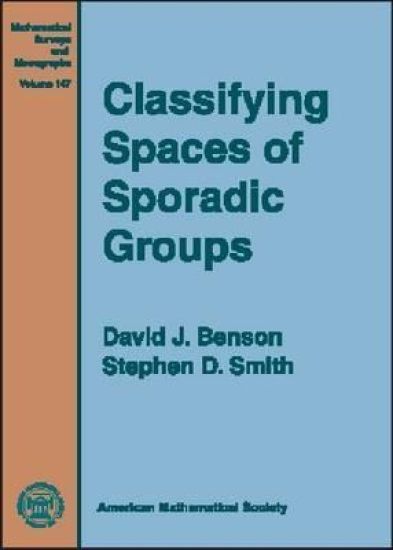
Classifying Spaces of Sporadic Groups

Classifying Spaces of Sporadic Groups

David J. Benson; Stephen D. Smith

Amer Mathematical Society
2008
sidottu
For each of the 26 sporadic finite simple groups, the authors construct a 2-completed classifying space using a homotopy decomposition in terms of classifying spaces of suitable 2-local subgroups. This construction leads to an additive decomposition of the mod 2 group cohomology. The authors also summarize the current status of knowledge in the literature about the ring structure of the mod 2 cohomology of sporadic simple groups.