Kirjojen hintavertailu. Mukana 12 326 046 kirjaa ja 12 kauppaa.

Kirjailija

David J. Hally

Kirjat ja teokset yhdessä paikassa: 2 kirjaa, julkaisuja vuosilta 2006-2008, suosituimpien joukossa Light on the Path. Vertaile teosten hintoja ja tarkista saatavuus suomalaisista kirjakaupoista.

2 kirjaa

Kirjojen julkaisuhaarukka 2006-2008.

Light on the Path

Light on the Path

Eric E. Bowne; Steven C. Hahn; David J. Hally; Scott Jones; William Martin Jurgelski; Adam King; Stephen A. Kowalewski; Jerald T. Milanich

The University of Alabama Press
2006
nidottu
The past 20 years have witnessed a change in the study of the prehistory and history of the native peoples of the American South. This paradigm shift is the bridging of prehistory and history to fashion a seamless social history that includes not only the 16th-century Late Mississippian period and the 18th-century colonial period but also the largely forgotten - and critically important - century in between. The shift is in part methodological, for it involves combining methods from anthropology, history, and archaeology. It is also conceptual and theoretical, employing historical and archaeological data to reconstruct broad patterns of history - not just political history with Native Americans as a backdrop, nor simply an archaeology with added historical specificity, but a true social history of the Southeastern Indians, spanning their entire existence in the American South. The scholarship underlying this shift comes from many directions, but much of the groundwork can be attributed to Charles Hudson. The papers in this volume were contributed by Hudson's colleagues and former students (many now leading scholars themselves) in his honor. The assumption linking these papers is that of a historical transformation between Mississippian societies and the Indian societies of the historic era that requires explanation and critical analysis. In all of the chapters, the legacy of Hudson's work is evident. Anthropologists, archaeologists, and historians are storming the bridge that connects prehistory and history in a manner unimaginable 20 years ago. While there remains much work to do on the path toward understanding this transformation and constructing a complete social history of the Southeastern Indians, the work of Charles Hudson and his colleagues have shown the way.
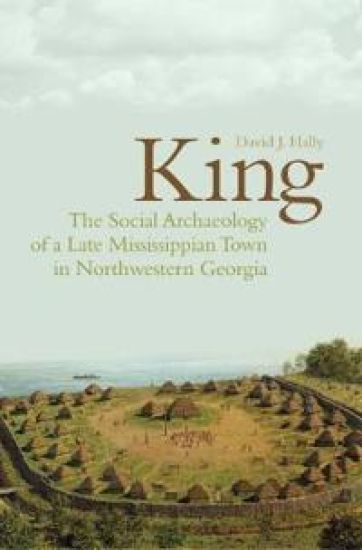
King

King

David J. Hally

The University of Alabama Press
2008
muu
At the time of Spanish contact in A.D. 1540, the Mississippian inhabitants of the great valley in north-western Georgia and adjacent portions of Alabama and Tennessee were organized into a number of chiefdoms distributed along the Coosa and Tennessee rivers and their major tributaries. The administrative centers of these polities were large settlements with one or more platform mounds and a plaza. Each had a large resident population, but most polity members lived in a half dozen or so towns located within a day's walk of the center. This book is about one such town, located on the Coosa River in Georgia and known to archaeologists as the King site.Excavations of two-thirds of the 5.1-acre King site reveal a detailed picture of the town's domestic and public architecture and overall settlement plan. Intensive analysis of architectural features, especially of domestic structures, enables a better understanding of the variation in structure size, compass orientation, construction stages, and symbolic cosmological associations; the identification of multi-family households; and the position of individual structures within the town's occupation sequence or life history. Comparison of domestic architecture and burials reveals considerable variation between households in house size, shell bead wealth, and prominence of adult members.One household is pre-eminent in all these characteristics and may represent the household of the town chief or his matrilineal extended family. Analysis of public architectural features has revealed the existence of a large meeting house with likely historical connections to 18th-century Creek town houses; a probable cosmological basis for the town's physical layout; and an impressive stockade-and-ditch defensive perimeter.The King site represents a nearly ideal opportunity to identify the kinds of status positions that were held by individual inhabitants; analyze individual households and investigate the roles they played in King site society; reconstruct the community that existed at King, including size, life history, symbolic associations, and integrative mechanisms; and place King in the larger regional political system. With excavations dating back to 1973, and supported in part by the National Endowment for the Humanities and the National Geographic Society, this is social archaeology at its best.