
Kirjailija
David J. Langum
Kirjat ja teokset yhdessä paikassa: 7 kirjaa, julkaisuja vuosilta 1995-2020, suosituimpien joukossa The Joy of Scholarship. Vertaile teosten hintoja ja tarkista saatavuus suomalaisista kirjakaupoista.
Mukana myös kirjoitusasut: David J Langum
7 kirjaa
Kirjojen julkaisuhaarukka 1995-2020.

From Maverick to Mainstream
David J. Langum; Howard P. Walthall
University of Georgia Press
2010
sidottu
Founded in 1847 in Lebanon, Tennessee, the Cumberland School of Law holds a unique place in the history of American legal education. As the premier law school in the South in the nineteenth century, Cumberland trained two United States Supreme Court justices, nine senators, a secretary of state, and scores of other federal and state judges, representatives, and governors.Cumberland is among the oldest law schools in the southeast and is the first law school to have been sold outright from one university to another, passing from Cumberland University to Birmingham, Alabama's Howard College (now Samford University) in 1961. This book is a comprehensive narrative analysis of the school's pedagogical and social history in the context of legal education throughout the South and the nation.
From Maverick to Mainstream
David J. Langum; Howard P. Walthall
University of Georgia Press
2010
pokkari
Founded in 1847 in Lebanon, Tennessee, the Cumberland School of Law holds a unique place in the history of American legal education. As the premier law school in the South in the nineteenth century, Cumberland trained two United States Supreme Court justices, nine senators, a secretary of state, and scores of other federal and state judges, representatives, and governors.Cumberland is among the oldest law schools in the southeast and is the first law school to have been sold outright from one university to another, passing from Cumberland University to Birmingham, Alabama's Howard College (now Samford University) in 1961. This book is a comprehensive narrative analysis of the school's pedagogical and social history in the context of legal education throughout the South and the nation.
Crossing over the Line describes the folly of the Mann Act of 1910—a United States law which made travel from one state to another by a man and a woman with the intent of committing an immoral act a major crime. Spawned by a national wave of "white slave trade" hysteria, the Act was created by the Congress of the United States as a weapon against forced prostitution. This book is the first history of the Mann Act's often bizarre career, from its passage to the amendment that finally laid it low. In David J. Langum's hands, the story of the Act becomes an entertaining cautionary tale about the folly of legislating private morality.Langum recounts the colorful details of numerous court cases to show how enforcement of the Act mirrored changes in America's social attitudes. Federal prosecutors became masters in the selective use of the Act: against political opponents of the government, like Charlie Chaplin; against individuals who eluded other criminal charges, like the Capone mobster "Machine Gun" Jack McGurn; and against black men, like singer Chuck Berry and boxer Jack Johnson, who dared to consort with white women. The Act engendered a thriving blackmail industry and was used by women like Frank Lloyd Wright's wife to extort favorable divorce settlements. "Crossing over the Line is a work of scholarship as wrought by a civil libertarian, and the text . . . sizzles with the passion of an ardent believer in real liberty under reasonable laws."—Jonathan Kirsch, Los Angeles Times
The true story of the defender of the Chicago 7 Alternately vilified as a publicity-seeking egoist and lauded as a rambunctious, fearless advocate, William Kunstler consistently embodied both of these qualities. Kunstler's unrelenting, radical critique of American racism and the legal system took shape as a result of his efforts to enlist the federal judicial system to support the civil rights movement. In the late 60s and the 70s, Kunstler, refocusing his attention on the Black Power and anti-war movement, garnered considerable public attention as defender of the Chicago Seven, and went on to represent such controversial figures as Leonard Peltier, the American Indian Movement leader charged with killing an FBI agent, and Jack Ruby, the killer of Lee Harvey Oswald. Later, Kunstler briefly represented Colin Ferguson, the Long Island Railroad mass murderer, outraging fans and detractors alike with his invocation of the infamous "black rage" defense. Defending those most loathed by mainstream, conventional America, William Kunstler delighted in taking on fiercely political cases, usually representing society's outcasts and pariahs free of charge and often achieving remarkable courtroom results in seemingly hopeless cases. Though Kunstler never gave up his revolutionary underpinnings, he gradually turned from defending clients whose political beliefs he personally supported to taking on apolitical clients, falling back on the broad rationale that his was a general struggle against an oppressive government. What ideological and tactical motives explain Kunstler's obsessive craving for media attention, his rhetorical flourishes in the courtroom and his instinctive and relentless drive for action? How did Kunstler migrate from a comfortable middle-class background to a life as a staunchly rebellious figure in social and legal history? David Langum's portrait gives depth to the already notorious breadth of William Kunstler's life.
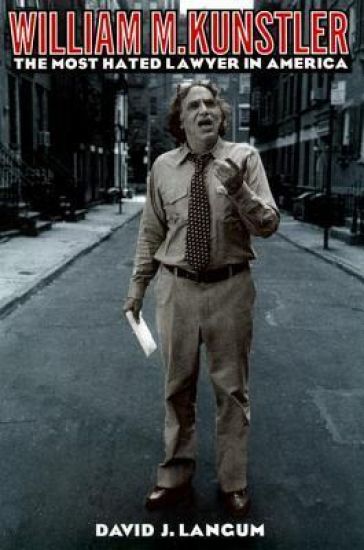
The true story of the defender of the Chicago 7 Alternately vilified as a publicity-seeking egoist and lauded as a rambunctious, fearless advocate, William Kunstler consistently embodied both of these qualities. Kunstler's unrelenting, radical critique of American racism and the legal system took shape as a result of his efforts to enlist the federal judicial system to support the civil rights movement. In the late 60s and the 70s, Kunstler, refocusing his attention on the Black Power and anti-war movement, garnered considerable public attention as defender of the Chicago Seven, and went on to represent such controversial figures as Leonard Peltier, the American Indian Movement leader charged with killing an FBI agent, and Jack Ruby, the killer of Lee Harvey Oswald. Later, Kunstler briefly represented Colin Ferguson, the Long Island Railroad mass murderer, outraging fans and detractors alike with his invocation of the infamous "black rage" defense. Defending those most loathed by mainstream, conventional America, William Kunstler delighted in taking on fiercely political cases, usually representing society's outcasts and pariahs free of charge and often achieving remarkable courtroom results in seemingly hopeless cases. Though Kunstler never gave up his revolutionary underpinnings, he gradually turned from defending clients whose political beliefs he personally supported to taking on apolitical clients, falling back on the broad rationale that his was a general struggle against an oppressive government. What ideological and tactical motives explain Kunstler's obsessive craving for media attention, his rhetorical flourishes in the courtroom and his instinctive and relentless drive for action? How did Kunstler migrate from a comfortable middle-class background to a life as a staunchly rebellious figure in social and legal history? David Langum's portrait gives depth to the already notorious breadth of William Kunstler's life.
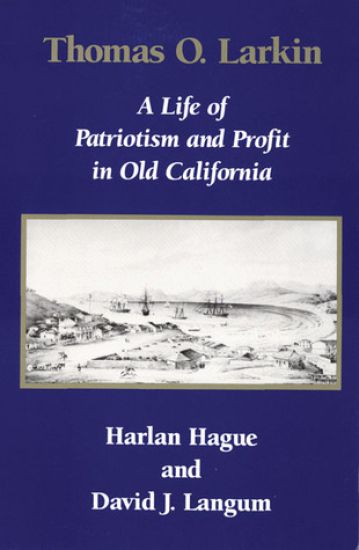
Arriving in Mexican California in 1832, Thomas O. Larkin (1802-1858) expected to become a rich man-and he did: he became a successful merchant, financier, and land developer. Larkin also became the confidant of California officials, American consul to California, and secret agent of the president of the United States during the territory's transition from Mexican to American control. Harlan Hague and David Langum have uncovered a large body of new information, shedding light on many aspects of Larkin's personal life as well as on his business and diplomatic activities. Historians and general readers will welcome this full-scale biography of one of the most important men in the history of early California.