Kirjojen hintavertailu. Mukana 12 345 090 kirjaa ja 12 kauppaa.

Kirjailija

David J. Siemers

Kirjat ja teokset yhdessä paikassa: 4 kirjaa, julkaisuja vuosilta 2002-2026, suosituimpien joukossa The Myth of Coequal Branches. Vertaile teosten hintoja ja tarkista saatavuus suomalaisista kirjakaupoista.

4 kirjaa

Kirjojen julkaisuhaarukka 2002-2026.

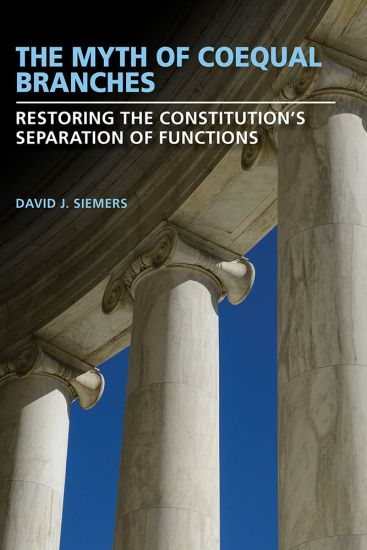
The Myth of Coequal Branches

The Myth of Coequal Branches

David J. Siemers

UNIVERSITY OF MISSOURI PRESS
2026
nidottu
The idea that the three branches of U.S. government are equal in power is taught in classrooms, proclaimed by politicians, and referenced in the media. But, as David Siemers shows, that idea is a myth, neither intended by the Founders nor true in practice. Siemers explains how adherence to this myth normalizes a politics of gridlock, in which the action of any branch can be checked by the reaction of any other. The Founders, however, envisioned a separation of functions rather than a separation of powers. Siemers argues that this view needs to replace our current view, so that the goals set out in the Constitution’s Preamble may be better achieved.
The Myth of Coequal Branches

The Myth of Coequal Branches

David J. Siemers

University of Missouri Press
2018
sidottu
The idea that the three branches of U.S. government are equal in power is taught in classrooms, proclaimed by politicians, and referenced in the media. But, as David Siemers shows, that idea is a myth, neither intended by the Founders nor true in practice. Siemers explains how adherence to this myth normalizes a politics of gridlock, in which the action of any branch can be checked by the reaction of any other. The Founders, however, envisioned a separation of functions rather than a separation of powers. Siemers argues that this view needs to replace our current view, so that the goals set out in the Constitution’s Preamble may be better achieved.
Ratifying the Republic

Ratifying the Republic

David J. Siemers

Stanford University Press
2004
pokkari
Ratifying the Republic explains how the United States Constitution made the transition from a very divisive proposal to a consensually legitimate framework for governing. This story has never been told in its entirety, mainly because the transition seemed so seamless. But the Federalists' proposal had been bitterly opposed, and constitutional legitimation required a major transformation. The story of that transformation is the substance of this book. The progression of constitutional contexts triggered new responses from participants in the ratification debate which led to legitimation. Antifederalists had been loath to scrap the Articles of Confederation because of their conservative approach to the rule of law. After ratification, this same conservative predisposition led them to agree to abide by the newly legalized Constitution and instruct their followers to do the same. Implementation of the Constitution yielded other responses which bolstered the document. For instance, this progression in "constitutional time" exposed incomplete views within the Federalist camp about how a constitution should be treated in practice. James Madison believed the Constitution fairly clearly distinguished federal powers from those retained by the states; successful constitutionalism dictated preserving that division. In contrast, Alexander Hamilton thought that a constitution that split sovereignty between the states and the nation was inherently unstable. His hope was to salvage the Union by extending national power, a project directly contrary to Madison's more static view. Madison and these Federalists who agreed with him joined with the former Antifederalists to become the Republican party. This alliance held the remaining Federalists to their well-publicized ratification debate argument that the Constitution was a grant of limited, specific powers only. This new alliance had sufficient strength to contemplate taking the reins of government. With majority status a distinct possibility, incentives to replace the new regime were minimized, eclipsed by a state-centric interpretation of the Constitution. The legislative process adopted by Congress was also satisfactory to the opposition, who were sticklers for proper procedures. Finally, the trying and financially unrewarding nature of service in the new government discouraged the best and the brightest from seeking national office, hindering institutional prestige and the growth of national power, developments which pleased those who favored dual sovereignty. Throughout, the author emphasizes the role fear, contingency, and happenstance played in the success and legitimation of the Constitution.
Ratifying the Republic

Ratifying the Republic

David J. Siemers

Stanford University Press
2002
sidottu
Ratifying the Republic explains how the United States Constitution made the transition from a very divisive proposal to a consensually legitimate framework for governing. This story has never been told in its entirety, mainly because the transition seemed so seamless. But the Federalists' proposal had been bitterly opposed, and constitutional legitimation required a major transformation. The story of that transformation is the substance of this book. The progression of constitutional contexts triggered new responses from participants in the ratification debate which led to legitimation. Antifederalists had been loath to scrap the Articles of Confederation because of their conservative approach to the rule of law. After ratification, this same conservative predisposition led them to agree to abide by the newly legalized Constitution and instruct their followers to do the same. Implementation of the Constitution yielded other responses which bolstered the document. For instance, this progression in "constitutional time" exposed incomplete views within the Federalist camp about how a constitution should be treated in practice. James Madison believed the Constitution fairly clearly distinguished federal powers from those retained by the states; successful constitutionalism dictated preserving that division. In contrast, Alexander Hamilton thought that a constitution that split sovereignty between the states and the nation was inherently unstable. His hope was to salvage the Union by extending national power, a project directly contrary to Madison's more static view. Madison and these Federalists who agreed with him joined with the former Antifederalists to become the Republican party. This alliance held the remaining Federalists to their well-publicized ratification debate argument that the Constitution was a grant of limited, specific powers only. This new alliance had sufficient strength to contemplate taking the reins of government. With majority status a distinct possibility, incentives to replace the new regime were minimized, eclipsed by a state-centric interpretation of the Constitution. The legislative process adopted by Congress was also satisfactory to the opposition, who were sticklers for proper procedures. Finally, the trying and financially unrewarding nature of service in the new government discouraged the best and the brightest from seeking national office, hindering institutional prestige and the growth of national power, developments which pleased those who favored dual sovereignty. Throughout, the author emphasizes the role fear, contingency, and happenstance played in the success and legitimation of the Constitution.