Kirjojen hintavertailu. Mukana 12 390 323 kirjaa ja 12 kauppaa.

Kirjailija

David Joselit

Kirjat ja teokset yhdessä paikassa: 10 kirjaa, julkaisuja vuosilta 2001-2025, suosituimpien joukossa Infinite Regress. Vertaile teosten hintoja ja tarkista saatavuus suomalaisista kirjakaupoista.

10 kirjaa

Kirjojen julkaisuhaarukka 2001-2025.

Plastics

Plastics

Anne Gunnison; David Joselit

PRINCETON UNIVERSITY PRESS
2025
pokkari
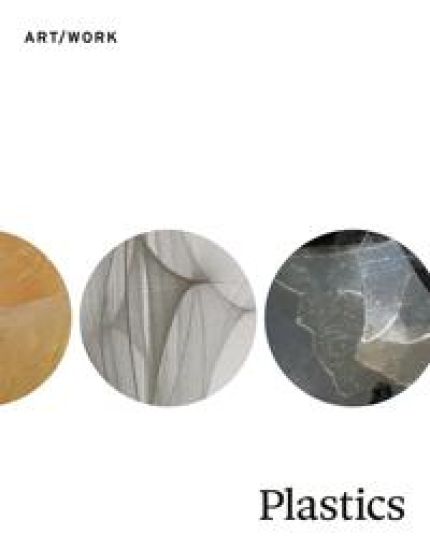
Why modern and contemporary art—and art conservation—can’t be understood without taking account of the revolutionary impact of plasticsModern and contemporary art wouldn’t exist without the invention of plastics. From sculpture to paint, and photography to film, plastics have shaped every major medium of art. In turn, plastics have revolutionized art conservation, transforming the possibilities of preservation but also producing new challenges for conservators struggling to preserve toxic and degrading material. Hailed as utopian in the twentieth century, plastics today are often understood as pollution and waste—a central cause of ecological crisis. Plastics is the first book to address the multifaceted history of plastics from the perspective of artists, art historians, conservators, and environmental scientists.Plastics demonstrates that this material cannot easily be summarized as toxic or utopian, catastrophic or necessary. Instead, plastics define the modern world in both its possibility and failures. The book also reveals how artists have been a critical overlooked voice in debates about plastics, and how they have offered theories of the material through works that explore its potential and harmfulness.Presenting a variety of perspectives on the world of plastics through the lens of art, artmaking, art history, and art conservation, Plastics shows why and how coming to terms with this material is critical to understanding not only modern and contemporary art and art conservation but also the crises of the twenty-first century.
Art’s Properties

Art’s Properties

David Joselit

PRINCETON UNIVERSITY PRESS
2023
sidottu
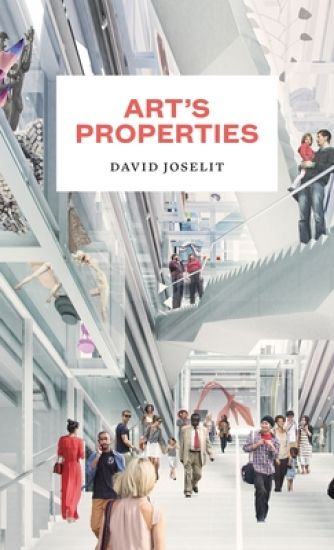
A revisionist reading of modern art that examines how artworks are captured as property to legitimize powerIn this provocative new account, David Joselit shows how art from the nineteenth to the twenty-first centuries began to function as a commodity, while the qualities of the artist, nation, or period themselves became valuable properties. Joselit explores repatriation, explaining that this is not just a contemporary conflict between the Global South and Euro-American museums, noting that the Louvre, the first modern museum, was built on looted works and faced demands for restitution and repatriation early in its history. Joselit argues that the property values of white supremacy underlie the ideology of possessive individualism animating modern art, and he considers issues of identity and proprietary authorship.Joselit redefines art’s politics, arguing that these pertain not to an artwork’s content or form but to the way it is “captured,” made to represent powerful interests—whether a nation, a government, or a celebrity artist collected by oligarchs. Artworks themselves are not political but occupy at once the here and now and an “elsewhere”—an alterity—that can’t ever be fully appropriated. The history of modern art, Joselit asserts, is the history of transforming this alterity into private property.Narrating scenes from the emergence and capture of modern art—touching on a range of topics that include the Byzantine church, French copyright law, the 1900 Paris Exposition, W.E.B. Du Bois, the conceptual artist Adrian Piper, and the controversy over Dana Schutz’s painting Open Casket—Joselit argues that the meaning of art is its infinite capacity to generate experience over time.
Ambulance Chasers

Ambulance Chasers

Abraham Adams; David Joselit

MIT PRESS LTD
2022
nidottu
A series of photographic diptychs that investigate the behavior of images and offer an account of American precarity. Ambulance Chasers offers a series of photographic diptychs by the artist Abraham Adams: on the left, the faces of personal injury lawyers photographed from roadside billboards; on the right, the landscapes they survey. The gesture is a double rotation: each photograph is imagined as the spectator of the other, and in each pairing, the exorbitant promises of the animated lawyers are deflated by their juxtaposition with an often featureless roadside landscape. The ambulance chasers smile, grin, grimace, scowl; their hair is neatly coiffed, slicked back, unnaturally dark. They gaze at country roads, busy highways, empty intersections, blue skies, building sites, and parking lots. They offer assistance--at a price. Adams's conceptual performance and art historian David Joselit's text tell a story of American precarity. Joselit's text unrolls alongside the photographs like a long, broken caption. Adams and Joselit conceived their collaboration as an investigation of the behavior and poetics of images--both in the world as billboards and in the book as reproductions--in a visual and textual language quite different from standard theoretical texts. In a long interview, they explore the project's aesthetic and historical concerns, focusing on its hybridization of typologies central to post-World War II photography--the conceptual catalogs best exemplified by the work of Bernd and Hilla Becher and their students, and the "anti-heroic" American landscape, as charted by artists ranging from Ed Ruscha to Lewis Baltz and Robert Adams.
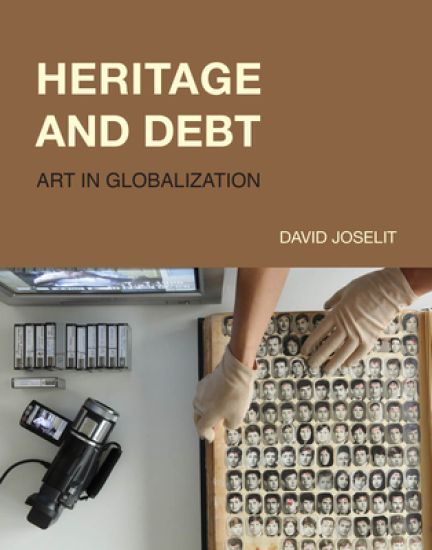
Heritage and Debt

Heritage and Debt

David Joselit

MIT Press
2020
sidottu
How global contemporary art reanimates the past as a resource for the present, combating modern art's legacy of Eurocentrism.If European modernism was premised on the new—on surpassing the past, often by assigning it to the “traditional” societies of the Global South—global contemporary art reanimates the past as a resource for the present. In this account of what globalization means for contemporary art, David Joselit argues that the creative use of tradition by artists from around the world serves as a means of combatting modern art's legacy of Eurocentrism. Modernism claimed to live in the future and relegated the rest of the world to the past. Global contemporary art shatters this myth by reactivating various forms of heritage—from literati ink painting in China to Aboriginal painting in Australia—in order to propose new and different futures. Joselit analyzes not only how heritage becomes contemporary through the practice of individual artists but also how a cultural infrastructure of museums, biennials, and art fairs worldwide has emerged as a means of generating economic value, attracting capital and tourist dollars.Joselit traces three distinct forms of modernism that developed outside the West, in opposition to Euro-American modernism: postcolonial, socialist realism, and the underground. He argues that these modern genealogies are synchronized with one another and with Western modernism to produce global contemporary art. Joselit discusses curation and what he terms “the curatorial episteme,” which, through its acts of framing or curating, can become a means of recalibrating hierarchies of knowledge—and can contribute to the dual projects of decolonization and deimperialization.
Rachel Harrison Life Hack

Rachel Harrison Life Hack

Elisabeth Sussman; David Joselit

Yale University Press
2019
sidottu
“The work of the sculptor Rachel Harrison is both the zeitgeist and the least digestible in contemporary art. It may also be the most important, owing to an originality that breaks a prevalent spell in an art world of recycled genres, styles, and ideas.”—Peter Schjeldahl, The New Yorker In her sculptures, room-sized installations, drawings, photographs, and artist’s books, Rachel Harrison (b. 1966) delves into themes of celebrity culture, pop psychology, history, and politics. This publication, created in close collaboration with the artist, explores twenty-five years of her practice and is the first comprehensive monograph on Harrison in nearly a decade. Its centerpiece is an in-depth plate section, which doubles as a chronology of Harrison’s major works, series, and exhibitions. Objects are illustrated with multiple views and details, and accompanied by short texts. This thorough approach elucidates Harrison’s complicated, eclectic oeuvre—in which she integrates found materials with handmade sculptural elements, upends traditions of museum display, and injects quotidian objects with a sense of strangeness. Six accompanying essays cover Harrison’s earliest works to her most recent output. The book also includes a handful of photo-collages that the artist created specifically for this project. Published here for the first time, these pieces superimpose found images with reproductions of Harrison’s own past work.Distributed for the Whitney Museum of American ArtExhibition Schedule:Whitney Museum of American Art, New York (October 25, 2019–January 12, 2020)
After Art

After Art

David Joselit

PRINCETON UNIVERSITY PRESS
2012
sidottu
Art as we know it is dramatically changing, but popular and critical responses lag behind. In this trenchant illustrated essay, David Joselit describes how art and architecture are being transformed in the age of Google. Under the dual pressures of digital technology, which allows images to be reformatted and disseminated effortlessly, and the exponential acceleration of cultural exchange enabled by globalization, artists and architects are emphasizing networks as never before. Some of the most interesting contemporary work in both fields is now based on visualizing patterns of dissemination after objects and structures are produced, and after they enter into, and even establish, diverse networks. Behaving like human search engines, artists and architects sort, capture, and reformat existing content. Works of art crystallize out of populations of images, and buildings emerge out of the dynamics of the circulation patterns they will house. Examining the work of architectural firms such as OMA, Reiser + Umemoto, and Foreign Office, as well as the art of Matthew Barney, Ai Weiwei, Sherrie Levine, and many others, After Art provides a compelling and original theory of art and architecture in the age of global networks.
Feedback

Feedback

David Joselit

MIT Press
2010
pokkari
In a world where politics is conducted through images, the tools of art history can be used to challenge the privatized antidemocratic sphere of American television.American television embodies a paradox: it is a privately owned and operated public communications network that most citizens are unable to participate in except as passive specators. Television creates an image of community while preventing the formation of actual social ties because behind its simulated exchange of opinions lies a highly centralized corporate structure that is profoundly antidemocratic. In Feedback, David Joselit describes the privatized public sphere of television and recounts the tactics developed by artists and media activists in the 1960s and 1970s to break open its closed circuit.The figures whose work Joselit examines-among them Nam June Paik, Dan Graham, Joan Jonas, Abbie Hoffman, Andy Warhol, and Melvin Van Peebles-staged political interventions within television's closed circuit. Joselit identifies three kinds of image-events: feedback, which can be both disabling noise and rational response-as when Abbie Hoffman hijacked television time for the Yippies with flamboyant stunts directed to the media; the image-virus, which proliferates parasitically, invading, transforming, and even blocking systems-as in Nam June Paik's synthesized videotapes and installations; and the avatar, a quasi-fictional form of identity available to anyone, which can function as a political actor-as in Melvin Van Peebles's invention of Sweet Sweetback, an African-American hero who appealed to a broad audience and influenced styles of Black Power activism. These strategies, writes Joselit, remain valuable today in a world where the overlapping information circuits of television and the Internet offer different opportunities for democratic participation.In Feedback, Joselit analyzes such midcentury image-events using the procedures and categories of art history. The trope of figure/ground reversal, for instance, is used to assess acts of representation in a variety of media-including the medium of politics. In a televisual world, Joselit argues, where democracy is conducted through images, art history has the capacity to become a political science.
American Art Since 1945

American Art Since 1945

David Joselit

Thames Hudson Ltd
2003
nidottu
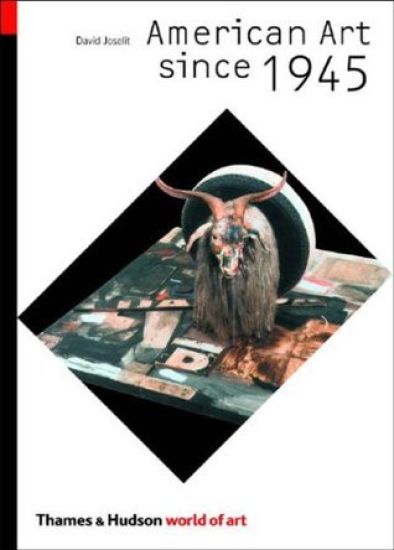
No other introductory book presents the diversity and complexity of postwar American art from Abstract Expressionism to the present as clearly and succinctly as this groundbreaking survey.David Joselit traces and analyses the often contradictory formal, ideological and political conditions during this period which made American art predominant throughout the world. Social and cultural transformations rooted in mass-media technologies – photography, television, video and the Internet – elevated consumer commodities to the status of legitimate art subjects, as in Pop and Installation art, and brought about a mechanization of the creative act. Artists also increasingly engaged with issues of gender, race, identity and power.Canonical movements and figures are discussed – Pollock, Rothko, Krasner, Oldenburg, Johns, Warhol, Paik, Ruscha, Sherman, Holzer, Koons and Barney – in juxtaposition with lesser known contemporary artists and practices.
Infinite Regress

Infinite Regress

David Joselit

MIT Press
2001
pokkari
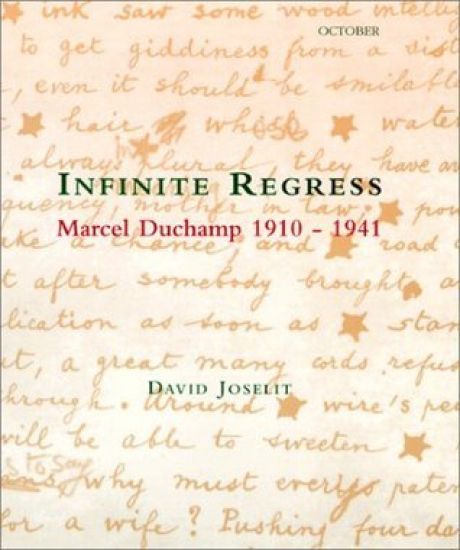
In Infinite Regress, David Joselit considers the plurality of identities and practices within Duchamp's life and art between 1910 and 1941, conducting a synthetic reading of his early and middle career.There is not one Marcel Duchamp, but several. Within his oeuvre Duchamp practiced a variety of modernist idioms and invented an array of contradictory personas: artist and art dealer, conceptualist and craftsman, chess champion and dreamer, dandy and recluse. In Infinite Regress, David Joselit considers the plurality of identities and practices within Duchamp's life and art between 1910 and 1941, conducting a synthetic reading of his early and middle career. Taking into account underacknowledged works and focusing on the conjunction of the machine and the commodity in Duchamp's art, Joselit notes a consistent opposition between the material world and various forms of measurement, inscription, and quantification. Challenging conventional accounts, he describes the readymade strategy not merely as a rejection of painting, but as a means of producing new models of the modern self.