Kirjojen hintavertailu. Mukana 12 127 145 kirjaa ja 12 kauppaa.
Kirjailija
David K. Reynolds
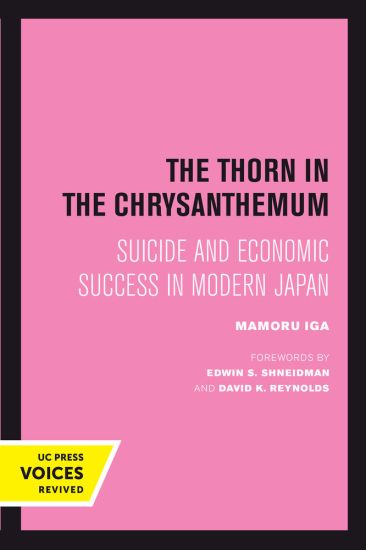
Kirjat ja teokset yhdessä paikassa: 25 kirjaa, julkaisuja vuosilta 1980-2024, suosituimpien joukossa The Thorn in the Chrysanthemum. Vertaile teosten hintoja ja tarkista saatavuus suomalaisista kirjakaupoista.
Japanese society is frequently held up to the Western world as a model of harmony and efficiency, but the price it pays tends to be overlooked. In a searching analysis that will fascinate students and admirers of Japan as much as it will inform psychologists and suicidologists, Mamoru Iga discusses the precise nature of the “thorn in the chrysanthemum,” a thorn that may hurt both the Japanese and the outsider who conducts business with them. The author, who was reared and educated in Japan, is uniquely qualified to interpret the value orientations of a society in which suicide is all too common. He finds that the traits leading to homogeneity and extreme adaptability in that society as a whole are the very traits that can produce painful reactions in the individual. Those traits are described as monism, groupism, authoritarianism, familism, and accommodationism, and together they comprise the Japanese “social character.” Because the individual’s behavior is based on the images, assumptions, and ideas about the world that make up his or her culture, conformism in the individual is one major manifestation of Japan’s social character. In Japan, the need to fill one’s socially prescribed role may make it doubly difficult to think independently and creatively and to find solutions for the resulting stress. Suicide notes and other personal documents reveal the painful cost of modern Japan’s success story, as the examination of individual suicides is related both to the theoretical framework of Durkheim’s types of suicide and to the sociological patterns that characterize suicide in Japan. It is in personal value orientations, however, that Iga finds the common ground between suicide and economic success. American readers will find especially interesting the contrast between value orientations in Japan and in the United States. Nearly the opposite of the Japanese traits described above, American values of rationalism, individualism, competition, and change create their own problems. There is much to be learned from this expert analysis of the problem of suicide in Japan. This title is part of UC Press's Voices Revived program, which commemorates University of California Press’s mission to seek out and cultivate the brightest minds and give them voice, reach, and impact. Drawing on a backlist dating to 1893, Voices Revived makes high-quality, peer-reviewed scholarship accessible once again using print-on-demand technology. This title was originally published in 1986.
Constructive Living proverbs inspired by proverbs from China, Japan, Tibet, and Mongolia. Common human wisdom from Asia distilled and adapted for Westerners though the lens of Constructive Living. Good for memorizing and posting around the home and workplace.
Constructive Living advice for young people. Practical suggestions for handling problems in the modern world. For more information about Constructive Living go to constructiveliving.org and constructiveliving2.weebly.com.
Published in the late twentieth century, a series of Constructive Living books carried some form of "Water" in the titles. This book contains some of the author's favorite chapters from those CL books.
The Constructive Living book, Even in Summer the Ice Doesn't Melt, revised and updated. Now available in e-book format.Constructive Living is a sensible, practical way to get the most out of life. Don't let anxiety, sorrow, regret or other feelings push you around. Learn about doing what needs to be done.
A revised, expanded, and updated version of the best-selling book, Playing Ball on Running Water. Written by the founder of Constructive Living this book shows the development of CL over the past 30 years.
Here, in plain language, is the definitive guide for taking control of your life and imbuing it with greater meaning and productivity. Constructive Living is an action-based way of looking at the world that combines good, old-fashioned straight talk and the celebrated Japanese psychotherapies Morita and Naikan. David Reynolds, the father of this brilliantly simple and effective therapy, shows us how to live thoughtfully and economically, to regard our actions as if they were divine rituals, and to perform them with the utmost care. He contends that contentment is achieved, not bestowed--attaining peace and satisfaction takes daily practice and learning. With user-friendly anecdotes, practical exercises, and a sense of humor, he refreshes the experienced student and takes the novice to the beginning, laying out the essence of Constructive Living.