Kirjojen hintavertailu. Mukana 12 595 353 kirjaa ja 12 kauppaa.

Kirjailija

David Kember

Kirjat ja teokset yhdessä paikassa: 8 kirjaa, julkaisuja vuosilta 2007-2016, suosituimpien joukossa Evaluating Teaching and Learning. Vertaile teosten hintoja ja tarkista saatavuus suomalaisista kirjakaupoista.

8 kirjaa

Kirjojen julkaisuhaarukka 2007-2016.

Understanding the Nature of Motivation and Motivating Students through Teaching and Learning in Higher Education
This book is based upon three interrelated open naturalistic studies conducted to better characterise the motivational orientation of students in higher education. Open semi-structured individual interviews were conducted with undergraduates, students at community colleges and students in taught postgraduate courses in Hong Kong. The analysis used an exploratory grounded theory approach and resulted in a motivational orientation framework with six continua with positive and negative poles. On enrolment students had positions on the six facets of motivation, which shifted as they progressed through their degree according to their perceptions of the teaching and learning environment. The framework can, therefore, be used to explain both initial decisions to enrol and motivation to continue studying. The interviews included descriptions of teaching approaches and learning activities and their effects on motivation. This made it possible to describe a teaching and learning environment conducive to motivation, with eight supportive conditions. Each facet of the teaching and learning environment is illustrated with quotations from the three groups of students, resulting in a guide to configuring a teaching and learning environment conducive to motivating students. The emerging community-college sector in Hong Kong is used as a case study of the effects on student motivation of the expansion of the higher education sector through private colleges. Cultural issues are discussed, particularly the performance of Asian students relative to those in the West.
Understanding the Nature of Motivation and Motivating Students through Teaching and Learning in Higher Education
This book is based upon three interrelated open naturalistic studies conducted to better characterise the motivational orientation of students in higher education. Open semi-structured individual interviews were conducted with undergraduates, students at community colleges and students in taught postgraduate courses in Hong Kong. The analysis used an exploratory grounded theory approach and resulted in a motivational orientation framework with six continua with positive and negative poles. On enrolment students had positions on the six facets of motivation, which shifted as they progressed through their degree according to their perceptions of the teaching and learning environment. The framework can, therefore, be used to explain both initial decisions to enrol and motivation to continue studying. The interviews included descriptions of teaching approaches and learning activities and their effects on motivation. This made it possible to describe a teaching and learning environment conducive to motivation, with eight supportive conditions. Each facet of the teaching and learning environment is illustrated with quotations from the three groups of students, resulting in a guide to configuring a teaching and learning environment conducive to motivating students. The emerging community-college sector in Hong Kong is used as a case study of the effects on student motivation of the expansion of the higher education sector through private colleges. Cultural issues are discussed, particularly the performance of Asian students relative to those in the West.
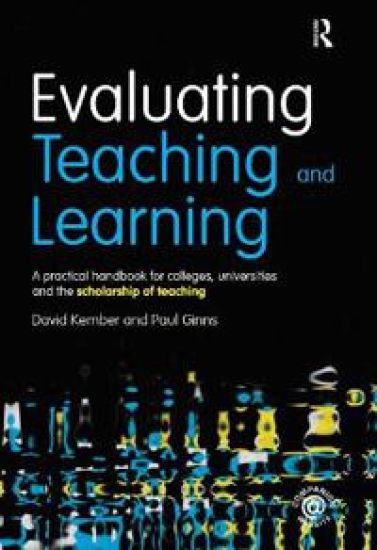
Evaluating Teaching and Learning

Evaluating Teaching and Learning

David Kember; Paul Ginns

Routledge
2011
sidottu
Every semester, colleges and universities ask students to complete innumerable course and teaching evaluation questionnaires to evaluate the learning and teaching in courses they have taken. For many universities it is a requirement that all courses be evaluated every semester. The laudable rationale is that the feedback provided will enable instructors to improve their teaching and the curriculum, thus enhancing the quality of student learning.In spite of this there is little evidence that it does improve the quality of teaching and learning. Ratings only improve if the instruments and the presentation of results are sufficiently diagnostic to identify potential improvements and there is effective counselling. Evaluating Teaching and Learning explains how evaluation can be more effective in enhancing the quality of teaching and learning and introduces broader and more diverse forms of evaluation.This guide explains how to develop questionnaires and protocols which are valid, reliabile and diagnostic. It also contains proven instruments that have undergone appropriate testing procedures, together with a substantial item bank. The book looks at the specific national frameworks for the evaluation of teaching in use in the USA, UK and Australia.It caters for diverse methodologies, both quantitative and qualitative and offers solutions that allow evaluation at a wide range of levels: from classrooms to programmes to departments and entire institutions. With detail on all aspects of the main evaluation techniques and instruments, the authors show how effective evaluation can make use of a variety of approaches and combine them into an effective project.With a companion website which has listings of the questionnaires and item bank, this book will be of interest to those concerned with organising and conducting evaluation in a college, university, faculty or department. It will also appeal to those engaged in the scholarship of teaching and learning.
Evaluating Teaching and Learning

Evaluating Teaching and Learning

David Kember; Paul Ginns

Routledge
2011
nidottu
Every semester, colleges and universities ask students to complete innumerable course and teaching evaluation questionnaires to evaluate the learning and teaching in courses they have taken. For many universities it is a requirement that all courses be evaluated every semester. The laudable rationale is that the feedback provided will enable instructors to improve their teaching and the curriculum, thus enhancing the quality of student learning.In spite of this there is little evidence that it does improve the quality of teaching and learning. Ratings only improve if the instruments and the presentation of results are sufficiently diagnostic to identify potential improvements and there is effective counselling. Evaluating Teaching and Learning explains how evaluation can be more effective in enhancing the quality of teaching and learning and introduces broader and more diverse forms of evaluation.This guide explains how to develop questionnaires and protocols which are valid, reliabile and diagnostic. It also contains proven instruments that have undergone appropriate testing procedures, together with a substantial item bank. The book looks at the specific national frameworks for the evaluation of teaching in use in the USA, UK and Australia.It caters for diverse methodologies, both quantitative and qualitative and offers solutions that allow evaluation at a wide range of levels: from classrooms to programmes to departments and entire institutions. With detail on all aspects of the main evaluation techniques and instruments, the authors show how effective evaluation can make use of a variety of approaches and combine them into an effective project.With a companion website which has listings of the questionnaires and item bank, this book will be of interest to those concerned with organising and conducting evaluation in a college, university, faculty or department. It will also appeal to those engaged in the scholarship of teaching and learning.
Reconsidering Open and Distance Learning in the Developing World
Distance learning is now more prevalent in the developing world than ever before. This book reconsiders the suitability and success of established modes of distance learning for current contexts in the developing world. It examines what adaptations are necessary to suit shifting needs including:the move from elite to mass higher educationincreased emphasis on knowledge base economiesgreater demand for lifelong learning and professional developmentthe effects of technical and societal changesdemand for post-secondary education.Drawing upon research into students' conceptions of, and approaches to learning, this critical analysis of the state of open and flexible learning examines the characteristics, needs and learning approaches of students, considering whether or not current provision is successful, what changes are necessary, and, crucially, how student retention can be improved.
Reconsidering Open and Distance Learning in the Developing World
Distance learning is now more prevalent in the developing world than ever before. This book reconsiders the suitability and success of established modes of distance learning for current contexts in the developing world. It examines what adaptations are necessary to suit shifting needs including:the move from elite to mass higher educationincreased emphasis on knowledge base economiesgreater demand for lifelong learning and professional developmentthe effects of technical and societal changesdemand for post-secondary education.Drawing upon research into students' conceptions of, and approaches to learning, this critical analysis of the state of open and flexible learning examines the characteristics, needs and learning approaches of students, considering whether or not current provision is successful, what changes are necessary, and, crucially, how student retention can be improved.
Enhancing University Teaching

Enhancing University Teaching

David Kember; Carmel McNaught

Routledge
2007
sidottu
Written by experts in the field, this book aims to provide an alternative approach to quality teaching in higher education by deriving a model of good university teaching from the academics which universities have chosen as their best teachers. Award-winning teachers outline their beliefs and practices as a teacher, covering key topics including:assessmentmotivating studentsplanning courses and lessonsteaching large classesreflection and feedbackmanaging discussion and group work.Illustrated with extracts from interviews with the award-winning teachers, and packed with activities and further reading, this textbook provides a set of principles for good teaching internationally.
Enhancing University Teaching

Enhancing University Teaching

David Kember; Carmel McNaught

Routledge
2007
nidottu
Written by experts in the field, this book aims to provide an alternative approach to quality teaching in higher education by deriving a model of good university teaching from the academics which universities have chosen as their best teachers. Award-winning teachers outline their beliefs and practices as a teacher, covering key topics including:assessmentmotivating studentsplanning courses and lessonsteaching large classesreflection and feedbackmanaging discussion and group work.Illustrated with extracts from interviews with the award-winning teachers, and packed with activities and further reading, this textbook provides a set of principles for good teaching internationally.