Kirjojen hintavertailu. Mukana 12 089 367 kirjaa ja 12 kauppaa.

Kirjailija

David Krieger

Kirjat ja teokset yhdessä paikassa: 11 kirjaa, julkaisuja vuosilta 1997-2024, suosituimpien joukossa Network Publicy Governance – On Privacy and the Informational Self. Vertaile teosten hintoja ja tarkista saatavuus suomalaisista kirjakaupoista.

11 kirjaa

Kirjojen julkaisuhaarukka 1997-2024.

From Systems to Actor-Networks

From Systems to Actor-Networks

Andr a Belliger; David Krieger

Ethics International Press Ltd
2024
sidottu
This book documents a paradigm shift, not only in the sciences but also in society. Everywhere in society systems are becoming networks. This implies not only a new understanding of social science but also of society and ourselves. The book describes the systems model based on Luhmann's theory of social systems and compares this to Latour's actor-network theory. It argues that present day society cannot be successfully modeled as a system and illustrates the transformation to a global network society by citing many examples from business, education, and healthcare. The authors argue that actor-network theory provides a more comprehensive account of these changes than systems theory. Based on actor-network theory, they propose a theory of the "digital transformation" that is ushering in the global network society. Although people in all areas talk about systems, adaptive behavior, evolution, complexity, and networks, few know where these concepts come from, and what they mean in the theories they belong to. This book is for all who are concerned with clarifying the often taken-for-granted assumptions and concepts that are implicitly or explicitly derived from systems theory and network theory. It offers an introduction to the work of Luhmann and Latour and a critical and constructive development of these important theories for the 21st century.

Network Publicy Governance – On Privacy and the Informational Self

Network Publicy Governance – On Privacy and the Informational Self

Andréa Belliger; David Krieger

Transcript Verlag
2021
nidottu
The information age has brought about a growing conflict between proponents of a data-driven society on the one side and demands for protection of individual freedom, autonomy, and dignity by means of privacy on the other. The causes of this conflict are rooted in the modern Western opposition of individual and society and a self-understanding of the human as an autonomous rational subject with an inalienable right to informational self-determination. Andréa Belliger and David J. Krieger propose a theory of information as a common good and redefine the individual as an informational self who exists in networks made up of both humans and nonhumans. Privacy is replaced by publicy and issues of data use and data protection are described in terms of governance instead of government.
In the Shadow of the Bomb: Poems of Survival

In the Shadow of the Bomb: Poems of Survival

David Krieger

Createspace Independent Publishing Platform
2018
nidottu
The poems in this volume have been written in the shadow of the bomb. They are poems of survival. They challenge the hubris of those who would rely on nuclear arms for their security. They pose the questions: "How shall we react? How shall we resist? How shall we awaken before it is too late?" This book sounds a warning siren, but it is also a book of hope-hope that people everywhere will awaken to the nuclear dangers that confront us; hope that our shared humanity will prevail; hope that the children of the future will thrive; hope that the bomb and its shadow will be resisted and forever banished from our world; and hope that there will be a new era of love, kindness, compassion and peace.
Portraits: Peacemakers, Warmongers and People Between

Portraits: Peacemakers, Warmongers and People Between

David Krieger

Createspace Independent Publishing Platform
2017
nidottu
Portraits: Peacemakers, Warmongers and People Between is a new book of peace poetry by David Krieger, president of the Nuclear Age Peace Foundation. The book begins with an examination of what it means to be human in our time, and ncludes portraits of Albert Einstein, Rosa Parks, Nelson Mandela, Muhammad Ali, Robert McNamara, and Emperor Hirohito, among others. Archbishop Desmond Tutu writes about the book, "Poetry that awakens our deepest humanity. Each poem leaves me wanting another." Perie Longo, Santa Barbara Poet Laureate Emerita, writes, "In the lessons of these sometimes tough, often poignant, well wrought poems, lies the hope of humanity's survival." An important book to read and share.
Wake Up!

Wake Up!

David Krieger

Createspace Independent Publishing Platform
2015
nidottu
Wake Up is the latest poetry book by David Krieger. He has written four books of peace poetry and also edited four peace poetry anthologies. He continues on his path of writing piercing and thought-provoking peace poetry. His poems are often poems of remembrance, as well as warnings about the dangers of the nuclear age. Wake Up is divided into six sections: Truth Is Beauty; War; Remembering Bush II; Global Hiroshima; Peace; Portraits; and Imperfection. Krieger has received many awards for his work for peace and a nuclear-free world, including three peace writing awards from the OMNI Center for Peace, Justice and Ecology. These poems leave us wanting to do more to build a peaceful world and assure humanity's future. The book has received much praise. Nobel Peace Laureate Archbishop Desmond Tutu wrote, "There is haunting beauty and truth in this poetry." Doug Rawlings, poet and Vietnam War veteran said of Wake Up that "...it reads like a series of eloquent telegrams sent directly to the heart of a culture, ours..." Lawrence Ferlinghetti, poet and author of A Coney Island of the Mind, wrote: "Wake Up is accessible and moving writing, setting itself against the dominant murderous culture of our time. Every poem hits home."
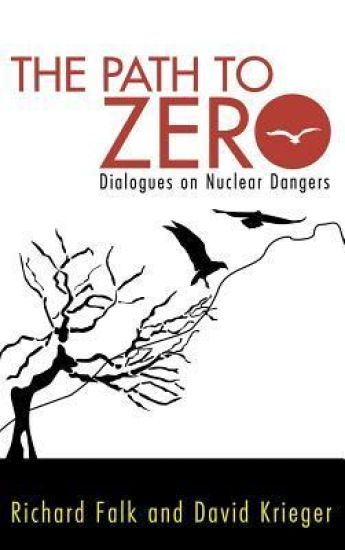
Path to Zero

Path to Zero

Richard A. Falk; David Krieger

Paradigm
2012
nidottu
The Path to Zero argues that it is time to re-open the public debate on nuclear weapons. In a series of clear and well-reasoned dialogues, long-time scholars and peace activists Richard Falk and David Krieger probe key questions about our nuclear capability and dig beneath the secrecy that has largely surrounded its existence. Falk and Krieger argue that Hiroshima and Nagasaki were only the beginning. In recent times, nuclear annihilation at the hands of rogue states and terrorists has become an even greater concern than the spectre of nuclear war between superpowers. The Path to Zero argues that whilst none of us has the power to bring about global change alone, together we are immensely powerful - powerful enough to overcome the threats of the Nuclear Age and move us appreciably along 'the path to zero'.
Path to Zero

Path to Zero

Richard A. Falk; David Krieger

Paradigm
2012
sidottu
The Path to Zero argues that it is time to re-open the public debate on nuclear weapons. In a series of clear and well-reasoned dialogues, long-time scholars and peace activists Richard Falk and David Krieger probe key questions about our nuclear capability and dig beneath the secrecy that has largely surrounded its existence. Falk and Krieger argue that Hiroshima and Nagasaki were only the beginning. In recent times, nuclear annihilation at the hands of rogue states and terrorists has become an even greater concern than the spectre of nuclear war between superpowers. The Path to Zero argues that whilst none of us has the power to bring about global change alone, together we are immensely powerful - powerful enough to overcome the threats of the Nuclear Age and move us appreciably along 'the path to zero'.
Natur als Kulturprodukt

Natur als Kulturprodukt

David Krieger; Christian Jäggi

Birkhauser Verlag AG
1997
nidottu
Der vorliegende Band ist aus dem dreijährigen Forschungsprojekt "Interreligiöse Umweltethik" des Instituts fur Kommunikationsforschung heraus entstanden, das vom Schweizerischen Nationalfonds finanziert wurde und im Rahmen des Schwerpunktprogramms Umwelt lief Das Buch setzt sich aus drei Teilen zusammen: Im ersten Teil wird der Zusammenhang zwischen Natur und Kultur reflektiert. Ausgehend von der Tatsache, dass Umweltforschung schon längst nicht mehr ausschliessliche Fragestellung oder gar Eigentum der Naturwissenschaften ist, werden Natur und Kultur als soziales System aufgefasst. Umwelttfagen, ihre Thematisierung oder Ignorierung sind Ausdruck gesellschaftlicher Kommunikation, bzw. der Art, wie eine Gesellschaft organisiert ist. Dabei wird versucht, Prinzipien einer (geisteswissenschaftlichen) Kulturökologie als Beitrag zur aktuellen Umwelt-und Ökologiediskussion zu skizzieren. Zentral im ersten Teil dieses Bandes ist die Frage nach einer "ökologischen" Kultur. Damit ist nicht eine Kultur gemeint, die an ihre natürliche Umwelt "angepasst" ist oder wird, sondern die Organisation gesellschaftlicher Kommunikation, die in sich genügend Komplexität, aber auch Flexibilität aufweist, um die Informationen, welche die Naturwissenschaften ständig liefern, politisch, wirtschaftlich, rechtlich usw. umzusetzen.