
Kirjojen hintavertailu. Mukana 12 390 323 kirjaa ja 12 kauppaa.

Kirjailija

David L. Wank

Kirjat ja teokset yhdessä paikassa: 4 kirjaa, julkaisuja vuosilta 1999-2023, suosituimpien joukossa Commodifying Communism. Vertaile teosten hintoja ja tarkista saatavuus suomalaisista kirjakaupoista.

4 kirjaa

Kirjojen julkaisuhaarukka 1999-2023.

The Space of Religion

The Space of Religion

Yoshiko Ashiwa; David L. Wank

Columbia University Press
2023
pokkari
Finalist, 2024 Award for Excellence in the Study of Religion in Analytical-Descriptive Studies, American Academy of ReligionHonorable Mention, 2024 Francis H.K. Hsu Book Prize, Society for East Asian AnthropologyThe Nanputuo Temple in the southeastern Chinese city of Xiamen has been a cherished site for the worship of the bodhisattva Guanyin for centuries. It was a center of modernizing Buddhism in the early twentieth century and a flagship for the revival of Buddhism after state suppression during the Cultural Revolution. The Space of Religion takes readers inside the Nanputuo Temple in order to explore the practice of Buddhism in modern China and the complex relationship between Buddhism and the Chinese state.Based on three decades of ethnographic research, Yoshiko Ashiwa and David L. Wank tell the story of Nanputuo against the backdrop of a dramatic stretch of Chinese history. They vividly depict episodes such as renovating the halls, reestablishing ties with overseas Chinese donors, conflicts with local government, revival of ritual life, reopening of its Buddhist academy, and the passion of the Guanyin birthday festival. To understand Nanputuo, Buddhist communities, and other temples in Xiamen, Ashiwa and Wank develop the concept of religion as a space constituted by physical, semiotic, and institutional dimensions. They also show how the Chinese state and Buddhism have each adapted to the other, as the temple has adjusted to government policy while the state has deployed Buddhism in its promotion of Chinese culture.This interdisciplinary book is both a theoretically generative analysis of religious spaces and an empirically rich account of the recovery of Buddhism in China after the Mao era.

The Space of Religion

The Space of Religion

Yoshiko Ashiwa; David L. Wank

Columbia University Press
2023
sidottu
Finalist, 2024 Award for Excellence in the Study of Religion in Analytical-Descriptive Studies, American Academy of ReligionHonorable Mention, 2024 Francis H.K. Hsu Book Prize, Society for East Asian AnthropologyThe Nanputuo Temple in the southeastern Chinese city of Xiamen has been a cherished site for the worship of the bodhisattva Guanyin for centuries. It was a center of modernizing Buddhism in the early twentieth century and a flagship for the revival of Buddhism after state suppression during the Cultural Revolution. The Space of Religion takes readers inside the Nanputuo Temple in order to explore the practice of Buddhism in modern China and the complex relationship between Buddhism and the Chinese state.Based on three decades of ethnographic research, Yoshiko Ashiwa and David L. Wank tell the story of Nanputuo against the backdrop of a dramatic stretch of Chinese history. They vividly depict episodes such as renovating the halls, reestablishing ties with overseas Chinese donors, conflicts with local government, revival of ritual life, reopening of its Buddhist academy, and the passion of the Guanyin birthday festival. To understand Nanputuo, Buddhist communities, and other temples in Xiamen, Ashiwa and Wank develop the concept of religion as a space constituted by physical, semiotic, and institutional dimensions. They also show how the Chinese state and Buddhism have each adapted to the other, as the temple has adjusted to government policy while the state has deployed Buddhism in its promotion of Chinese culture.This interdisciplinary book is both a theoretically generative analysis of religious spaces and an empirically rich account of the recovery of Buddhism in China after the Mao era.
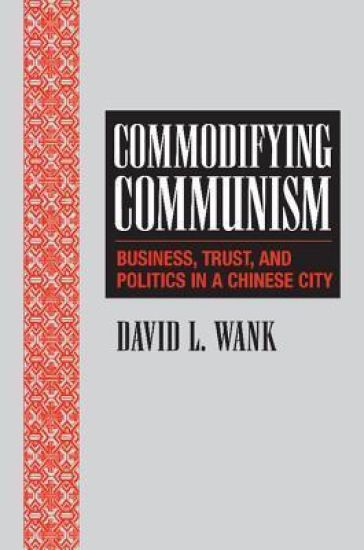
Commodifying Communism

Commodifying Communism

David L. Wank

Cambridge University Press
2001
pokkari
Commodifying Communism is an ethnographically grounded account of the institutional organization and political consequences of China's historically unprecedented market growth. Drawing upon almost two years of ethnographic fieldwork, this book challenges conventional views of post-communist emerging markets being tied to the retreat of the state. David Wank shows how entrepreneurs running private trading companies in Xiamen City, Fujian Province (one of China's five special economic zones) maximize profit and security through patron-client networks with local state agents. The book examines how processes of opportunity, exchange, expectations, and advantage are constrained by both statist and popular institutions in market clientelism. It also considers the implications of market clientelism for the dynamism of China's emerging market economy relative to Eastern European post-communist economies and its political consequences for state-society and center-local relations.
Commodifying Communism

Commodifying Communism

David L. Wank

Cambridge University Press
1999
sidottu
Commodifying Communism is an ethnographically grounded account of the institutional organization and political consequences of China's historically unprecedented market growth. Drawing upon almost two years of ethnographic fieldwork, this book challenges conventional views of post-communist emerging markets being tied to the retreat of the state. David Wank shows how entrepreneurs running private trading companies in Xiamen City, Fujian Province (one of China's five special economic zones) maximize profit and security through patron-client networks with local state agents. The book examines how processes of opportunity, exchange, expectations, and advantage are constrained by both statist and popular institutions in market clientelism. It also considers the implications of market clientelism for the dynamism of China's emerging market economy relative to Eastern European post-communist economies and its political consequences for state-society and center-local relations.