Kirjojen hintavertailu. Mukana 12 390 323 kirjaa ja 12 kauppaa.

Kirjailija

David L. Woodruff

Kirjat ja teokset yhdessä paikassa: 6 kirjaa, julkaisuja vuosilta 2006-2022, suosituimpien joukossa Introduction to Computational Optimization Models for Production Planning in a Supply Chain. Vertaile teosten hintoja ja tarkista saatavuus suomalaisista kirjakaupoista.

6 kirjaa

Kirjojen julkaisuhaarukka 2006-2022.

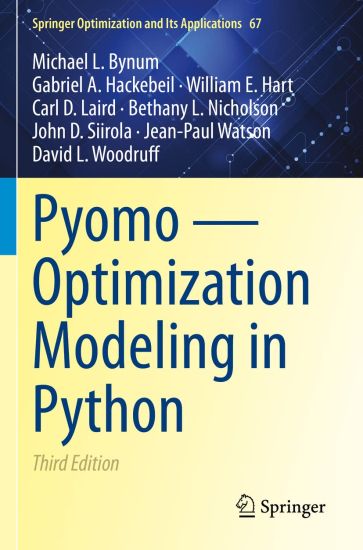
Pyomo — Optimization Modeling in Python

Pyomo — Optimization Modeling in Python

Michael L. Bynum; Gabriel A. Hackebeil; William E. Hart; Carl D. Laird; Bethany L. Nicholson; John D. Siirola; Jean-Paul Watson; David L. Woodruff

Springer Nature Switzerland AG
2022
nidottu
This book provides a complete and comprehensive guide to Pyomo (Python Optimization Modeling Objects) for beginning and advanced modelers, including students at the undergraduate and graduate levels, academic researchers, and practitioners. Using many examples to illustrate the different techniques useful for formulating models, this text beautifully elucidates the breadth of modeling capabilities that are supported by Pyomo and its handling of complex real-world applications. In the third edition, much of the material has been reorganized, new examples have been added, and a new chapter has been added describing how modelers can improve the performance of their models. The authors have also modified their recommended method for importing Pyomo. A big change in this edition is the emphasis of concrete models, which provide fewer restrictions on the specification and use of Pyomo models. Pyomo is an open source software package for formulating and solving large-scale optimization problems. The software extends the modeling approach supported by modern AML (Algebraic Modeling Language) tools. Pyomo is a flexible, extensible, and portable AML that is embedded in Python, a full-featured scripting language. Python is a powerful and dynamic programming language that has a very clear, readable syntax and intuitive object orientation. Pyomo includes Python classes for defining sparse sets, parameters, and variables, which can be used to formulate algebraic expressions that define objectives and constraints. Moreover, Pyomo can be used from a command-line interface and within Python's interactive command environment, which makes it easy to create Pyomo models, apply a variety of optimizers, and examine solutions.
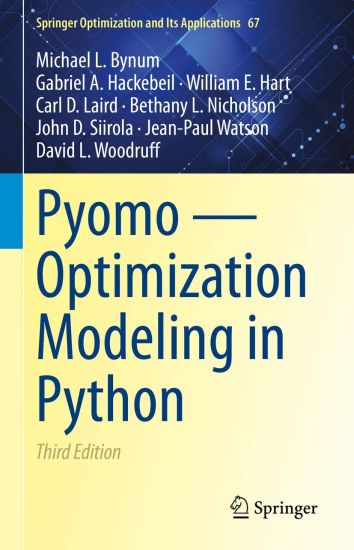
Pyomo — Optimization Modeling in Python

Pyomo — Optimization Modeling in Python

Michael L. Bynum; Gabriel A. Hackebeil; William E. Hart; Carl D. Laird; Bethany L. Nicholson; John D. Siirola; Jean-Paul Watson; David L. Woodruff

Springer Nature Switzerland AG
2021
sidottu
This book provides a complete and comprehensive guide to Pyomo (Python Optimization Modeling Objects) for beginning and advanced modelers, including students at the undergraduate and graduate levels, academic researchers, and practitioners. Using many examples to illustrate the different techniques useful for formulating models, this text beautifully elucidates the breadth of modeling capabilities that are supported by Pyomo and its handling of complex real-world applications. In the third edition, much of the material has been reorganized, new examples have been added, and a new chapter has been added describing how modelers can improve the performance of their models. The authors have also modified their recommended method for importing Pyomo. A big change in this edition is the emphasis of concrete models, which provide fewer restrictions on the specification and use of Pyomo models. Pyomo is an open source software package for formulating and solving large-scale optimization problems. The software extends the modeling approach supported by modern AML (Algebraic Modeling Language) tools. Pyomo is a flexible, extensible, and portable AML that is embedded in Python, a full-featured scripting language. Python is a powerful and dynamic programming language that has a very clear, readable syntax and intuitive object orientation. Pyomo includes Python classes for defining sparse sets, parameters, and variables, which can be used to formulate algebraic expressions that define objectives and constraints. Moreover, Pyomo can be used from a command-line interface and within Python's interactive command environment, which makes it easy to create Pyomo models, apply a variety of optimizers, and examine solutions.
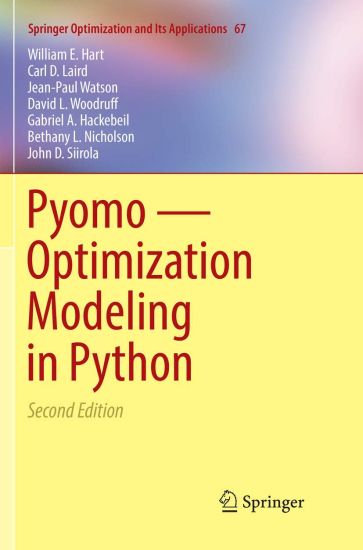
Pyomo — Optimization Modeling in Python

Pyomo — Optimization Modeling in Python

William E. Hart; Carl D. Laird; Jean-Paul Watson; David L. Woodruff; Gabriel A. Hackebeil; Bethany L. Nicholson; John D. Siirola

Springer International Publishing AG
2018
nidottu
?This book provides a complete and comprehensive guide to Pyomo (Python Optimization Modeling Objects) for beginning and advanced modelers, including students at the undergraduate and graduate levels, academic researchers, and practitioners. Using many examples to illustrate the different techniques useful for formulating models, this text beautifully elucidates the breadth of modeling capabilities that are supported by Pyomo and its handling of complex real-world applications. This second edition provides an expanded presentation of Pyomo’s modeling capabilities, providing a broader description of the software that will enable the user to develop and optimize models. Introductory chapters have been revised to extend tutorials; chapters that discuss advanced features now include the new functionalities added to Pyomo since the first edition including generalized disjunctive programming, mathematical programming with equilibrium constraints, and bilevel programming.Pyomois an open source software package for formulating and solving large-scale optimization problems. The software extends the modeling approach supported by modern AML (Algebraic Modeling Language) tools. Pyomo is a flexible, extensible, and portable AML that is embedded in Python, a full-featured scripting language. Python is a powerful and dynamic programming language that has a very clear, readable syntax and intuitive object orientation. Pyomo includes Python classes for defining sparse sets, parameters, and variables, which can be used to formulate algebraic expressions that define objectives and constraints. Moreover, Pyomo can be used from a command-line interface and within Python's interactive command environment, which makes it easy to create Pyomo models, apply a variety of optimizers, and examine solutions.
Pyomo – Optimization Modeling in Python

Pyomo – Optimization Modeling in Python

William E. Hart; Carl Laird; Jean-Paul Watson; David L. Woodruff

Springer-Verlag New York Inc.
2014
nidottu
This book provides a complete and comprehensive reference/guide to Pyomo (Python Optimization Modeling Objects) for both beginning and advanced modelers, including students at the undergraduate and graduate levels, academic researchers, and practitioners. The text illustrates the breadth of the modeling and analysis capabilities that are supported by the software and support of complex real-world applications. Pyomo is an open source software package for formulating and solving large-scale optimization and operations research problems. The text begins with a tutorial on simple linear and integer programming models. A detailed reference of Pyomo's modeling components is illustrated with extensive examples, including a discussion of how to load data from data sources like spreadsheets and databases. Chapters describing advanced modeling capabilities for nonlinear and stochastic optimization are also included. The Pyomo software provides familiar modeling features within Python, a powerful dynamic programming language that has a very clear, readable syntax and intuitive object orientation. Pyomo includes Python classes for defining sparse sets, parameters, and variables, which can be used to formulate algebraic expressions that define objectives and constraints. Moreover, Pyomo can be used from a command-line interface and within Python's interactive command environment, which makes it easy to create Pyomo models, apply a variety of optimizers, and examine solutions. The software supports a different modeling approach than commercial AML (Algebraic Modeling Languages) tools, and is designed for flexibility, extensibility, portability, and maintainability but also maintains the central ideas in modern AMLs.
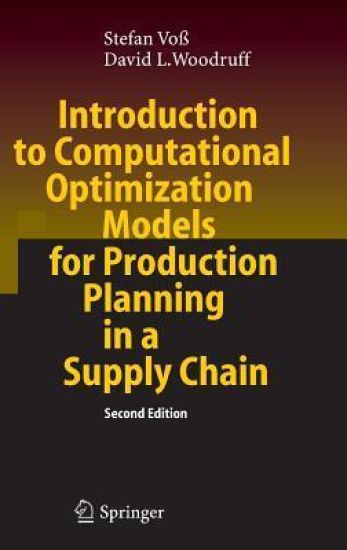
Introduction to Computational Optimization Models for Production Planning in a Supply Chain

Introduction to Computational Optimization Models for Production Planning in a Supply Chain

Stefan Voss; David L. Woodruff

Springer-Verlag Berlin and Heidelberg GmbH Co. K
2010
nidottu
provide models that could be used by do-it-yourselfers and also can be used toprovideunderstandingofthebackgroundissuessothatonecandoabetter job of working with the (proprietary) algorithms of the software vendors. In this book we strive to provide models that capture many of the - tails faced by ?rms operating in a modern supply chain, but we stop short of proposing models for economic analysis of the entire multi-player chain. In other words, we produce models that are useful for planning within a supply chain rather than models for planning the supply chain. The usefulness of the models is enhanced greatly by the fact that they have been implemented - ing computer modeling languages. Implementations are shown in Chapter 7, which allows solutions to be found using a computer. A reasonable question is: why write the book now? It is a combination of opportunities that have recently become available. The availability of mod- inglanguagesandcomputersthatprovidestheopportunitytomakepractical use of the models that we develop. Meanwhile, software companies are p- viding software for optimized production planning in a supply chain. The opportunity to make use of such software gives rise to a need to understand some of the issues in computational models for optimized planning. This is best done by considering simple models and examples.
Introduction to Computational Optimization Models for Production Planning in a Supply Chain

Introduction to Computational Optimization Models for Production Planning in a Supply Chain

Stefan Voss; David L. Woodruff

Springer-Verlag Berlin and Heidelberg GmbH Co. K
2006
sidottu
provide models that could be used by do-it-yourselfers and also can be used toprovideunderstandingofthebackgroundissuessothatonecandoabetter job of working with the (proprietary) algorithms of the software vendors. In this book we strive to provide models that capture many of the - tails faced by ?rms operating in a modern supply chain, but we stop short of proposing models for economic analysis of the entire multi-player chain. In other words, we produce models that are useful for planning within a supply chain rather than models for planning the supply chain. The usefulness of the models is enhanced greatly by the fact that they have been implemented - ing computer modeling languages. Implementations are shown in Chapter 7, which allows solutions to be found using a computer. A reasonable question is: why write the book now? It is a combination of opportunities that have recently become available. The availability of mod- inglanguagesandcomputersthatprovidestheopportunitytomakepractical use of the models that we develop. Meanwhile, software companies are p- viding software for optimized production planning in a supply chain. The opportunity to make use of such software gives rise to a need to understand some of the issues in computational models for optimized planning. This is best done by considering simple models and examples.