Kirjojen hintavertailu. Mukana 12 595 353 kirjaa ja 12 kauppaa.

Kirjailija

David Leblang

Kirjat ja teokset yhdessä paikassa: 4 kirjaa, julkaisuja vuosilta 2006-2023, suosituimpien joukossa Democratic Processes and Financial Markets. Vertaile teosten hintoja ja tarkista saatavuus suomalaisista kirjakaupoista.

4 kirjaa

Kirjojen julkaisuhaarukka 2006-2023.

The Ties That Bind

The Ties That Bind

David Leblang; Benjamin Helms

Cambridge University Press
2023
pokkari
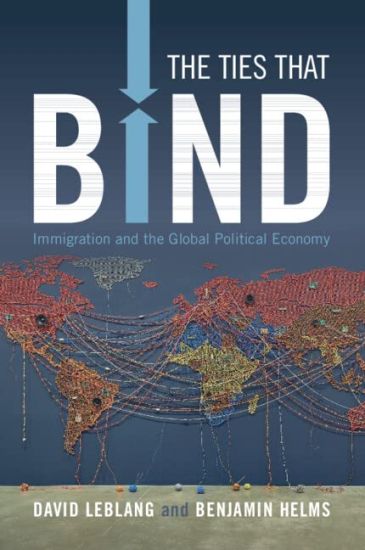
Migration is among the central domestic and global political issues of today. Yet the causes and consequences - and the relationship between migration and global markets – are poorly understood. Migration is both costly and risky, so why do people decide to migrate? What are the political, social, economic, and environmental factors that cause people to leave their homes and seek a better life elsewhere? Leblang and Helms argue that political factors - the ability to participate in the political life of a destination - are as important as economic and social factors. Most migrants don't cut ties with their homeland but continue to be engaged, both economically and politically. Migrants continue to serve as a conduit for information, helping drive investment to their homelands. The authors combine theory with a wealth of micro and macro evidence to demonstrate that migration isn't static, after all, but continuously fluid.

The Ties That Bind

The Ties That Bind

David Leblang; Benjamin Helms

Cambridge University Press
2023
sidottu
Migration is among the central domestic and global political issues of today. Yet the causes and consequences - and the relationship between migration and global markets – are poorly understood. Migration is both costly and risky, so why do people decide to migrate? What are the political, social, economic, and environmental factors that cause people to leave their homes and seek a better life elsewhere? Leblang and Helms argue that political factors - the ability to participate in the political life of a destination - are as important as economic and social factors. Most migrants don't cut ties with their homeland but continue to be engaged, both economically and politically. Migrants continue to serve as a conduit for information, helping drive investment to their homelands. The authors combine theory with a wealth of micro and macro evidence to demonstrate that migration isn't static, after all, but continuously fluid.
Democratic Processes and Financial Markets

Democratic Processes and Financial Markets

William Bernhard; David Leblang

Cambridge University Press
2006
pokkari
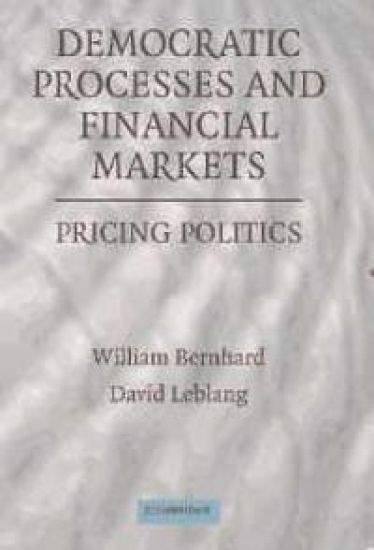
The authors examine the conditions under which democratic events, including elections, cabinet formations, and government dissolutions, affect asset markets. Where these events have less predictable outcomes, market returns are depressed and volatility increases. In contrast, where market actors can forecast the result, returns do not exhibit any unusual behavior. Further, political expectations condition how markets respond to the political process. When news causes market actors to update their political beliefs, market actors reallocate their portfolios, and overall market behavior changes. To measure political information, Professors Bernhard and Leblang employ sophisticated models of the political process. They draw on a variety of models of market behavior, including the efficient markets hypothesis, capital asset pricing model, and arbitrage pricing theory, to trace the impact of political events on currency, stock, and bond markets. The analysis will appeal to academics, graduate students, and advanced undergraduates across political science, economics, and finance.
Democratic Processes and Financial Markets

Democratic Processes and Financial Markets

William Bernhard; David Leblang

Cambridge University Press
2006
sidottu
The authors examine the conditions under which democratic events, including elections, cabinet formations, and government dissolutions, affect asset markets. Where these events have less predictable outcomes, market returns are depressed and volatility increases. In contrast, where market actors can forecast the result, returns do not exhibit any unusual behavior. Further, political expectations condition how markets respond to the political process. When news causes market actors to update their political beliefs, market actors reallocate their portfolios, and overall market behavior changes. To measure political information, Professors Bernhard and Leblang employ sophisticated models of the political process. They draw on a variety of models of market behavior, including the efficient markets hypothesis, capital asset pricing model, and arbitrage pricing theory, to trace the impact of political events on currency, stock, and bond markets. The analysis will appeal to academics, graduate students, and advanced undergraduates across political science, economics, and finance.