Kirjojen hintavertailu. Mukana 12 595 353 kirjaa ja 12 kauppaa.

Kirjailija

David Lewis Schaefer

Kirjat ja teokset yhdessä paikassa: 4 kirjaa, julkaisuja vuosilta 1992-2007, suosituimpien joukossa Illiberal Justice. Vertaile teosten hintoja ja tarkista saatavuus suomalaisista kirjakaupoista.

4 kirjaa

Kirjojen julkaisuhaarukka 1992-2007.

Illiberal Justice

Illiberal Justice

David Lewis Schaefer

University of Missouri Press
2007
sidottu
Often considered the greatest American political philosopher of the twentieth century, and the most important liberal theorist since John Stuart Mill, John Rawls enjoys a practically sacrosanct status among scholars of political theory, law, and ethics. In ""Illiberal Justice"", David Schaefer offers the most thorough challenge to Rawls' doctrine yet published, demonstrating how his teachings deviate from the core tradition of constitutional liberalism as exemplified by leading American statesmen from the founders through Lincoln and beyond. ""Illiberal Justice"" is the first comprehensive overview of all of Rawls' writings, emphasizing the continuity in his thought and intention to a greater extent than other scholars have done. Schaefer offers a fundamental critique of both Rawls' conception of political philosophy and the policy judgments he derives from his ""principles of justice."" Schaefer argues that Rawls' failure to ground his teaching about justice in a serious analysis of human nature or an empirical grasp of political life is symptomatic of a larger crisis within contemporary liberal political and jurisprudential theorizing. Although Rawls is commonly viewed as a welfare-state liberal, Schaefer stresses that his writings actually embody a radical transformation of liberalism in the direction of libertarianism that deviates sharply from the American liberal tradition. Citing empirical evidence of the persistence of political and economic opportunity in America, Schaefer challenges Rawls' allegations that our polity suffers from grave injustices. He points out the strikingly apocalyptic tone of Rawls' last writings, in which Rawls even questions whether human existence is worthwhile if his principles are not actualized. ""Illiberal Justice"" is not only a critique of Rawls' political program and philosophic methodology, it is also a defense of the American constitutional order against Rawls' dogmatic theorizing, which Schaefer argues has exercised an increasing, and detrimental, effect on our jurisprudence. By combining a thorough critical exegesis of Rawls' texts with a broad engagement with the tradition of political philosophy and American political thought, Schaefer makes an important contribution to both our understanding of Rawls and the enterprise of political philosophy.
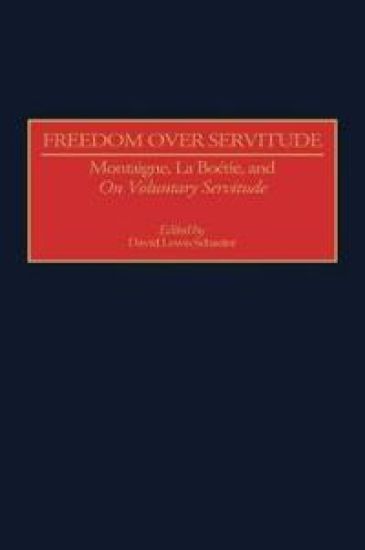
Freedom Over Servitude

Freedom Over Servitude

David Lewis Schaefer

Praeger Publishers Inc
1998
sidottu
This volume contains five articles by prominent scholars of French literature and political philosophy that examine the relation between Montaigne's Essays, one of the classic works of the French philosophical and literary traditions, and the writings attributed by Montaigne to his friend, the French humanist Etienne de La Boétie's.Three contributors to the volume suggest that Montaigne was the real author of the revolutionary tract On Voluntary Servitude, along with the other works he attributed to La Boétie's. Two contributors describe the remarkable mathematical and/or mythological patterns found in both the Essays and the works ascribed to La Boétie's. Several essays articulate the revolutionary political teaching found in the Essays as well as On Voluntary Servitude, challenging the conventional view of Montaigne as a political conservative. And all the contributors challenge the received view that he was an artless or nonchalant writer. The volume also includes new translations of both On Voluntary Servitude and the 29 Sonnets of Etienne de La Boetie that Montaigne included in all editions of the Essays except the final one. An important work for students and scholars of political philosophy, Renaissance history, and French and comparative literature.
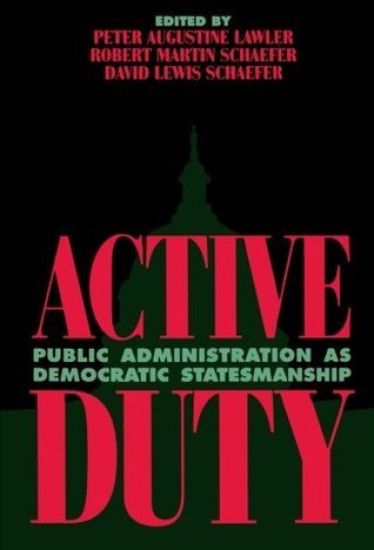
Active Duty

Active Duty

Robert Martin Schaefer; David Lewis Schaefer

Rowman Littlefield
1998
nidottu
In Active Duty: Public Administration as Democratic Statesmanship, a distinguished group of contributors examines the role of the American civil service under the Constitution. The common concern that unites the otherwise diverse approaches of the authors is the conception of public administration as a particular form of political activity. The contributors relate administrative issues to the broader questions of political life, such as political judgment and responsibility, the Constitution and constitutionalism, and the promotion of human liberty and the common good. They aim to encourage the administrator to become a democratic statesman. Present and prospective American civil servants, as well as political scientists and political philosophers, will find this book of interest.
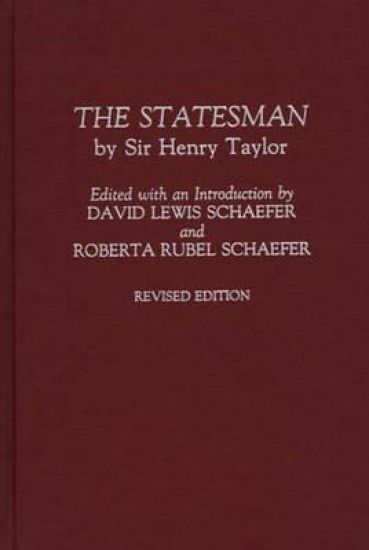
The Statesman

The Statesman

Henry Taylor; David Lewis Schaefer; Roberta Rubel Schaefer

Praeger Publishers Inc
1992
sidottu
Sir Henry Taylor's classic treatise The Statesman, originally published in 1836, is the first modern book to be devoted to the subject of public administration. It has been read and studied by generations for its keen insights into the relationship between public administrators and elected officials in a democracy. It has also been appreciated for its wit. The present volume is the first twentieth-century edition to be based on the revised and expanded text that Taylor published in 1878 as part of his Collected Works. It is also the first edition to be fully annotated.The lengthy editors' introduction to this volume emphasizes the relevance of Taylor's thought to the fundamental issues of public administration in the contemporary United States. The editors demonstrate the superiority of Taylor's understanding of the relationship between politics and administration to the widely accepted model of that relation that derives from the thought of Woodrow Wilson. Above all, they argue, Taylor's insights merit our attention because they indicate how a properly organized civil service can be a locus of statesmanship in a democracy, fulfilling the intentions of the authors of the American Constitution in a contemporary context that differs significantly from what the Founders themselves anticipated.