Kirjailija
David Lockwood
Kirjat ja teokset yhdessä paikassa: 16 kirjaa, julkaisuja vuosilta 1968-2024, suosituimpien joukossa The Indian Bourgeoisie. Vertaile teosten hintoja ja tarkista saatavuus suomalaisista kirjakaupoista.
16 kirjaa
Kirjojen julkaisuhaarukka 1968-2024.
A new evaluation of the history of the Malayan Communist Party. By 1946, the Malayan Communist Party (MCP) had become one of the most successful communist parties in Asia. From its foundation in 1930, it had built up a membership in the thousands, mainly among Chinese and Indian workers in Malaya. When the Japanese arrived, the MCP organized the Malayan People’s Anti-Japanese Army (MPAJA), the only effective resistance force. After the War, when the British returned, the Party launched a legal campaign for independence, but by 1948, the MCP had surrendered its achievements and taken many members underground to launch a disastrous, failed insurrection against the British. To understand these momentous turns of history, a fresh view is required of the Malayan Communist Party as a political actor. The Politics of the Malayan Communist Party from 1930 to 1948 gives a political history of the Party and explains why the MCP self-destructed in 1948. In particular, David Lockwood questions assumptions that post-war politics led inevitably to armed struggle and questions the accepted narrative of Party Chairman Lai Tek's treachery. This is a revisionist history of a period, and political force, that has left a lasting mark on the politics of Malaya and Singapore.

Fooled by the Winners: How Survivor Bias Deceives Us
David Lockwood
Greenleaf Book Group Press
2021
sidottu
Fooled by the Winners will change the way you think about the stock market, health care, global warming, diets, lotteries, restaurants, and your siblings. It will reshape your perspective of the past and give you a clearer view of the future. Fooled by the Winners is a book about survivor bias, the cognitive error of focusing on the winners, the successes, and the living. But in many instances, we can learn more from those who have lost, failed, or died. After reading this book, you will understand how survivor bias is often used to deceive us. You will learn how to stop paying for financial services that promise more than they deliver, for health care that doesn't make us healthier, for diets that don't make us slimmer, and for advice books that don't offer good advice. You will also come away with a different view of our past, including our perilous evolutionary journey and how history has often been written by the winners. You will come to understand how we are fooled by the winners in warfare, such as in the deployment of nuclear weapons and the most famous example of survivor bias--the missing Allied bombers of WWII. Previous studies of survivor bias have been inaccessible to most, housed in formula-laden statistical journals. But you won't find any math or technical jargon here. David Lockwood, a former member of the faculty of the Graduate School of Business at Stanford University, applies the concept of survivor bias to specific, real-world examples--minus the equations. Through compelling analysis and the real-life stories, this book demonstrates the deceptive influence of survivor bias in our daily lives and on our thinking.
The complex and hard-fought movement for political freedom in India coincided with the rise of a wealthy capitalist class of Indian industrialists who had profited under British rule. By 1947, these prominent businessmen had forged a partnership with the socialist-led Indian National Congress, and supported Jawaharlal Nehru's implementation of a centrally-planned economy. In this political history of modern India, David Lockwood traces the roots of this capitalist class, concentrated in Bombay, Calcutta and the west Bengal coal mining region, and examines British economic policy in the nineteenth century. Indian capitalists, such as J.R.D Tata of Tata Steel, established powerful relationships with domestic governments throughout the period, holding indigenous industrial conferences and supporting the swadeshi movement which aimed to promote Indian-manufactured goods. The Indian Bourgeoisie is a unique and important contribution to the lively debate on the role of India's capitalists during the Raj and throughout the early years of independence.
Syntactic Analysis and Description
David Lockwood
Continuum International Publishing Group Ltd.
2005
nidottu
This book is designed to teach undergraduate and beginning graduate students how to understand, analyse and describe syntactic phenomena in different languages. The book covers every aspect of syntax from the basics to more specialised topics, such as clitics which have grammatical importance but cannot be used in isolation, and negation, in which a construction contradicts the meaning of a sentence. The approach taken combines concepts from different theoretical schools, which view syntax differently. These include M. A. K. Halliday's systemic functional linguistics, the stratificational school advocated by Sydney Lamb, and Kenneth L. Pike's tagmemic model. The emphasis of the book is on syntactic structures rather than linguistic meaning, and the book stresses the difference between a well-formed sentence and a meaningful one. The final chapter brings these two aspects together, to show the connections between syntax and semology. Each chapter concludes with exercises from a diverse range of languages and a list of major technical terms. The book also includes a glossary as an essential resource for students approaching this difficult subject for the first time.
Syntactic Analysis and Description
David Lockwood
Continuum International Publishing Group Ltd.
2003
nidottu
This book is designed to teach undergraduate and beginning graduate students about the varieties of syntactic phenomena in different languages and a method of analyzing and describing them. The method is based on the concept of the syntactic construction, which is shared by various views of language structure. In this particular presentation, a construction is characterized as a combination of obligatory and optional functions, and each of these functions is related to a class of manifestations. Syntax as a whole is then seen as interrelating constructions on the ranks (size-levels) of the phrase, clause, and sentence.Besides the essential features of phrase, clause, and sentence structures, there are chapters devoted to special topics such as clitics, negation, clausal organization, and voice and related devices.While the emphasis is on the actual syntactic structures observable in the data, the relation of syntactic phenomena to linguistic meaning is also considered. In particular, the final chapter shows how account of syntax can often be simplified if control from meaning structure is assumed. Throughout the book, a distinction between meaningfulness and syntactic-well formedness is consistently made.
Syntactic Analysis and Description
David Lockwood
Continuum International Publishing Group Ltd.
2003
sidottu
Aimed at undergraduate and beginning graduate students, this work covers the varieties of syntactic phenomena in different languages and a method of analyzing and describing them. The method is based on the concept of the syntactic construction, which is shared by various views of language structure. In this particular presentation, a construction is characterized as a combination of obligatory and optional functions, and each of these functions is related to a class of manifestations. Syntax as a whole is then seen as interrelating constructions on the ranks (size-levels) of the phrase, clause, and sentence. Besides the essential features of phrase, clause, and sentence structures, there are chapters devoted to special topics such as clitics, negation, clausal organization, and voice and related devices.
This book presents a critical comparison and evaluation of the assumptions underlying explanations of social order and conflict which are to be found in the work of Durkheim and Marx, and of their most important followers. Its major theme is that, although the two bodies of theory rest on fundamentally opposed ideas of social structure and social action, both have to draw on auxiliary hypotheses which are to a high degree complementary - the residual categories of the one theory proving to be those that are analytically central to the other. This is most evident when Durkheimian theory seeks to account for social disorder, and Marxist theory for its absence. This challenging argument is developed in detail, by reference to a wide range of empirical research, and points the way to new ways of thinking about how societies alternate between the poles of solidarity and schism.
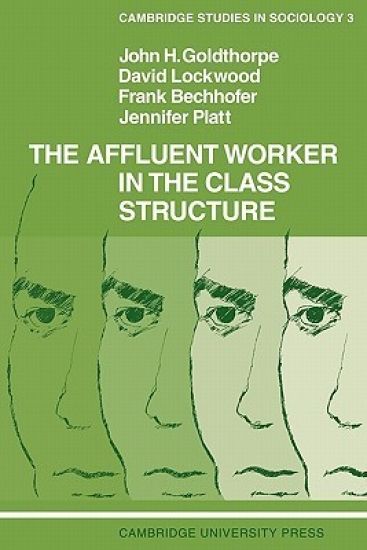
The Affluent Worker in the Class Structure
Goldthorpe John H.; David Lockwood; Bechhofer Frank; Jennifer Platt
Cambridge University Press
1969
sidottu
This final book in The Affluent Worker series was originally published in 1969. It contains the findings and conclusions on the issues the research was specifically designed to investigate - the extent of working class embourgeoisment. This thesis is examined in the several contexts of work, sociability, social aspirations and imagery, and so on. At all these points it is called into question empirically and conceptually. In this volume which brings the project to an end, the authors also take up again the broad questions of class and politics out of which the investigation originally sprang.
The Affluent Worker in the Class Structure
John H. Goldthorpe; David Lockwood; Frank Bechhofer; Jennifer Platt
Cambridge University Press
1969
pokkari
This final book in The Affluent Worker series was originally published in 1969. It contains the findings and conclusions on the issues the research was specifically designed to investigate - the extent of working class embourgeoisment. This thesis is examined in the several contexts of work, sociability, social aspirations and imagery, and so on. At all these points it is called into question empirically and conceptually. In this volume which brings the project to an end, the authors also take up again the broad questions of class and politics out of which the investigation originally sprang.
The Affluent Worker
John H. Goldthorpe; David Lockwood; Frank Bechhofer; Jennifer Platt
Cambridge University Press
1968
pokkari
This 1968 volume, the second of The Affluent Worker monographs, reports on the voting and political attitudes of highly paid manual workers. As in the first book, the affluent workers studied are employed in Luton, a town which benefited faster and more consistently than almost any other in Britain from the economic progress of the 'fifties and early 'sixties. The sample was chosen as a 'critical' case to test some widely accepted views on the assimilation of the working classes into patterns of middle-class social life. On the basis of material from interviews, the authors give an account of the workers' political orientations, and this is followed by an analysis of voting in relationship to income house ownership, social origin and trade union membership. The main findings - that, despite their affluence, the majority of these workers remain staunch supporters of the Labour Party - runs counter to contemporary beliefs about working-class embourgeoisement.
The Affluent Worker: Industrial Attitudes and Behaviour
John H. Goldthorpe; David Lockwood; Frank Bechhofer; Jennifer Platt
Cambridge University Press
1968
pokkari
The affluent workers studied in this book, originally published in 1968, were employees of three major industrial concerns sited in Luton at the time. The three firms were selected as being amongst Luton's best-paying employers and also on account of their advanced personnel and labour relations policies. This choice enabled comparisons to be made between workers engaged in very different types of production system. On the basis of material from interviews and other data, the authors examine in detail workers' experience of their industrial jobs, their relations with workmates, and the nature of their attachment both to the organizations which employ them and to their trade unions. This study forms part of a larger project which was aimed at testing empirically the thesis, which was most prevalent 1968, that of the progressive assimilation of manual workers and their families into the pattern of middle class social life.