Kirjojen hintavertailu. Mukana 12 390 323 kirjaa ja 12 kauppaa.
Kirjailija
David Luban
Kirjat ja teokset yhdessä paikassa: 11 kirjaa, julkaisuja vuosilta 1988-2026, suosituimpien joukossa Georgetown Journal of International Affairs. Vertaile teosten hintoja ja tarkista saatavuus suomalaisista kirjakaupoista.
This book is about conscience and moral clarity. It asks how some people keep their judgment steadfast even when many around them are swept away by conspiracy theories, moral panics, and murderous ideologies-or, on a smaller scale, by immersion in a corrupt and corrupting workplace culture. It asks about the surprising fragility of common sense, including moral common sense, and it asks where morality fits into a meaningful human life. Beyond this, the book asks about legal accountability for crimes committed when moral judgment fails on a vast and deadly scale. Hannah Arendt addressed all these questions in a profound and original way. Drawing on her published works, letters, diaries, and notes, David Luban offers clear accounts of Arendt's contributions to moral philosophy and international law, showing how her ideas about judgment and accountability remain crucially important to the moral and legal life of our century.
Buy a new version of this textbook and receive access to the Connected eBook on Casebook Connect, including lifetime access to the online ebook with highlight, annotation, and search capabilities. Access also includes an outline tool and other helpful resources. Connected eBooks provide what you need most to be successful in your law school classes. International and Transnational Criminal Law, Fourth Edition, by David J. Luban, Julie R. O'Sullivan, David P. Stewart, and Neha Jain covers both international criminal law and the application of U.S. criminal law transnationally. This comprehensive and versatile book has chapters on each of the core crimes (aggression, genocide, crimes against humanity, and war crimes) as well as terrorism and torture. It has separate chapters on the international tribunals from Nuremberg on and the ICC. Other chapters treat modes of liability, defenses, crimes against women, and alternatives to criminal prosecution in post-conflict societies. It also covers U.S. criminal law in transnational contexts, including money laundering, Foreign Corrupt Practices Act, trafficking, and terrorism. In addition, it includes chapters on extradition, evidence gathering abroad, comparative criminal procedure and comparative sentencing, and U.S. constitutional rights abroad. Introductory chapters on the nature of international criminal law, transnational jurisdiction, and the basics of public international law make the book accessible to students (as well as government lawyers and private practitioners) with no prior background in this increasingly important field.New to the Fourth Edition: Recent developments in the international tribunals, including the Special Court for the Central African Republic and Colombia's Special Jurisdiction for Peace.Updates on post-Morrison jurisdictional developments, including new cases and exposition. Expanded treatment of aggression, including coverage of the Russia-Ukraine conflict.Comprehensive revision of the chapter on obtaining evidence abroad, with greater emphasis on difficulties facing defense counsel.Updates on ICC jurisprudence, including developments on command responsibility and criminal defenses.Updated genocide chapter, including a new section on cultural genocide and discussion of the Ukraine v. Russia ICJ litigation.Professors and students will benefit from: Versatility: The book can be used for courses on international criminal law and also for courses on U.S. criminal law applied across borders.Self-contained introductory chapters on basic public international law, transnational jurisdiction, and the nature of criminal law.A detailed treatment of "headline" issues including torture, terrorism, war crimes, and the Russia-Ukraine conflict. Readable background on historical context.
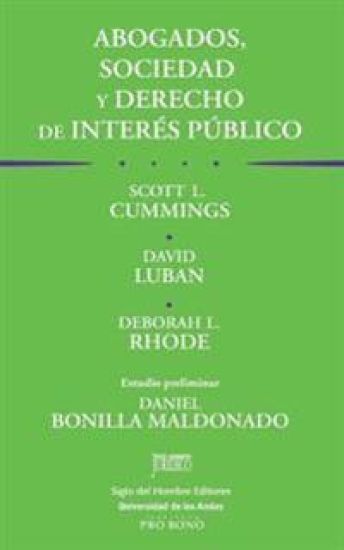
Los abogados tienen dos tipos de obligaciones profesionales. Las primeras son las obligaciones contractuales que exigen que los abogados representen tica y competentemente a sus clientes y las segundas son las obligaciones sociales que tienen los abogados con su comunidad pol tica. El libro tiene dos objetivos que se relacionan con este ltimo tipo de obligaciones: analizar la estructura b sica que articula y promueve el trabajo jur dico pro bono y examinar la manera como esta estructura se conecta con las obligaciones sociales de los abogados. Por tanto, busca introducir a los abogados y estudiantes de Derecho en el tema del trabajo pro bono y hacer expl citas sus fortalezas y debilidades.
According to the United Nations, 9.6 billion people will inhabit our planet by 2050. Population growth and movement will have an enormous impact on global dynamics in the twenty-first century, in both the developing world as well as in advanced industrialized societies. In light of this global demographic reality, this issue of the Georgetown Journal of International Affairs focuses on the topic of "Destabilizing Demographics," exploring the opportunities and challenges presented by dynamic population patterns and structures. Demographic shifts affect multiple facets of international affairs, impacting economies, modifying politics, and reshaping the fabric of our societies. These changes could have catastrophic international consequences if ignored or evaded. However, as this issue's Forum demonstrates, the future holds promise for those who choose to reorganize on the cusp of significant population transformation. Adaptation as a form of mitigation must be informed by diverse solutions and multi-sectoral cooperation. Consider, for example, the intersection of family planning and climate change, or the connection between gender gaps and crime. Through pragmatic policymaking and international collaboration, seismic demographic change may not necessitate disaster. We round out this issue with articles regarding decidedly twenty-first century concerns: communication, integration, and globalization. Moha Ennaji describes the challenges of Berber language incorporation in Morocco and its significance to democratic reform. Dan Saxon examines the role of human judg-ment in semi-autonomous weapons use, questioning the ethics of unmanned machines. Andres Monroy-Hernandez and Luis Daniel Palacios analyze the utility, efficacy, and implications of citizen journalism within Mexico's ongoing drug war. And Lawrence Gostin and Alexandra Phelan explore how, in an increasingly interconnected world, the international community can collectively prevent and control the spread of infectious diseases. The Georgetown Journal of International Affairs is the official publication of the Edmund A. Walsh School of Foreign Service at Georgetown University. Each issue of the journal provides readers with a diverse array of timely, peer-reviewed content penned by top policymakers, business leaders, and academic luminaries. The Journal takes a holistic approach to international affairs and features a 'Forum' that offers focused analysis on a specific key issue with each new edition of the publication, as well as nine regular sections: Books, Business & Economics, Conflict & Security, Culture & Society, Law & Ethics, A Look Back, Politics & Diplomacy, Science & Technology, and View from the Ground.
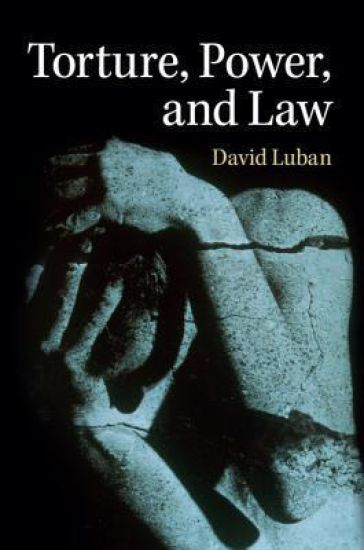
This volume brings together the most important writing on torture and the 'war on terror by one of the leading US voices in the torture debate. Philosopher and legal ethicist David Luban reflects on this contentious topic in a powerful sequence of essays including two new and previously unpublished pieces. He analyzes the trade-offs between security and human rights, as well as the connection between torture, humiliation, and human dignity, the fallacy of using ticking bomb scenarios in debates about torture, and the ethics of government lawyers. The book develops an illuminating and novel conception of torture as the use of pain and suffering to communicate absolute dominance over the victim. Factually stimulating and legally informed, this volume provides the clearest analysis to date of the torture debate. It brings the story up to date by discussing the Obama administration's failure to hold torturers accountable.
This volume brings together the most important writing on torture and the 'war on terror by one of the leading US voices in the torture debate. Philosopher and legal ethicist David Luban reflects on this contentious topic in a powerful sequence of essays including two new and previously unpublished pieces. He analyzes the trade-offs between security and human rights, as well as the connection between torture, humiliation, and human dignity, the fallacy of using ticking bomb scenarios in debates about torture, and the ethics of government lawyers. The book develops an illuminating and novel conception of torture as the use of pain and suffering to communicate absolute dominance over the victim. Factually stimulating and legally informed, this volume provides the clearest analysis to date of the torture debate. It brings the story up to date by discussing the Obama administration's failure to hold torturers accountable.
David Luban is one of the world's leading scholars of legal ethics. In this collection of his most significant papers he ranges over such topics as the moral psychology of organisational evil, the strengths and weaknesses of the adversary system, and jurisprudence from the lawyer's point of view. His discussion combines philosophical argument, legal analysis and many cases drawn from actual law practice, and he defends a theory of legal ethics that focuses on lawyers' role in enhancing human dignity and human rights. In addition to an analytical introduction, the volume includes two major previously unpublished papers, including a detailed critique of the US government lawyers who produced the notorious 'torture memos'. It will be of interest to a wide range of readers in both philosophy and law.
David Luban is one of the world's leading scholars of legal ethics. In this collection of his most significant papers he ranges over such topics as the moral psychology of organisational evil, the strengths and weaknesses of the adversary system, and jurisprudence from the lawyer's point of view. His discussion combines philosophical argument, legal analysis and many cases drawn from actual law practice, and he defends a theory of legal ethics that focuses on lawyers' role in enhancing human dignity and human rights. In addition to an analytical introduction, the volume includes two major previously unpublished papers, including a detailed critique of the US government lawyers who produced the notorious 'torture memos'. It will be of interest to a wide range of readers in both philosophy and law.
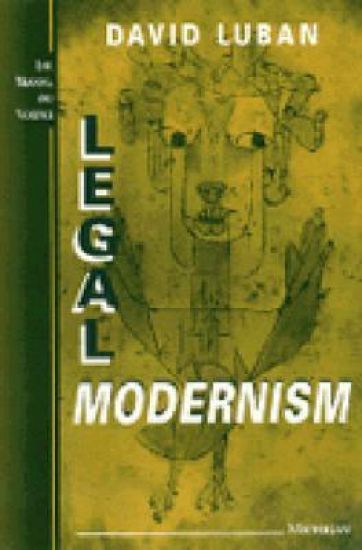
Modernism in legal theory is no different from modernism in the arts: both respond to a cultural crisis, a sense that institutions and traditions have lost their validity. Some doubt the importance of the rule of law, others question the objectivity of legal reasoning. We have lost confidence in the justice of our legal institutions, and even in our very capacity to identify justice.Legal philosopher David Luban argues that we cannot escape the modernist predicament. Accusing contemporary legal theorists of evading rather than confronting the challenge of modernity, he offers important and original objections to pragmatism, traditionalism, and nihilism. He argues that only by weaving together the broken narrative and forgotten voices of history's victims can we come to appreciate the nature of justice in modern society. Calling a trial the embodiment of the law's self-criticism, Luban demonstrates the centrality of narrative by analyzing the trial of Martin Luther King, the Nuremberg trials, and trial scenes in Homer, Hesiod, and Aeschylus. With these examples, Luban explores several of the tensions that motivate much more contemporary legal theory: order versus justice, obedience versus resistance, statism versus communitarianism.". . . an illuminating account of how contemporary legal theory can be understood as an expression of 'the modernist predicament' by exploring the analogy between modernism in the arts and modernism in law, politics, and philosophy. . . . a valuable critical discussion of modern legal theory." --ChoiceDavid Luban is Morton and Sophia Macht Professor of Law at the University of Maryland and Research Scholar at the Institute for Philosophy and Public Policy. His other books include Lawyers and Justice: An Ethical Study.
The law, Holmes said, is no brooding omnipresence in the sky. "If that is true," writes David Luban, "it is because we encounter the legal system in the form of flesh-and-blood human beings: the police if we are unlucky, but for the (marginally) luckier majority, the lawyers." For practical purposes, the lawyers are the law. In this comprehensive study of legal ethics, Luban examines the conflict between common morality and the lawyer's "role morality" under the adversary system and how this conflict becomes a social and political problem for a community. Using real examples and drawing extensively on case law, he develops a systematic philosophical treatment of the problem of role morality in legal practice. He then applies the argument to the problem of confidentiality, outlines an affordable system of legal services for the poor, and provides an in-depth philosophical treatment of ethical problems in public interest law.


![International and Transnational Criminal Law: [Connected Ebook]](/covers/9781543847093.jpg)