Kirjojen hintavertailu. Mukana 12 595 353 kirjaa ja 12 kauppaa.

Kirjailija

David M. Gordon

Kirjat ja teokset yhdessä paikassa: 8 kirjaa, julkaisuja vuosilta 1982-2012, suosituimpien joukossa Beyond the Wasteland. Vertaile teosten hintoja ja tarkista saatavuus suomalaisista kirjakaupoista.

Mukana myös kirjoitusasut: David M Gordon

8 kirjaa

Kirjojen julkaisuhaarukka 1982-2012.

Invisible Agents

Invisible Agents

David M. Gordon

Ohio University Press
2012
pokkari
Invisible Agents shows how personal and deeply felt spiritual beliefs can inspire social movements and influence historical change. Conventional historiography concentrates on the secular, materialist, or moral sources of political agency. Instead, David M. Gordon argues, when people perceive spirits as exerting power in the visible world, these beliefs form the basis for individual and collective actions. Focusing on the history of the south-central African country of Zambia during the nineteenth and twentieth centuries, his analysis invites reflection on political and religious realms of action in other parts of the world, and complicates the post-Enlightenment divide of sacred and profane. The book combines theoretical insights with attention to local detail and remarkable historical sweep, from oral narratives communicated across slave-trading routes during the nineteenth century, through the violent conflicts inspired by Christian and nationalist prophets during colonial times, and ending with the spirits of Pentecostal rebirth during the neoliberal order of the late twentieth century. To gain access to the details of historical change and personal spiritual beliefs across this long historical period, Gordon employs all the tools of the African historian. His own interviews and extensive fieldwork experience in Zambia provide texture and understanding to the narrative. He also critically interprets a diverse range of other sources, including oral traditions, fieldnotes of anthropologists, missionary writings and correspondence, unpublished state records, vernacular publications, and Zambian newspapers. Invisible Agents will challenge scholars and students alike to think in new ways about the political imagination and the invisible sources of human action and historical change.
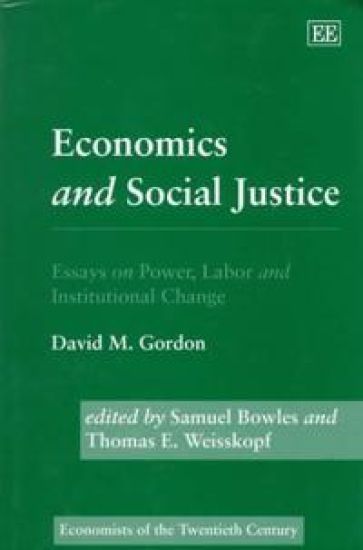
Economics and Social Justice

Economics and Social Justice

David M. Gordon

Edward Elgar Publishing Ltd
1998
sidottu
David Gordon was a pioneer in the burgeoning field of institutional growth economics, introducing the concept of a 'social structure of accumulation', and richly illustrating its usefulness with both econometric and historical studies. Gordon also helped to develop the theory of segmented labor markets and contributed to the econometric and historical analysis of their evolution. This authoritative collection of his most influential works - selected and introduced by his two closest collaborators - embraces the full range of his lifelong scholarly endeavor to deploy modern economic reasoning in the cause of social justice.The work opens with an introduction and overview of David Gordon's career and published work. This is followed by his major essays on a great variety of topics, including the economics of crime, urban history, wage stagnation in the US economy, the organization of work, the 'top-heavy' modern corporation, the social and institutional determinants of productivity growth and the globalization of economic life, as well as labor market segmentation and the social structure of accumulation.Gordon's synthesis of questions of neo-Marxian and more conventional provenance, and his integration of historical and econometric methods in providing answers, makes Economics and Social Justice a unique and intellectually rewarding analysis of contemporary capitalism.
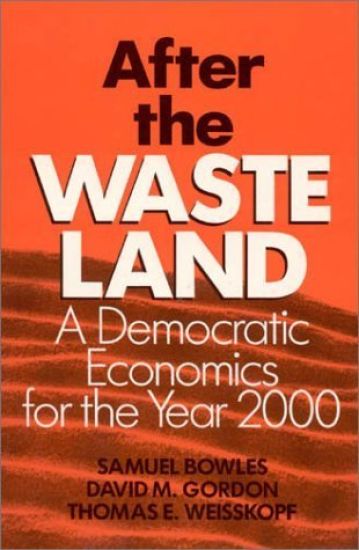
After the Waste Land

After the Waste Land

Samuel Bowles; David M. Gordon; Thomas E. Weisskopf

M.E. Sharpe
1990
nidottu
This critique of Reaganomics attempts to provide alternatives to both the supply experiments of the 1980s and neoliberal strategies of austerity. It presents arguments for economic democracy with a worker-oriented blueprint for improving productivity, growth, employment and economic justice.
After the Waste Land

After the Waste Land

Samuel Bowles; David M. Gordon; Thomas E. Weisskopf

M.E. Sharpe
1990
sidottu
This critique of Reaganomics attempts to provide alternatives to both the supply experiments of the 1980s and neoliberal strategies of austerity. It presents arguments for economic democracy with a worker-oriented blueprint for improving productivity, growth, employment and economic justice.
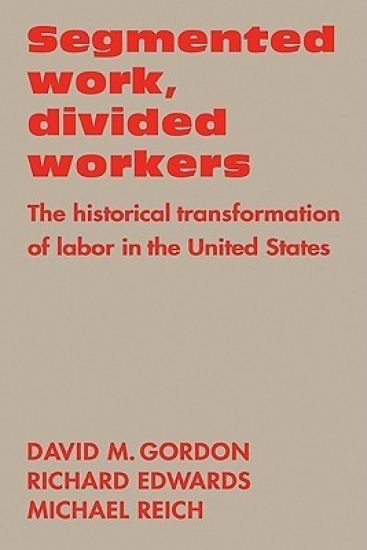
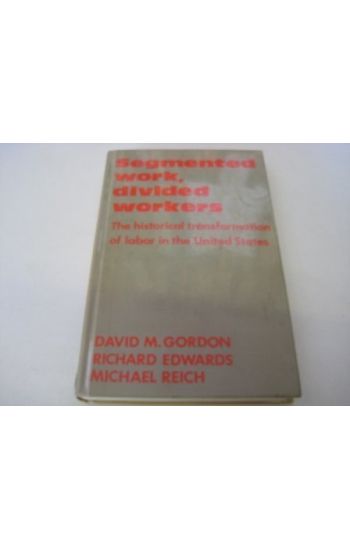
Segmented Work, Divided Workers

Segmented Work, Divided Workers

David M. Gordon; Richard Edwards; Michael Reich

Cambridge University Press
1982
pokkari
Segmented Work, Divided Workers presents a restatement and expansion of the theory of labor segmentation by three of its founding scholars. The authors argue that divisions with the US working class are rooted in a segmentation of jobs since World War II. They explain the origins of job segmentation through a careful and systematic historical analysis of changes in the labor process and the structure of labor markets since the early 1800s. this analysis builds, in turn, upon hypotheses about successive stages in the history of capitalist development. Segmented Work, Divided Workers integrates this economics analysis with a careful historial appreciation of the complexity of working-class experience in the United States.
Segmented Work, Divided Workers

Segmented Work, Divided Workers

David M. Gordon

Cambridge University Press
1982
sidottu
Segmented Work, Divided Workers presents a restatement and expansion of the theory of labor segmentation by three of its founding scholars. The authors argue that divisions with the US working class are rooted in a segmentation of jobs since World War II. They explain the origins of job segmentation through a careful and systematic historical analysis of changes in the labor process and the structure of labor markets since the early 1800s. this analysis builds, in turn, upon hypotheses about successive stages in the history of capitalist development. Segmented Work, Divided Workers integrates this economics analysis with a careful historial appreciation of the complexity of working-class experience in the United States.