Kirjojen hintavertailu. Mukana 12 390 323 kirjaa ja 12 kauppaa.
Kirjailija
David M Levinson
Kirjat ja teokset yhdessä paikassa: 10 kirjaa, julkaisuja vuosilta 2002-2025, suosituimpien joukossa The End of Traffic and the Future of Access. Vertaile teosten hintoja ja tarkista saatavuus suomalaisista kirjakaupoista.
This book describes how to create the 30-Minute City. The first part of the book explains accessibility. We next consider access through history (chapter 2). Access is the driving force behind how cities were built. Its use today is described when looking at access and the Greater Sydney Commission's plan for Sydney. We then examine short-run fixes: things that can be done instantaneously, or nearly so, at low budget to restore access for people, which include retiming traffic signals (chapter 3) and deploying bike sharing (chapter 5) supported by protected bike lane networks (chapter 4), as well public transport timetables (chapter 6). We explore medium-run fixes that include implementing rapid bus networks (chapter 7) and configuring how people get to train stations by foot and on bus (chapter 8). We turn to longer-run fixes. These are as much policy changes as large investments, and include job/worker balance (chapter 10) and network restructuring (chapter 9) as well as urban restoration (chapter 11), suburban retrofit (chapter 12), and greenfield development (chapter 13). We conclude with thoughts about the 'pointlessness' of cities and how to restructure practice (chapter 14). The appendices provide detail on access measurement (Appendix A), the idea of accessibility loss (B), valuation (C), the rationale for the 30-minute threshold (D), and reliability (E). It concludes with what should we research (F).
This book describes how to create the 30-Minute City. The first part of the book explains accessibility. We next consider access through history (chapter 2). Access is the driving force behind how cities were built. Its use today is described when looking at access and the Greater Sydney Commission's plan for Sydney.We then examine short-run fixes: things that can be done instantaneously, or nearly so, at low budget to restore access for people, which include retiming traffic signals (chapter 3) and deploying bike sharing (chapter 5) supported by protected bike lane networks (chapter 4), as well public transport timetables (chapter 6).We explore medium-run fixes that include implementing rapid bus networks (chapter 7) and configuring how people get to train stations by foot and on bus (chapter 8).We turn to longer-run fixes. These are as much policy changes as large investments, and include job/worker balance (chapter 10) and network restructuring (chapter 9) as well as urban restoration (chapter 11), suburban retrofit (chapter 12), and greenfield development (chapter 13).We conclude with thoughts about the 'pointlessness' of cities and how to restructure practice (chapter 14).The appendices provide detail on access measurement (Appendix A), the idea of accessibility loss (B), valuation (C), the rationale for the 30-minute threshold (D), and reliability (E). It concludes with what should we research (F).
As cities around the globe respond to rapid technological changes and political pressures, coordinated transport and land use planning is an often targeted aim.Metropolitan Transport and Land Use, the second edition of Planning for Place and Plexus, provides unique and updated perspectives on metropolitan transport networks and land use planning, challenging current planning strategies, offering frameworks to understand and evaluate policy, and suggesting alternative solutions.The book includes current and cutting-edge theory, findings, and recommendations which are cleverly illustrated throughout using international examples. This revised work continues to serve as a valuable resource for students, researchers, practitioners, and policy advisors working across transport, land use, and planning.
As cities around the globe respond to rapid technological changes and political pressures, coordinated transport and land use planning is an often targeted aim.Metropolitan Transport and Land Use, the second edition of Planning for Place and Plexus, provides unique and updated perspectives on metropolitan transport networks and land use planning, challenging current planning strategies, offering frameworks to understand and evaluate policy, and suggesting alternative solutions.The book includes current and cutting-edge theory, findings, and recommendations which are cleverly illustrated throughout using international examples. This revised work continues to serve as a valuable resource for students, researchers, practitioners, and policy advisors working across transport, land use, and planning.
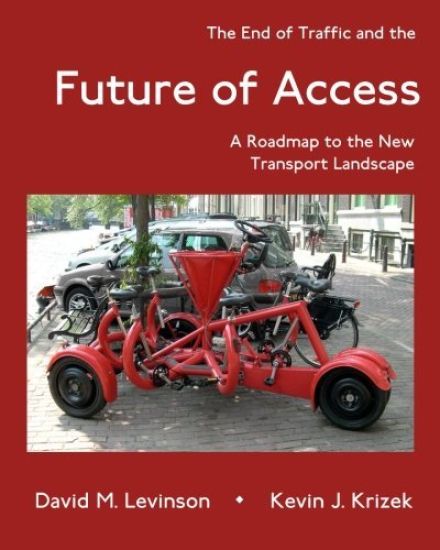
In this book we propose the welcome notion that traffic-as most people have come to know it-is ending and why. We depict a transport context in most communities where new opportunities are created by the collision of slow, medium, and fast moving technologies. We then unfold a framework to think more broadly about concepts of transport and accessibility. In this framework, transport systems are being augmented with a range of information technologies; it invokes fresh flows of goods and information. We discuss large scale trends that are revolutionizing the transport landscape: electrification, automation, the sharing economy, and big data. Based on all of this, the final chapters offer strategies to shape the future of infrastructure needs and priorities.We aim for a quick read-and to encourage you and other readers to think outside your immediate realm. By the end of this book (today, if you so choose) you will appreciate the changing times in which you live. You will hopefully appreciate what is new about transport discussions and how definitions of accessibility are being reframed. You will be provided with new ways of thinking about the planning of transport infrastructure that coincide with this changing landscape. Even if transport is not your bailiwick, we like to think there is something interesting for you here. We aim to share new perspectives and reframe debates about the future of transport in cities.
There are several themes in the book. Cities and their networks operate on multiple timescales simultaneously. Traffic lights change by the second, rights-of-way last millennia. Cities see massive daily flows of people in and out. The core, timeless, enduring elements contrast with the faddish ephemera that too much effort is focused on. The future is emerging, but determining what we are looking forward to will be enduring or ephemeral should be the critical focus of anyone involved with transport and city design. This book will not shy away from the normative and prescriptive. In this it differs from much academic work, including my own, which tends to the positive and descriptive. Principles are laid out, which I believe to be true and correct, many of which are not scientific in the way they are framed. They of course may lead to testable hypotheses, but they are also value-based. The idea of the "spontaneous city," one that serves needs and wants in real-time, is a theme running through both the title and the text. What conditions encourage people to take advantage of their city (and therefore make it stronger)? What conditions worsen life for the users of the city? The emergence of new transport technologies gives us a chance to restore and correct, to right what is wrong with the places we live. From the railroad and electric streetcar creating separation between places where people lived and where they worked, to the elevator enabling high rise construction, to the motorcar which put suburbanization into over- drive, all significant transport innovations reshape cities. The new autonomous vehicle, the new electric vehicle, the new shared vehicle, the vehicle form, shape, and size are a transformation of similar scale and scope. These changes will create opportunities over the coming decades, which we can seize or reject. This book is about how cities do work, how cities can work, and how cities should work. In part it is about traditional fields of planning and engineering, but takes a much broader concept of design principles than those fields usually do. This is because it is also about evolution and it is about opportunism. The world is changing fast. We can make it a more humane place than it has ever been, or we can allow it to devolve into a more brutish environment, where we remain a victim of our collectively built environments, rather than their master. When the book speaks of "cities" it really means the entire metropolitan "urban system," not just the historic core city (or the central business district). Downtown is but a part of the city, and the central city in many metropolises is not even a plurality of residents. Much of this book includes complaint, and it may feel like shouting into the wind. But every complaint is about a design failure, either with intention or by accident, that degrades experience for everyone, or degrades the experience of some for the benefit of others. Life is comprised of tradeoffs, but not all tradeoffs are made at the appropriate rate of exchange. Both cities and their transport networks are the product of thoughtful human actions and unconscious emergent processes, where systematic behavior drives the underlying logic of designs. The optimal design of transport networks to serve the goal of spontaneous access cannot be determined in the absence of knowledge about the actual development pattern. The optimal development pattern cannot be known without regards to the plan of the network. Discovering the right combinations of networks, land use, and other urban features is what makes cities successful. The measure of their success is their population, their wealth, their happiness. But even more importantly, the optimal transport network for the technology of one era is not necessarily the optimal network of the future, and the same is true for development.
While much of the transportation systems in Europe and the United States are mature (if not senescent), the rest of the world is still planning, developing, and deploying new systems. The accomplishments and mistakes of places like the United Kingdom and the United States, then, can teach us lessons that may be applied to places where transportation remains nascent or adolescent. The Transportation Experience seeks to understand the genesis of transportation policy in America and the UK, along with the roles that this policy plays as systems are innovated, deployed, and reach maturity, and how policies might be improved. The second edition updates all data that appeared in the first edition (published in 2005), and features significant revision of approximately half of the book. The book has been reorganized for improved presentation, and smoothly integrates all new material. This second edition also includes two new chapters on safety and security in transportation systems and user interface.
Pollution, alternative fuels, congestion, intelligent transportation systems, and the shift from construction to maintenance all call for a reconsideration of the existing highway revenue mechanisms, especially the gas tax. David Levinson explores the fundamental theoretical basis of highway finance, in particular the use of tolls, and supports that theory with empirical evidence. The author examines highway finance from the perspective of individual jurisdictions and travellers, and considers their interactions rather than specifying a single optimal solution. Congestion pricing has long been a goal of transportation economists, who believe it will result in a more efficient use of resources. Levinson argues that if the governance were to become more decentralized, and collection costs continue to drop, tolls could return to prominence as the preferred means of financing roads for both local and intercity travel. An approach that creates the local winners necessary to implement road pricing is required before it can be expected to become widespread.Economists, civil engineers, planners, students and policymakers will find this detailed examination of transportation networks enlightening and useful.