Kirjojen hintavertailu. Mukana 12 390 323 kirjaa ja 12 kauppaa.

Kirjailija

David M. Levy

Kirjat ja teokset yhdessä paikassa: 12 kirjaa, julkaisuja vuosilta 2002-2020, suosituimpien joukossa Mindful Tech. Vertaile teosten hintoja ja tarkista saatavuus suomalaisista kirjakaupoista.

12 kirjaa

Kirjojen julkaisuhaarukka 2002-2020.

Towards an Economics of Natural Equals

Towards an Economics of Natural Equals

David M. Levy; Sandra J. Peart

Cambridge University Press
2020
sidottu
The Virginia School's economics of natural equals makes consent critical for policy. Democracy is understood as government by discussion, not majority rule. The claim of efficiency unsupported by consent, as common in orthodox economics, appeals to social hierarchy. Politics becomes an act of exchange among equals where the economist is only entitled to offer advice to citizens, not to dictators. The foundation of natural equality and consent explains the common themes of James Buchanan and John Rawls as well as Ronald Coase and the Fabian socialists. What orthodox economics treats as efficient racial discrimination violates the fair chance entitlement to which people consent in a market economy. The importance of replication stressed by Gordon Tullock, developing themes from Karl Popper, is another expression of natural equality since the foresight of replication induces care into research. The publication of previously unpublished correspondence and documentation allows the reader to judge recent controversy.

Mindful Tech

Mindful Tech

David M. Levy

Yale University Press
2017
pokkari
Through a series of lucid and engaging exercises, readers are invited to discover healthier and more effective digital practices From email to smart phones, and from social media to Google searches, digital technologies have transformed the way we learn, entertain ourselves, socialize, and work. Despite their usefulness, these technologies have often led to information overload, stress, and distraction. In recent years many of us have begun to look at the pluses and minuses of our online lives and to ask how we might more skillfully use the tools we’ve developed. David M. Levy, who has lived his life between the “fast world” of high tech and the “slow world” of contemplation, offers a welcome guide to being more relaxed, attentive, and emotionally balanced, and more effective, while online. In a series of exercises carefully designed to help readers observe and reflect on their own use, Levy has readers watch themselves closely while emailing and while multitasking, and also to experiment with unplugging for a specified period. Never prescriptive, the book opens up new avenues for self-inquiry and will allow readers—in the workplace, in the classroom, and in the privacy of their homes—to make meaningful and powerful changes.
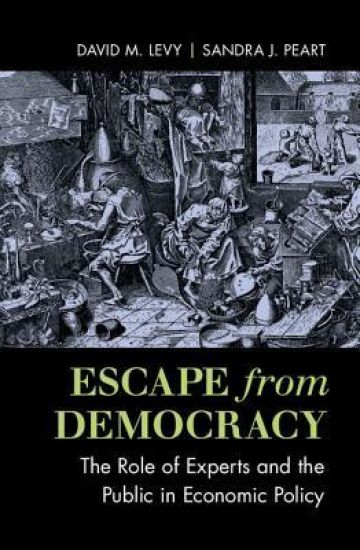
Escape from Democracy

Escape from Democracy

David M. Levy; Sandra J. Peart

Cambridge University Press
2016
sidottu
The orthodox view of economic policy holds that public deliberation sets the goals or ends, and then experts select the means to implement these goals. This assumes that experts are no more than trustworthy servants of the public interest. David M. Levy and Sandra J. Peart examine the historical record to consider cases in which experts were trusted with disastrous results, such as eugenics, the regulatory use of security ratings, and central economic planning. This history suggests that experts have not only the public interest but also their own interests to consider. The authors then recover and extend an alternative view of economic policy that subjects experts' proposals to further discussion, resulting in transparency and ensuring that the public obtains the best insights of experts in economics while avoiding pitfalls such as expert bias.
Escape from Democracy

Escape from Democracy

David M. Levy; Sandra J. Peart

Cambridge University Press
2016
pokkari
The orthodox view of economic policy holds that public deliberation sets the goals or ends, and then experts select the means to implement these goals. This assumes that experts are no more than trustworthy servants of the public interest. David M. Levy and Sandra J. Peart examine the historical record to consider cases in which experts were trusted with disastrous results, such as eugenics, the regulatory use of security ratings, and central economic planning. This history suggests that experts have not only the public interest but also their own interests to consider. The authors then recover and extend an alternative view of economic policy that subjects experts' proposals to further discussion, resulting in transparency and ensuring that the public obtains the best insights of experts in economics while avoiding pitfalls such as expert bias.
The Street Porter and the Philosopher

The Street Porter and the Philosopher

Sandra Peart; David M. Levy

The University of Michigan Press
2008
sidottu
Adam Smith, asserting the common humanity of the street porter and the philosopher, articulated the classical economists' model of social interactions as exchanges among equals. This model had largely fallen out of favor until, recently, a number of scholars in the avant-garde of economic thought rediscovered it and rechristened it "analytical egalitarianism." In this volume, Sandra J. Peart and David M. Levy bring together an impressive array of authors to explore the ramifications of this analytical ideal and to discuss the ways in which an egalitarian theory of individuality can enable economists to reconcile ideas from opposite ends of the political spectrum."The analytical egalitarianism project that Peart and Levy have advanced has come to occupy a prominent place in the current agenda of historians of economic thought."---Ross Emmett, Associate Professor of Economics and Co-Director of the Michigan Center for Innovation and Economic Prosperity, Michigan State University"These essays and dialogs from the Summer Institute would make Adam Smith, economist and moral philosopher, proud."---J. Daniel Hammond, Hultquist Family Professor of Economics, Wake Forest UniversityWith essays by:James M. Buchanan, Alfred Nobel Memorial Prize in Economic Sciences recipient (1985) and Professor Emeritus, George Mason University and Virginia Polytechnic and State University Juan Pablo Couyoumdijian, Universidad del Desearrollo, Chile Tyler Cowen, George Mason University Eric Crampton, University of Canterbury, New Zealand Andrew Farrant, Dickinson College Samuel Hollander, Professor Emeritus, University of Toronto M. Ali Khan, Johns Hopkins University Thomas Leonard, Princeton University Deirdre McCloskey, University of Illinois, Chicago Leonidas Montes, Dean of School of Government, Universidad Adolfo Ibañez, Chile Maria Pia Paganelli, Yeshiva University and New York University Warren J. Samuels, Professor Emeritus, Michigan State University Eric Schliesser, VENI post-doctoral research fellow, Leiden University, and University of Amsterdam Gordon Tullock, George Mason UniversitySandra J. Peart is Dean of the Jepson School of Leadership Studies, University of Richmond, Virginia.David M. Levy is Professor of Economics at George Mason University (GMU) and Research Associate at the Center for Study of Public Choice at GMU.They are Co-Directors of George Mason University's Summer Institute for the Preservation of the History of Economics.
The "Vanity of the Philosopher"

The "Vanity of the Philosopher"

Sandra Peart; David M. Levy

The University of Michigan Press
2005
sidottu
The "Vanity of the Philosopher" continues the themes introduced in Levy's acclaimed book How the Dismal Science Got Its Name.Here, Peart and Levy tackle the issues of racism, eugenics, hierarchy, and egalitarianism in classical economics and take a broad view of classical economics' doctrine of human equality. Responding to perennial accusations from the left and the right that the market economy has created either inequality or too much equality, the authors trace the role of the eugenics movement in pulling economics away from the classical economist's respect for the individual toward a more racist view at the turn of the century.The "Vanity of the Philosopher" reveals the consequences of hierarchy in social science. It shows how the "vanity of the philosopher" has led to recommendations that range from the more benign but still objectionable "looking after" paternalism, to overriding preferences, and, in the extreme, to eliminating purportedly bad preferences. The authors suggest that an approach that abstracts from difference and presumes equal competence is morally compelling."People in the know on intellectual history and economics await the next book from Peart and Levy with much the same enthusiasm that greets a new Harry Potter book in the wider world. This book delivers the anticipated delights big time!"-William Easterly, Professor of Economics and Africana Studies, NYU, and non-resident Senior Fellow, Center for Global Development"In their customary idiosyncratic manner, Sandra Peart and David Levy reexamine the way in which the views of classical economists on equality and hierarchy were shifted by contact with scholars in other disciplines, and the impact this had on attitudes towards race, immigration, and eugenics. This is an imaginative and solid work of scholarship, with an important historical message and useful lessons for scholars today."-Stanley Engerman, John Munro Professor of Economics and Professor of History, University of RochesterSandra J. Peart, Professor of Economics at Baldwin-Wallace College, has published articles on utilitarianism, the methodology of J. S. Mill, and the transition to neoclassicism. This is her fourth book. David M. Levy is Professor of Economics at George Mason University and Director of the Center for Study of Public Choice. This is his third book.
The Tabernacle––Shadows of the Messiah – Its Sacrifices, Services, and Priesthood
The Tabernacle dominates fifty chapters in the Old Testament, while all of creation requires only two. Yet attaining an understanding of the design and significance of God's first house among His people gets scant attention in most churches today. A proper understanding of the Tabernacle provides a graphic understanding of God's redemptive program. It clearly pictures sinful man, holy God, and the incredible price required to bring the two together. A grasp of the Tabernacle's sacrifices, services, and priesthood is prerequisite to a proper understanding of more than half the book of Hebrews, and countless other New Testament passages. While numerous books have been written on the Tabernacle, most focus on its services, virtually omitting the priesthood and the various sacrifices. Newer Tabernacle books are often sketchy in their content, overly fanciful in their typology, and include exaggerated anti-types of Christ that the text never intended. David M. Levy provides a resource equally helpful for those with little Bible knowledge and those with many years of personal Bible study, promising to challenge the reader with the significance of the Tabernacle.
How the Dismal Science Got Its Name

How the Dismal Science Got Its Name

David M. Levy

The University of Michigan Press
2002
nidottu
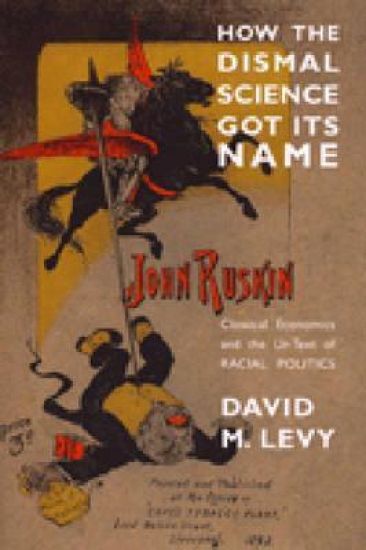
It is widely asserted that the Victorian sages attacked classical economics from a humanistic or egalitarian perspective, calling it "the dismal science," and that their attack is relevant to modern discussions of market society. David M. Levy here demonstrates that these assertions are simply false: political economy became "dismal" because Carlyle, Ruskin, and Dickens were horrified at the idea that systems of slavery were being replaced by systems in which individuals were allowed to choose their own paths in life. At a minimum, they argued, "we" white people ought to be directing the lives of "them," people of color. Economists of the time argued, on the other hand, that people of color were to be protected by the rule of law--hence the moniker "the dismal science." A startling image from 1893, which is reproduced in full color on this book's jacket, shows Ruskin killing someone who appears to be nonwhite. A close look reveals that the victim is reading "The Dismal Science." Levy discusses this image at length and also includes in his text weblinks to Carlyle's "Occasional Discourse on the Negro Question" and to Mill's response, demonstrating that these are central documents in British classical economics. He explains Adam Smith's egalitarian foundations, contrasting Smith's approach to the hierarchical alternative proposed by Carlyle. Levy also examines various visual representations of this debate and provides an illuminating discussion of Smith's "katallactics," the science of exchange, comparing it with the foundations of modern neoclassical economics. How the Dismal Science Got Its Name also introduces the notion of "rational choice scholarship" to explain how attacks on market economics from a context in which racial slavery was idealized have been interpreted as attacks on market economics from a humanistic or egalitarian context. Thus it will greatly appeal to economists, political scientists, philosophers, students of Victorian literature, and historians. David M. Levy is Associate Professor of Economics and Research Associate, Center for Study of Public Choice, George Mason University.