Kirjojen hintavertailu. Mukana 12 595 353 kirjaa ja 12 kauppaa.

Kirjailija

David M Powers

Kirjat ja teokset yhdessä paikassa: 5 kirjaa, julkaisuja vuosilta 2014-2017, suosituimpien joukossa Damnable Heresy. Vertaile teosten hintoja ja tarkista saatavuus suomalaisista kirjakaupoista.

Mukana myös kirjoitusasut: David M. Powers

5 kirjaa

Kirjojen julkaisuhaarukka 2014-2017.

Good and Comfortable Words

Good and Comfortable Words

David M Powers; Meredith M Neuman

Wipf Stock Publishers
2017
pokkari
Thanks to coded notes taken by the teenager John Pynchon, this volume transports the reader, virtually, back to Sundays in the seventeenth century, when the community gathered to listen to the Rev. George Moxon. The setting was Springfield, Massachusetts, founded in 1636 by John's father William Pynchon. As a note-taker, John recorded just what he heard in this rare resource, which allows the reader to listen in on the weekly sermons he documented in the 1640s. This symbol-by-symbol transcription into a word-for-word text preserves the character of the minister's original remarks, and reveals Moxon as an able, engaging speaker who offered encouragement--and challenge--to the growing plantation he faithfully served through its earliest years on the edge of a wilderness. Not only do the sermons in this collection provide snippets of popular theological discourse at particular moments in the 1600s; they also point to issues of the day, and they help us get inside the thoughts and word patterns of that era. ""These series of sermons from the 1640s, recorded by Pynchon as Moxon preached, reflect both a particular religious culture and the difficulties faced by the English settlers--an impressive reconstruction. Even more impressive, however, is the work Powers has done to retrieve these words. Deciphering seventeenth-century script is challenging enough, but he has done the hard detective work of figuring out obsolete shorthand systems, and the result is this real national treasure."" --Kenneth Minkema, Executive Editor and Director, Jonathan Edwards Center, Yale University ""A manuscript mystery has been solved, thanks to David Powers. Reading John Pynchon's unique script in notes of sermons from the 1640s caused whole words to leap off the page. But they were surrounded by a maze of indecipherable symbols--a vexing problem for the museum's staff, but an irresistible challenge to David. As a result, we now have a unique perspective into life in early Springfield."" --Maggie Humberston, Head of Library and Archives, Lyman and Merrie Wood Museum of Springfield History, Springfield, Massachusetts ""David Powers' careful, learned, and imaginative scholarship brings us yet another step closer to the lived experience of New England's first settlers. Like no other study, this one takes us right into church and sits us down on a bench; we can almost hear the spoken words of the sermon, still ringing in the ears of the hearers. Powers has provided a unique and valuable addition to our understanding of the ordinary people who made Puritan New England possible."" --Margaret Bendroth, Executive Director, The Congregational Library and Archives, Boston, Massachusetts David M. Powers is a graduate of Carleton College and Harvard University. He is the author of Damnable Heresy: William Pynchon, the Indians, and the First Book Banned (and Burned) in Boston (Wipf & Stock, 2015). He is a native of Springfield, Massachusetts, and lives on Cape Cod.
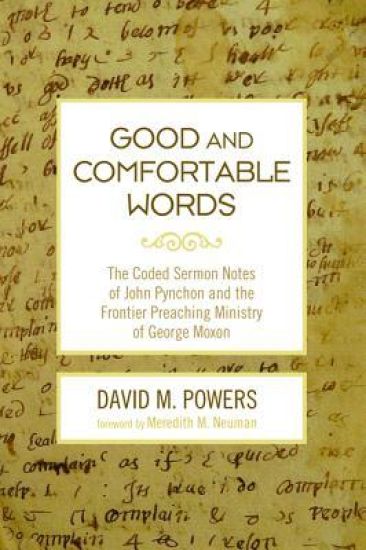
Good and Comfortable Words

Good and Comfortable Words

David M Powers; Meredith M Neuman

Wipf Stock Publishers
2017
sidottu
Thanks to coded notes taken by the teenager John Pynchon, this volume transports the reader, virtually, back to Sundays in the seventeenth century, when the community gathered to listen to the Rev. George Moxon. The setting was Springfield, Massachusetts, founded in 1636 by John's father William Pynchon. As a note-taker, John recorded just what he heard in this rare resource, which allows the reader to listen in on the weekly sermons he documented in the 1640s. This symbol-by-symbol transcription into a word-for-word text preserves the character of the minister's original remarks, and reveals Moxon as an able, engaging speaker who offered encouragement--and challenge--to the growing plantation he faithfully served through its earliest years on the edge of a wilderness. Not only do the sermons in this collection provide snippets of popular theological discourse at particular moments in the 1600s; they also point to issues of the day, and they help us get inside the thoughts and word patterns of that era. ""These series of sermons from the 1640s, recorded by Pynchon as Moxon preached, reflect both a particular religious culture and the difficulties faced by the English settlers--an impressive reconstruction. Even more impressive, however, is the work Powers has done to retrieve these words. Deciphering seventeenth-century script is challenging enough, but he has done the hard detective work of figuring out obsolete shorthand systems, and the result is this real national treasure."" --Kenneth Minkema, Executive Editor and Director, Jonathan Edwards Center, Yale University ""A manuscript mystery has been solved, thanks to David Powers. Reading John Pynchon's unique script in notes of sermons from the 1640s caused whole words to leap off the page. But they were surrounded by a maze of indecipherable symbols--a vexing problem for the museum's staff, but an irresistible challenge to David. As a result, we now have a unique perspective into life in early Springfield."" --Maggie Humberston, Head of Library and Archives, Lyman and Merrie Wood Museum of Springfield History, Springfield, Massachusetts ""David Powers' careful, learned, and imaginative scholarship brings us yet another step closer to the lived experience of New England's first settlers. Like no other study, this one takes us right into church and sits us down on a bench; we can almost hear the spoken words of the sermon, still ringing in the ears of the hearers. Powers has provided a unique and valuable addition to our understanding of the ordinary people who made Puritan New England possible."" --Margaret Bendroth, Executive Director, The Congregational Library and Archives, Boston, Massachusetts David M. Powers is a graduate of Carleton College and Harvard University. He is the author of Damnable Heresy: William Pynchon, the Indians, and the First Book Banned (and Burned) in Boston (Wipf & Stock, 2015). He is a native of Springfield, Massachusetts, and lives on Cape Cod.
Damnable Heresy

Damnable Heresy

David M Powers; David D Hall

Wipf Stock Publishers
2015
sidottu
Misunderstandings between races, hostilities between cultures. Anxiety from living in a time of war in one's own land. Being accused of profiteering when food was scarce. Unruly residents in a remote frontier community. Charged with speaking the unspeakable and publishing the unprintable. All of this can be found in the life of one man--William Pynchon, the Puritan entrepreneur and founder of Springfield, Massachusetts, in 1636. Two things in particular stand out in Pynchon's pioneering life: he enjoyed extraordinary and uniquely positive relationships with Native peoples, and he wrote the first book banned--and burned--in Boston. Now for the first time, this book provides a comprehensive account of Pynchon's story, beginning in England, through his New England adventures, to his return home. Discover the fabric of his times and the roles Pynchon played in the Puritan venture in Old England and New England. ""As the key founder of Springfield, Massachusetts, William Pynchon has been used by historians to show the economic origins of New England. But as David Powers shows, Pynchon was every bit as much an intercultural pioneer and religious figure with unorthodox ideas. This first book-length biography of Pynchon brings to bear new knowledge and approaches to the settlement period of New England, to give us a portrait of a person who was as complex as the Puritan movement from which he came."" --Kenneth P. Minkema, Director, Jonathan Edwards Center, Yale University, New Haven, CT ""If David Powers's remarkable work were only the story of William Pynchon's life and thought it would be a model of scholarly depth, well worth reading as a solid, learned account of an unusual Puritan. This book is something much more, however: a broad and deeply textured view of life in early New England, blending theology, politics, and economic realities into a single compelling story."" --Margaret Bendroth, Executive Director, Congregational Library, Boston, MA ""David Powers's new book makes an important contribution to the long and venerable tradition of early New England studies. His subject, William Pynchon, was one of the movers and shakers of the period. His achievement however, goes beyond biography to more general matters: life in and around western Massachusetts, the cross-cutting textures of Puritan belief and practice, the very shape of life at ground level in the 'world we have lost.' The research is thorough and deep. The book's architecture is effective, even elegant. The prose, too, is excellent: smooth, clear, with many pleasing touches. Altogether: a remarkable accomplishment "" --John P. Demos, Professor of History emeritus, Yale University, New Haven, CT David M. Powers is a graduate of Carleton College and Harvard University. He is a native of Springfield, MA, and lives on Cape Cod.
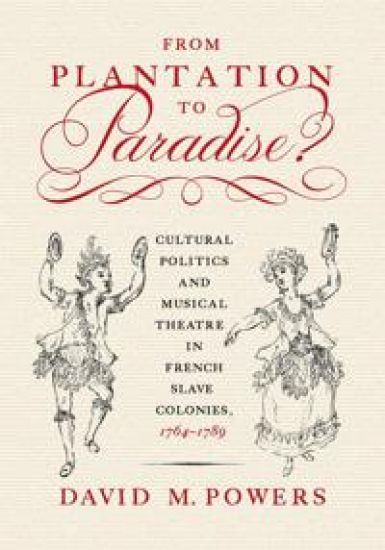
From Plantation to Paradise?

From Plantation to Paradise?

David M. Powers

Michigan State University Press
2014
pokkari
In 1764 the first printing press was established in the French Caribbean colonies, launching the official documentation of operas and plays performed there, and marking the inauguration of the first theatre in the colonies. A rigorous study of pre-French Revolution performance practices in Guadeloupe, Martinique, and Saint-Domingue (now Haiti), Powers's book examines the elaborate system of social casting in these colonies; the environments in which nonwhite artists emerged; and both negative and positive contributions of the Catholic Church and the military to operas and concerts produced in the colonies. The author also explores the level of participation of nonwhites in these productions, as well as theatre architecture, decor, repertoire, seating arrangements, and types of audiences. The status of nonwhite artists in colonial society; the range of operas in which they performed; their accomplishments, praise, criticism; and the use of creole texts and white actors/singers a visage noirs (with blackened faces) present a clear picture of French operatic culture in these colonies.Approaching the French Revolution, the study concludes with an examination of the ways in which colonial opera was affected by slave uprisings, the French Revolution, the emergence of "patriotic theatres," and their role in fostering support for the king, as well as the impact on subsequent operas produced in the colonies and in the United States.