Kirjojen hintavertailu. Mukana 12 493 028 kirjaa ja 12 kauppaa.

Kirjailija

David M. Robinson

Kirjat ja teokset yhdessä paikassa: 25 kirjaa, julkaisuja vuosilta 1980-2026, suosituimpien joukossa Ming China and its Allies. Vertaile teosten hintoja ja tarkista saatavuus suomalaisista kirjakaupoista.

Mukana myös kirjoitusasut: David M Robinson

25 kirjaa

Kirjojen julkaisuhaarukka 1980-2026.

Closeted Writing and Lesbian and Gay Literature

Closeted Writing and Lesbian and Gay Literature

David M. Robinson

Ashgate Publishing Limited
2006
sidottu
Arguing for renewed attention to covert same-sex-oriented writing (and to authorial intention more generally), this study explores the representation of female and male homosexuality in late sixteenth- through mid-eighteenth-century British and French literature. The author also uncovers and analyzes long-term continuities in the representation of same-sex love, sex, and desire between the classical, early modern, eighteenth-century, and even modern periods. Among the seventeenth- and eighteenth-century authors and texts examined here are Mme de Murat, Les Memoires De Madame La Comtesse De M*** (1697); John Cleland, Memoirs of a Woman of Pleasure (1748-49); Tobias Smollett, The Adventures of Roderick Random (1748); Nicolas Chorier and Jean Nicolas, L'Academie des dames (1680); Delarivier Manley, The New Atalantis (1709); and Isaac de Benserade, Iphis et Iante (1637). Classical texts brought into the discussion include Juvenal's Satires, Lucian's Erotes, and, most importantly, Ovid's Metamorphoses. Casting its net broadly yet exploring deeply-poems, plays, novels, and more; from the serious to the satiric, the polite to the pornographic; well-known and little-known; written in English, French, and Latin; published in early modern and eighteenth-century Britain and France; plus key classical texts-this study engages with the historiography of sexuality as a whole.
Natural Life

Natural Life

David M. Robinson

Cornell University Press
2004
sidottu
"An essential step in Thoreau's recovery of a 'natural life' is to reawaken and expand his awareness of the present moment, not only in the sense of knowing more of the world around him, but of entering into it fully. Admitting in Walden that 'I did not read books the first summer; I hoed beans,' he also confesses to moments in which he neglected both of these conflicting duties.... In periods of reverie, Thoreau gave himself over to his senses, finding a fulfillment in his own attentive presence at the pond and the surrounding hills."—from Natural Life Henry David Thoreau's Walden was first published 150 years ago, an event celebrated by many gatherings scheduled for 2004 and marked by the publication of this exceptional book. David M. Robinson tells the story of a mind at work, focusing on Thoreau's idea of "natural life" as both a subject of study and a model for personal growth and ethical purpose. Robinson traces Thoreau's struggle to find a fulfilling vocation and his gradual recovery from his grief over the loss of his brother. Robinson emphasizes Thoreau's development of the credo of living a "natural life," a phrase drawn from his first book, A Week on the Concord and Merrimack Rivers. The depiction of the contemplative life close to nature in Walden exemplifies this credo. But it is also fulfilled through Thoreau's later life as a saunterer in the fields and forests around Concord, devoted to his studies of the natural world and dedicated to a life of principle. Natural Life takes note of and encourages growing interest in the later phase of Thoreau's career and his engagement with science and natural history. Robinson looks closely at Walden and the essays and natural history projects that followed it, such as "Walking" and "Wild Apples," and the remarkable and little-observed writing on night and moonlight found in Thoreau's journal.
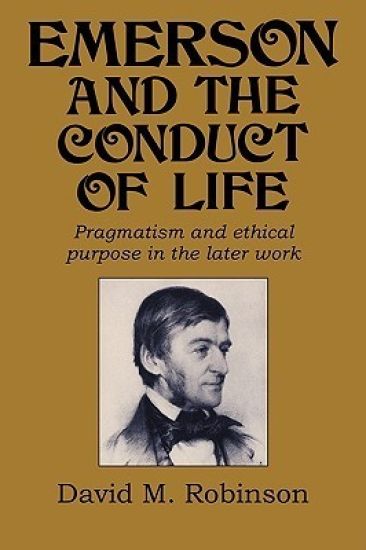
Emerson and the Conduct of Life

Emerson and the Conduct of Life

David M. Robinson

Cambridge University Press
1993
sidottu
'I like not the man who is thinking how to be good,' Ralph Waldo Emerson wrote, 'but the man thinking how to accomplish his work'. The ethical emphasis on work and activity signals the shift in his thinking that is the subject of Emerson and the Conduct of Life. In this book, David M. Robinson describes Emerson's evolution from mystic to pragmatist and shows the importance of Emerson's undervalued later writing. Emerson's reputation has rested on the addresses and essays of the 1830s and 1840s, in which he propounded a version of transcendental idealism and memorably portrayed moments of mystical insight. But Emerson's later thinking suggests an increasing concern over the elusiveness of mysticism and an increasing emphasis on ethical choice and practical power. Robinson discusses each of Emerson's major later works noting their increasing orientation to a philosophy of the 'conduct of life'. These books represent Emerson's attempt to forge a philosophy based on the centrality of domestic life, vocation and social relations and they reveal Emerson as an ethical philosopher who stressed the spiritual value of human relations, work and social action.