Kirjojen hintavertailu. Mukana 12 390 323 kirjaa ja 12 kauppaa.

Kirjailija

David Motadel

Kirjat ja teokset yhdessä paikassa: 5 kirjaa, julkaisuja vuosilta 2017-2026, suosituimpien joukossa The Shah's Great Tour. Vertaile teosten hintoja ja tarkista saatavuus suomalaisista kirjakaupoista.

5 kirjaa

Kirjojen julkaisuhaarukka 2017-2026.

The Shah's Great Tour

The Shah's Great Tour

David Motadel

Oxford University Press
2026
sidottu
At the height of the imperial age, the shahs of Persia regularly embarked on grand royal journeys, roaming the courtly world from the Ottoman empire to the shores of Scotland. Causing great excitement wherever they appeared, the monarchs and their entourages were received with great pomp in the capitals of Europe—St. Petersburg, London, Paris, Berlin, Vienna, Brussels, The Hague, Rome, Constantinople, and beyond. Offering a groundbreaking reinterpretation of relations between non-European and European rulers in the age of empire, the book shows that royal visits provided the guests a way of integrating themselves and their countries into an international order dominated by Europe's great powers. The shahs' participation in the rituals of state visits—such as gift-giving, the exchange of orders, and military spectacle—gave expression to their dynastic legitimacy and their country's sovereignty. Acclaimed historian David Motadel draws a sweeping panorama of fin-de-siècle Europe, as seen from the outside, tracing the shahs' encounters with monarchs and ministers, magnates and merchants, priests and prostitutes, revolutionaries and assassins. Their royal tours also inspired the writings of some of the era's greatest authors, from Anton Chekhov to Mark Twain. The fruit of decades of research, The Shah's Great Tour is based on a wealth of documents unearthed in more than fifty archives across fifteen countries, including the Persian travelogues of the shahs. A monumental feat of scholarship, it sheds light on the glittering, globalized world of monarchs in the age of empire.
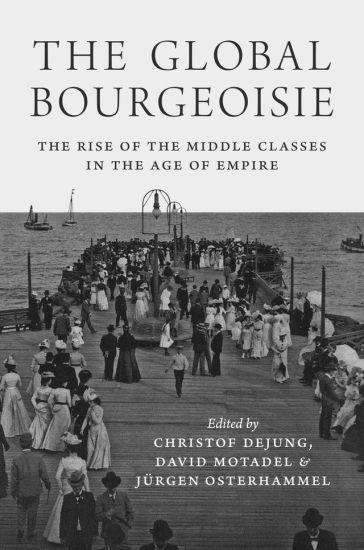
The Global Bourgeoisie

The Global Bourgeoisie

Christof Dejung; David Motadel; Jürgen Osterhammel

Princeton University Press
2019
pokkari
The first global history of the middle class While the nineteenth century has been described as the golden age of the European bourgeoisie, the emergence of the middle class and bourgeois culture was by no means exclusive to Europe. The Global Bourgeoisie explores the rise of the middle classes around the world during the age of empire. Bringing together eminent scholars, this landmark essay collection compares middle-class formation in various regions, highlighting differences and similarities, and assesses the extent to which bourgeois growth was tied to the increasing exchange of ideas and goods. The contributors indicate that the middle class was from its very beginning, even in Europe, the result of international connections and entanglements.Essays are grouped into six thematic sections: the political history of middle-class formation, the impact of imperial rule on the colonial middle class, the role of capitalism, the influence of religion, the obstacles to the middle class beyond the Western and colonial world, and, lastly, reflections on the creation of bourgeois cultures and global social history. Placing the establishment of middle-class society into historical context, this book shows how the triumph or destabilization of bourgeois values can shape the liberal world order.The Global Bourgeoisie irrevocably changes the understanding of how an important social class came to be.
The Global Bourgeoisie

The Global Bourgeoisie

Christof Dejung; David Motadel; Jürgen Osterhammel

PRINCETON UNIVERSITY PRESS
2019
sidottu
The first global history of the middle class While the nineteenth century has been described as the golden age of the European bourgeoisie, the emergence of the middle class and bourgeois culture was by no means exclusive to Europe. The Global Bourgeoisie explores the rise of the middle classes around the world during the age of empire. Bringing together eminent scholars, this landmark essay collection compares middle-class formation in various regions, highlighting differences and similarities, and assesses the extent to which bourgeois growth was tied to the increasing exchange of ideas and goods. The contributors indicate that the middle class was from its very beginning, even in Europe, the result of international connections and entanglements.Essays are grouped into six thematic sections: the political history of middle-class formation, the impact of imperial rule on the colonial middle class, the role of capitalism, the influence of religion, the obstacles to the middle class beyond the Western and colonial world, and, lastly, reflections on the creation of bourgeois cultures and global social history. Placing the establishment of middle-class society into historical context, this book shows how the triumph or destabilization of bourgeois values can shape the liberal world order.The Global Bourgeoisie irrevocably changes the understanding of how an important social class came to be.
Islam and Nazi Germany’s War

Islam and Nazi Germany’s War

David Motadel

The Belknap Press
2017
nidottu
Winner of the Ernst Fraenkel Prize, Wiener Holocaust LibraryAn Open Letters Monthly Best History Book of the YearA New York Post “Must-Read”In the most crucial phase of the Second World War, German troops confronted the Allies across lands largely populated by Muslims. Nazi officials saw Islam as a powerful force with the same enemies as Germany: the British Empire, the Soviet Union, and the Jews. Islam and Nazi Germany’s War is the first comprehensive account of Berlin’s remarkably ambitious attempts to build an alliance with the Islamic world.“Motadel describes the Mufti’s Nazi dealings vividly…Impeccably researched and clearly written, [his] book will transform our understanding of the Nazi policies that were, Motadel writes, some ‘of the most vigorous attempts to politicize and instrumentalize Islam in modern history.’”—Dominic Green, Wall Street Journal“Motadel’s treatment of an unsavory segment of modern Muslim history is as revealing as it is nuanced. Its strength lies not just in its erudite account of the Nazi perception of Islam but also in illustrating how the Allies used exactly the same tactics to rally Muslims against Hitler. With the specter of Isis haunting the world, it contains lessons from history we all need to learn.”—Ziauddin Sardar, The Independent