Kirjailija
David Mumford
Kirjat ja teokset yhdessä paikassa: 20 kirjaa, julkaisuja vuosilta 1966-2024, suosituimpien joukossa Tata Lectures on Theta I. Vertaile teosten hintoja ja tarkista saatavuus suomalaisista kirjakaupoista.
20 kirjaa
Kirjojen julkaisuhaarukka 1966-2024.
This volume contains the first two out of four chapters which are intended to survey a large part of the theory of theta functions. These notes grew out of a series of lectures given at the Tata Institute of Fundamental Research in the period October, 1978, to March, 1979, on which notes were taken and excellently written up by C. Musili and M. Nori. I subsequently lectured at greater length on the contents of Chapter III at Harvard in the fall of 1979 and at a Summer School in Montreal in August, 1980, and again notes were very capably put together by E. Previato and M. Stillman, respectively. Both the Tata Institute and the University of Montreal publish lecture note series in which I had promised to place write-ups of my lectures there. However, as the project grew, it became clear that it was better to tie all these results together, rearranging and consolidating the material, and to make them available from one place. I am very grateful to the Tata Institute and the University of Montreal for permission to do this, and to Birkhauser-Boston for publishing the final result. The first 2 chapters study theta functions strictly from the viewpoint of classical analysis. In particular, in Chapter I, my goal was to explain in the simplest cases why the theta functions attracted attention.
The second in a series of three volumes surveying the theory of theta functions, this volume gives emphasis to the special properties of the theta functions associated with compact Riemann surfaces and how they lead to solutions of the Korteweg-de-Vries equations as well as other non-linear differential equations of mathematical physics. This book presents an explicit elementary construction of hyperelliptic Jacobian varieties and is a self-contained introduction to the theory of the Jacobians. It also ties together nineteenth-century discoveries due to Jacobi, Neumann, and Frobenius with recent discoveries of Gelfand, McKean, Moser, John Fay, and others. A definitive body of information and research on the subject of theta functions, this volume will be a useful addition to individual and mathematics research libraries.
Pattern theory is a distinctive approach to the analysis of all forms of real-world signals. At its core is the design of a large variety of probabilistic models whose samples reproduce the look and feel of the real signals, their patterns, and their variability. Bayesian statistical inference then allows you to apply these models in the analysis of new signals. This book treats the mathematical tools, the models themselves, and the computational algorithms for applying statistics to analyze six representative classes of signals of increasing complexity. The book covers patterns in text, sound, and images. Discussions of images include recognizing characters, textures, nature scenes, and human faces. The text includes online access to the materials (data, code, etc.) needed for the exercises.
This book is a collection of essays written by a distinguished mathematician with a very long and successful career as a researcher and educator working in many areas of pure and applied mathematics. The author writes about everything he found exciting about math, its history, and its connections with art, and about how to explain it when so many smart people (and children) are turned off by it. The three longest essays touch upon the foundations of mathematics, upon quantum mechanics and Schrodinger's cat phenomena, and upon whether robots will ever have consciousness. Each of these essays includes some unpublished material. The author also touches upon his involvement with and feelings about issues in the larger world. The author's main goal when preparing the book was to convey how much he loves math and its sister fields.
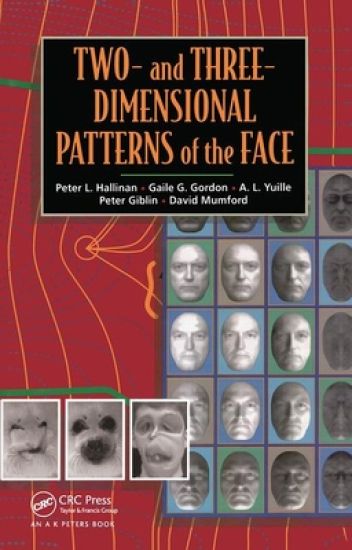
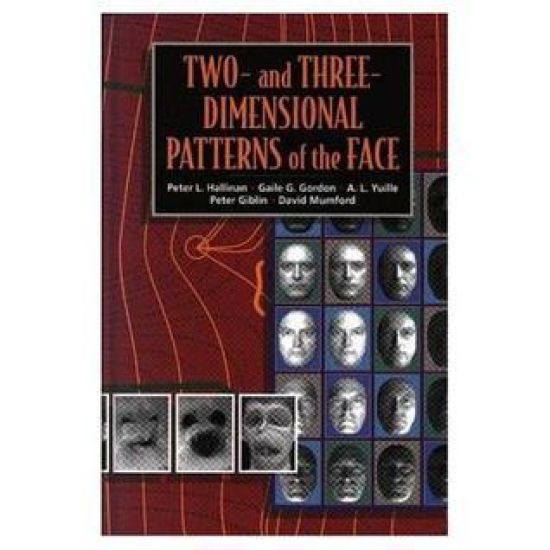
Two- and Three-Dimensional Patterns of the Face
Peter W. Hallinan; Gaile Gordon; A. L. Yuille; Peter Giblin; David Mumford
CRC Press
2019
nidottu
The human face is perhaps the most familiar and easily recognized object in the world, yet both its three-dimensional shape and its two-dimensional images are complex and hard to characterize. This book develops the vocabulary of ridges and parabolic curves, of illumination eigenfaces and elastic warpings for describing the perceptually salient features of a face and its images. The book also explores the underlying mathematics and applies these mathematical techniques to the computer vision problem of face recognition, using both optical and range images.
These more than 30 articles span the years from 1961-1980 while David Mumford was an active researcher in the area of algebraic geometry. While Volume I contained the papers on classification of varieties and moduli spaces, Volume II contains all other papers in algebraic geomtetry, such as Mumford's paper with Pierre Deligne, The Irreducibility of the space of curves of given genus (1969). Mumford's correspondence of the years 1958 to 1986 with Alexander Grothendieck is also included.From the reviews of Volume II:“Selected Papers Volume II collects twenty-nine articles by Mumford, along with four previously unpublished pieces and dozens of letters between Mumford and Grothendieck. … this book the same way I felt about the first volume: this is a book that most algebraic geometers – and all libraries – will not want to do without.” (Darren Glass, The Mathematical Association of America, October, 2010)
This volume contains a collection of 30 of the 51 papers that David Mumford wrote in algebraic geometry. The volume divides Mumford’s papers into three broad areas, each preceded by an easy summarizing the results and outlining their influence on further developments by David Gieseker, George Kempf, Herbert Lange and Eckart Viehweg.Further generations of researchers in this field, graduate students, mathematical physicists, and mathematical historians will profit a great deal from this collection of selected papers.
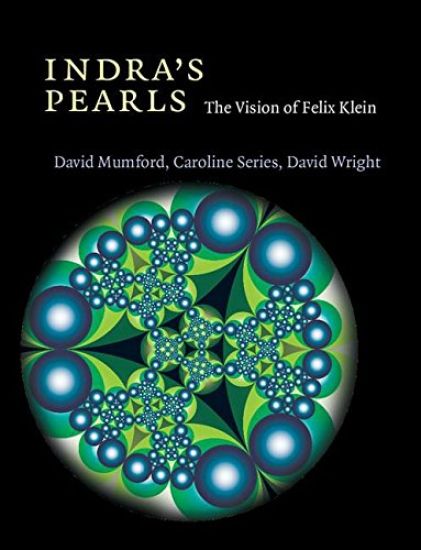
Felix Klein, one of the great nineteenth-century geometers, discovered in mathematics an idea prefigured in Buddhist mythology: the heaven of Indra contained a net of pearls, each of which was reflected in its neighbour, so that the whole Universe was mirrored in each pearl. Klein studied infinitely repeated reflections and was led to forms with multiple coexisting symmetries. For a century, these images barely existed outside the imagination of mathematicians. However, in the 1980s, the authors embarked on the first computer exploration of Klein's vision, and in doing so found many further extraordinary images. Join the authors on the path from basic mathematical ideas to the simple algorithms that create the delicate fractal filigrees, most of which have never appeared in print before. Beginners can follow the step-by-step instructions for writing programs that generate the images. Others can see how the images relate to ideas at the forefront of research.
This annual anthology brings together the year's finest mathematics writing from around the world. Featuring promising new voices alongside some of the foremost names in the field, The Best Writing on Mathematics 2012 makes available to a wide audience many articles not easily found anywhere else--and you don't need to be a mathematician to enjoy them. These writings offer surprising insights into the nature, meaning, and practice of mathematics today. They delve into the history, philosophy, teaching, and everyday occurrences of math, and take readers behind the scenes of today's hottest mathematical debates. Here Robert Lang explains mathematical aspects of origami foldings; Terence Tao discusses the frequency and distribution of the prime numbers; Timothy Gowers and Mario Livio ponder whether mathematics is invented or discovered; Brian Hayes describes what is special about a ball in five dimensions; Mark Colyvan glosses on the mathematics of dating; and much, much more. In addition to presenting the year's most memorable writings on mathematics, this must-have anthology includes a foreword by esteemed mathematician David Mumford and an introduction by the editor Mircea Pitici. This book belongs on the shelf of anyone interested in where math has taken us--and where it is headed.
Geometric Invariant Theory
David Mumford; John Fogarty; Frances Kirwan
Springer-Verlag Berlin and Heidelberg GmbH Co. K
2012
nidottu
“Geometric Invariant Theory” by Mumford/Fogarty (the first edition was published in 1965, a second, enlarged edition appeared in 1982) is the standard reference on applications of invariant theory to the construction of moduli spaces. This third, revised edition has been long awaited for by the mathematical community. It is now appearing in a completely updated and enlarged version with an additional chapter on the moment map by Prof. Frances Kirwan (Oxford) and a fully updated bibliography of work in this area. The book deals firstly with actions of algebraic groups on algebraic varieties, separating orbits by invariants and construction quotient spaces; and secondly with applications of this theory to the construction of moduli spaces. It is a systematic exposition of the geometric aspects of the classical theory of polynomial invariants.
Pattern theory is a distinctive approach to the analysis of all forms of real-world signals. At its core is the design of a large variety of probabilistic models whose samples reproduce the look and feel of the real signals, their patterns, and their variability. Bayesian statistical inference then allows you to apply these models in the analysis of new signals. This book treats the mathematical tools, the models themselves, and the computational algorithms for applying statistics to analyze six representative classes of signals of increasing complexity. The book covers patterns in text, sound, and images. Discussions of images include recognizing characters, textures, nature scenes, and human faces. The text includes online access to the materials (data, code, etc.) needed for the exercises.
Smooth Compactifications of Locally Symmetric Varieties
Avner Ash; David Mumford; Michael Rapoport; Yung-sheng Tai
Cambridge University Press
2010
pokkari
The new edition of this celebrated and long-unavailable book preserves the original book's content and structure and its unrivalled presentation of a universal method for the resolution of a class of singularities in algebraic geometry. At the same time, the book has been completely re-typeset, errors have been eliminated, proofs have been streamlined, the notation has been made consistent and uniform, an index has been added, and a guide to recent literature has been added. The book brings together ideas from algebraic geometry, differential geometry, representation theory and number theory, and will continue to prove of value for researchers and graduate students in these areas.
Felix Klein, one of the great nineteenth-century geometers, discovered in mathematics an idea prefigured in Buddhist mythology: the heaven of Indra contained a net of pearls, each of which was reflected in its neighbour, so that the whole Universe was mirrored in each pearl. Klein studied infinitely repeated reflections and was led to forms with multiple coexisting symmetries. For a century, these images barely existed outside the imagination of mathematicians. However, in the 1980s, the authors embarked on the first computer exploration of Klein's vision, and in doing so found many further extraordinary images. Join the authors on the path from basic mathematical ideas to the simple algorithms that create the delicate fractal filigrees, most of which have never appeared in print before. Beginners can follow the step-by-step instructions for writing programs that generate the images. Others can see how the images relate to ideas at the forefront of research.
The Red Book of Varieties and Schemes
David Mumford
Springer-Verlag Berlin and Heidelberg GmbH Co. K
1999
nidottu
Mumford's famous "Red Book" gives a simple readable account of the basic objects of algebraic geometry, preserving as much as possible their geometric flavour and integrating this with the tools of commutative algebra. It is aimed at mainly at graduate students and researchers.
Two- and Three-Dimensional Patterns of the Face
Peter W. Hallinan; Gaile Gordon; A. L. Yuille; Peter Giblin; David Mumford
A K Peters
1999
sidottu
The human face is perhaps the most familiar and easily recognized object in the world, yet both its three-dimensional shape and its two-dimensional images are complex and hard to characterize. This book develops the vocabulary of ridges and parabolic curves, of illumination eigenfaces and elastic warpings for describing the perceptually salient features of a face and its images. The book also explores the underlying mathematics and applies these mathematical techniques to the computer vision problem of face recognition, using both optical and range images.
Let me begin with a little history. In the 20th century, algebraic geometry has gone through at least 3 distinct phases. In the period 1900-1930, largely under the leadership of the 3 Italians, Castelnuovo, Enriques and Severi, the subject grew immensely. In particular, what the late 19th century had done for curves, this period did for surfaces: a deep and systematic theory of surfaces was created. Moreover, the links between the "synthetic" or purely "algebro-geometric" techniques for studying surfaces, and the topological and analytic techniques were thoroughly explored. However the very diversity of tools available and the richness of the intuitively appealing geometric picture that was built up, led this school into short-cutting the fine details of all proofs and ignoring at times the time consuming analysis of special cases (e. g. , possibly degenerate configurations in a construction). This is the traditional difficulty of geometry, from High School Euclidean geometry on up. In the period 1930-1960, under the leadership of Zariski, Weil, and (towards the end) Grothendieck, an immense program was launched to introduce systematically the tools of commutative algebra into algebraic geometry and to find a common language in which to talk, for instance, of projective varieties over characteristic p fields as well as over the complex numbers. In fact, the goal, which really goes back to Kronecker, was to create a "geometry" incorporating at least formally arithmetic as well as projective geo metry.
Geometric Invariant Theory
David Mumford; John Fogarty; Frances Kirwan
Springer-Verlag Berlin and Heidelberg GmbH Co. K
1994
sidottu
“Geometric Invariant Theory” by Mumford/Fogarty (the first edition was published in 1965, a second, enlarged edition appeared in 1982) is the standard reference on applications of invariant theory to the construction of moduli spaces. This third, revised edition has been long awaited for by the mathematical community. It is now appearing in a completely updated and enlarged version with an additional chapter on the moment map by Prof. Frances Kirwan (Oxford) and a fully updated bibliography of work in this area. The book deals firstly with actions of algebraic groups on algebraic varieties, separating orbits by invariants and construction quotient spaces; and secondly with applications of this theory to the construction of moduli spaces. It is a systematic exposition of the geometric aspects of the classical theory of polynomial invariants.
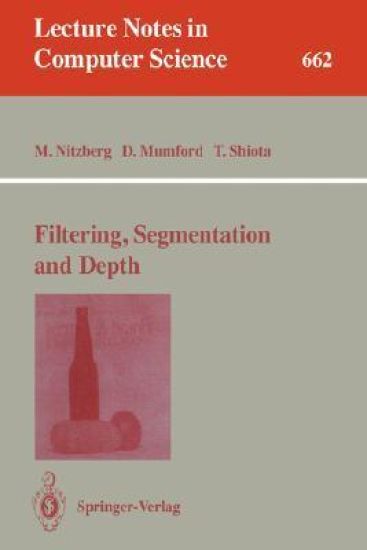
Filtering, Segmentation and Depth
Mark Nitzberg; David Mumford; Takahiro Shiota
Springer-Verlag Berlin and Heidelberg GmbH Co. K
1993
nidottu
Computer vision seeks a process that starts with a noisy, ambiguous signal from a TV camera and ends with a high-level description of discrete objects located in 3-dimensional space and identified in a human classification. This book addresses the process at several levels. First to be treated are the low-level image-processing issues of noise removaland smoothing while preserving important lines and singularities in an image. At a slightly higher level, a robust contour tracing algorithm is described that produces a cartoon of the important lines in the image. Thirdis the high-level task of reconstructing the geometry of objects in the scene. The book has two aims: to give the computer vision community a new approach to early visual processing, in the form of image segmentation that incorporates occlusion at a low level, and to introduce real computer algorithms that do a better job than what most vision programmers use currently. The algorithms are: - a nonlinear filter that reduces noise and enhances edges, - an edge detector that also finds corners and produces smoothed contours rather than bitmaps, - an algorithm for filling gaps in contours.
These lectures, delivered by Professor Mumford at Harvard in 1963-1964, are devoted to a study of properties of families of algebraic curves, on a non-singular projective algebraic curve defined over an algebraically closed field of arbitrary characteristic. The methods and techniques of Grothendieck, which have so changed the character of algebraic geometry in recent years, are used systematically throughout. Thus the classical material is presented from a new viewpoint.