Kirjojen hintavertailu. Mukana 12 152 606 kirjaa ja 12 kauppaa.
Kirjailija
David O. Lomen
Kirjat ja teokset yhdessä paikassa: 7 kirjaa, julkaisuja vuosilta 1998-2022, suosituimpien joukossa Applied Calculus. Vertaile teosten hintoja ja tarkista saatavuus suomalaisista kirjakaupoista.
Deborah Hughes-Hallett; Patti Frazer Lock; Andrew M. Gleason; Daniel E. Flath; Sheldon P. Gordon; David O. Lomen; David Lovelock; William G. McCallum; Brad G. Osgood; Andrew Pasquale; Jeff Tecosky-Feldman; Joseph Thrash; Karen R. Rhea; Thomas W. Tucker
Hughes-Hallett Deborah; William G. McCallum; Gleason Andrew M.; Flath Daniel E.; Patti Frazer Lock; Gordon Sheldon P.; David O. Lomen; Lovelock David; Osgood Brad G.; Pasquale Andrew; Douglas Quinney; Tecosky-Feldman Jeff; Thrash Joseph; Karen R Rhea; Tucker Thomas W.
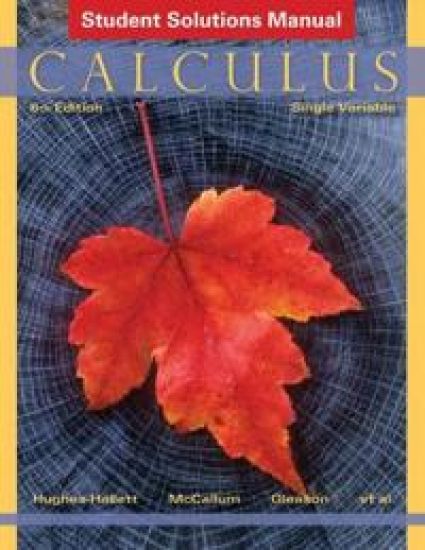
The Student Solutions Manual to CalculusCalculus teachers recognize this book as the leading resource among the reform projects that employ the rule of four and streamline the curriculum in order to deepen conceptual understanding. This edition uses all strands of the "Rule of Four" -- graphical, numeric, symbolic/algebraic, and verbal/applied presentations -- to make concepts easier to understand. The book focuses on exploring fundamental ideas rather than comprehensive coverage of multiple similar cases that are not fundamentally unique.
William G. McCallum; Hughes-Hallett Deborah; Gleason Andrew M.; David O. Lomen; Lovelock David; Tecosky-Feldman Jeff; Tucker Thomas W.; Flath Daniel E.; Thrash Joseph; Karen R Rhea; Pasquale Andrew; Gordon Sheldon P.; Douglas Quinney; Patti Frazer Lock
The Student Solutions Manual to CalculusCalculus teachers recognize this book as the leading resource among the reform projects that employ the rule of four and streamline the curriculum in order to deepen conceptual understanding. This edition uses all strands of the "Rule of Four" -- graphical, numeric, symbolic/algebraic, and verbal/applied presentations -- to make concepts easier to understand. The book focuses on exploring fundamental ideas rather than comprehensive coverage of multiple similar cases that are not fundamentally unique.
Hughes-Hallett Deborah; Gleason Andrew M.; William G. McCallum; Flath Daniel E.; Patti Frazer Lock; David O. Lomen; Lovelock David; Osgood Brad G.; Douglas Quinney; Karen R Rhea; Tecosky-Feldman Jeff; Tucker Thomas W.; Bretscher Otto K.; Gordon Sheldon P.; Pasquale Andrew; Thrash Joseph
Calculus teachers recognize Calculus as the leading resource among the "reform" projects that employ the rule of four and streamline the curriculum in order to deepen conceptual understanding. The Sixth Edition uses all strands of the 'Rule of Four' - graphical, numeric, symbolic/algebraic, and verbal/applied presentations - to make concepts easier to understand. The book focuses on exploring fundamental ideas rather than comprehensive coverage of multiple similar cases that are not fundamentally unique.
Deborah Hughes-Hallett; Patti Frazer Lock; Andrew M. Gleason; Daniel E. Flath; Sheldon P. Gordon; David O. Lomen; David Lovelock; William G. McCallum; Brad G. Osgood; Andrew Pasquale; Jeff Tecosky-Feldman; Joseph Thrash; Karen R. Rhea; Thomas W. Tucker
Fully-worked solutions with clear explanations The Student Solutions Manual to accompany Differential Equations: Graphics, Models, Data provides fully-worked solutions to problems from the text. Clear explanations back step-by-step solutions to facilitate full understanding of the problem, approach, and answer, while graphs provide a visual representation of the scenario described in the problem. Common incorrect answers are noted where they exist, and references to figures in the text provide additional guidance for review. Any calculus student can benefit from extra study, and this solutions manual makes studying more effective by truly enhancing your understanding of the material.
Viewing stained glass from different angles or in various lights is necessary to discover its many qualities. Likewise, viewing solutions of differential equations from several points of view is essential to fully understand their behavior. Lomen and Lovelock provide an active environment for students to explore differential equations by using analytical, numerical, graphical, and descriptive techniques, and for students to use ODEs as a natural tool for modeling many interesting processes in science and engineering.