Kirjojen hintavertailu. Mukana 12 311 916 kirjaa ja 12 kauppaa.

Kirjailija

David O. Whitten

Kirjat ja teokset yhdessä paikassa: 6 kirjaa, julkaisuja vuosilta 1983-2022, suosituimpien joukossa The Emergence of Giant Enterprise, 1860-1914. Vertaile teosten hintoja ja tarkista saatavuus suomalaisista kirjakaupoista.

6 kirjaa

Kirjojen julkaisuhaarukka 1983-2022.

The Emergence of Giant Enterprise, 1860-1914

The Emergence of Giant Enterprise, 1860-1914

David O. Whitten

Praeger Publishers Inc
1983
sidottu
The second edition of this guide to basic reference sources in the social sciences contains 2200 entries. In addition to revising and substantially enlarging the chapters on reference sources, the author has added a chapter on geography and one on business that is distinct from economics. Since the publication of the first edition, there have been two obvious developments in information storage and retrieval: the rapid development of online databases and the development of CD-ROM. Instead of devoting a separate chapter to these developments, the book incorporates online databases, CD-ROM and other forms of data sources into the text. In addition, there is a brief introduction to these developments. Although the general deadline for inclusion in the volume was December 1988, quite a few titles published in 1989 are included. The volume consists of two parts: the social sciences in general, dealing with the nature of the social sciences, bibliographical needs and usage of social scientists, research resources and reference sources in the social sciences in general; and sub-disciplines of the social sciences, including cultural anthropology, history, law, political science, psychology, and sociology. Reference sources for each sub-discipline in part two (and some chapters in part one) are broadly classified into four sections: access to sources, sources of information, periodicals, and additional reference sources. Each secion is further divided as follows. Under the access to sources section, headings start with guides, followed in general by bibliographies of bibliographies, bibliographies, theses and dissertations, reviews, indexes, abstracts, and contents reproduction. In the sources of information section, headings are arranged in the following sequence: primary sources, encyclopaedias, dictionaries, directories, biographies, statistical sources, and handbooks, yearbooks and the like. Headings may be further divided by subject, depending on the number of sources. Titles under each heading and sub-heading are arranged alphabetically by title. All titles are suppled with ISBN and/or ISSN number, if known.
Getting Out of the Mud

Getting Out of the Mud

Martin T. Olliff; David O. Whitten

THE UNIVERSITY OF ALABAMA PRESS
2022
nidottu
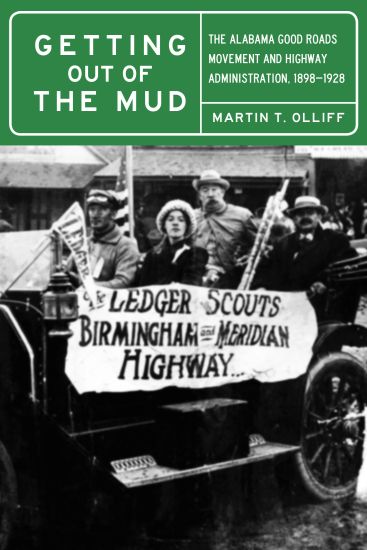
Recounts the history of the Good Roads Movement that arose in progressive-era Alabama, how it used the power of the state to achieve its objectives of improving market roads for farmers and highways for automobilesGetting Out of the Mud: The Alabama Good Roads Movement and Highway Administration, 1898–1928 explores the history of the Good Roads Movement and investigates the nature of early twentieth-century progressivism in the state. Martin T. Olliff reveals how middle-class reformers secured political, economic, and social power not only by fighting against corporate domination and labor recalcitrance but also by proposing alternative projects like road improvement and identifying the interests of the rising middle class as being the most important to public interest. With the development of national markets in the late nineteenth and early twentieth centuries, Americans began to regard the nation as a whole, rather than their state or region, as the most important political entity. Many Alabamians wished to travel beyond their local communities in all seasons without getting stuck in the mud of rudimentary rutted dirt roads. The onset of the automobile age bolstered the need for roadmaking, alerting both automobilists and good roads advocates to the possibility of a new transportation infrastructure. The Good Roads Movement began promoting farm-to-market roads, then highways that linked cities, then those that connected states. Federal matching funds for road construction after 1916 led state and federal governments to supplant the Good Roads Movement, building and administering the highway system that emerged by the late 1920s. Olliff’s study of how Alabamians dealt with strained resources and overcame serious political obstacles in order to construct a road system that would accommodate economic growth in the twentieth century may offer clues to the resurrection of a similar strategy in our modern era. Many problems are unchanged over the hundred years between crises: Alabamians demand good roads and a government that has the capacity to build and maintain such an infrastructure while, at the same time, citizens are voting into office men and women who promise lower taxes and smaller government.
Getting Out of the Mud

Getting Out of the Mud

Martin T. Olliff; David O. Whitten

The University of Alabama Press
2017
sidottu
Martin T. Olliff recounts the history of the Good Roads Movement that arose in progressive-era Alabama, how it used the power of the state to achieve its objectives of improving market roads for farmers and highways for automobilists, and how state and federal highway administrations replaced the Good Roads Movement.Getting Out of the Mud: The Alabama Good Roads Movement and Highway Administration, 1898–1928 explores the history of the Good Roads Movement and investigates the nature of early twentieth-century progressivism in the state. Martin T. Olliff reveals how middle-class reformers secured political, economic, and social power not only by fighting against corporate domination and labor recalcitrance but also by proposing alternative projects like road improvement and identifying the interests of the rising middle class as being the most important to public interest. With the development of national markets in the late nineteenth and early twentieth centuries, Americans began to regard the nation as a whole, rather than their state or region, as the most important political entity. Many Alabamians wished to travel beyond their local communities in all seasons without getting stuck in the mud of rudimentary rutted dirt roads. The onset of the automobile age bolstered the need for roadmaking, alerting both automobilists and good roads advocates to the possibility of a new transportation infrastructure. The Good Roads Movement began promoting farm-to-market roads, then highways that linked cities, then those that connected states. Federal matching funds for road construction after 1916 led state and federal governments to supplant the Good Roads Movement, building and administering the highway system that emerged by the late 1920s. Olliff’s study of how Alabamians dealt with strained resources and overcame serious political obstacles in order to construct a road system that would accommodate economic growth in the twentieth century may offer clues to the resurrection of a similar strategy in our modern era. Many problems are unchanged over the hundred years between crises: Alabamians demand good roads and a government that has the capacity to build and maintain such an infrastructure while, at the same time, citizens are voting into office men and women who promise lower taxes and smaller government.
The Birth of Big Business in the United States, 1860-1914

The Birth of Big Business in the United States, 1860-1914

David O. Whitten; Bessie E. Whitten

Praeger Publishers Inc
2005
sidottu
The economic and cultural roots of contemporary American business can be traced directly to developments in the era between the Civil War and World War I. The physical expansion of the country combined with development of transportation and communication infrastructures to create a free market of vast proportion and businesses capable of capitalizing on the accompanying economies of scale, through higher productivity, lower costs, and broader distribution. The Birth of Big Business in the United States illuminates the conditions that changed the face of American business and the national economy, giving rise to such titans as Standard Oil, United States Steel, American Tobacco, and Sears, Roebuck, as well as institutions such as the United States Post Office. During this period, commercial banking and law also evolved, and, as the authors argue, business and government were not antagonists but partners in creating mass consumer markets, process innovations, and regulatory frameworks to support economic growth. The Birth of Big Business in the United States is not only an incisive account of modern business development but a fascinating glimpse into a dynamic period of American history.
Democracy in Desperation

Democracy in Desperation

Douglas Steeples; David O. Whitten

Praeger Publishers Inc
1998
sidottu
The Panic of 1893 and the depression it triggered mark one of the decisive crises in American history. Devastating broad sections of the country like a tidal wave, the depression forced the nation to change its way of life and altered the pattern and pace of national development ever after. The depression served as the setting for the transformation from an agricultural to an industrial society, exposed grave economic and social problems, sharply tested the country's resourcefulness, reshaped popular thought, and changed the direction of foreign policy. It was a crucible in which the elements of the modern United States were clarified and refined. Yet no study to date has examined the depression in its entirety. This is the first book to treat these disparate matters in detail, and to trace and interpret the business contraction of the 1890s in the context of national economic, political, and social development. Steeples and Whitten first explain the origins of the depression, measure its course, and interpret the business recovery, giving full coverage to structural changes in the economy; namely, the growing importance of manufacturing, emergence of new industries, consolidation of business, and increasing importance of finance capitalism. The remainder of the book examines the depression's impact on society—discussing, for example, unemployment, birth rate, health, and education—and on American culture, politics and international relations. Placing the business collapse at the center of the scene, the book shows how the depression was a catalyst for ushering in a more modern America.
Extractives, Manufacturing, and Services

Extractives, Manufacturing, and Services

David O. Whitten

Greenwood Press
1997
sidottu
The second volume in the Handbook of American Business History series, this book offers concise histories of extractive, manufacturing, and service industries as well as extensive bibliographic essays pointing to the leading sources on each industry and bibliographic checklists. Supplementing other bibliographic materials in business history, this volume provides researchers with a much needed path through the vast array of material available in the library and on the Internet. Indicating which resources to check and which to bypass, the book is a guide to a sometimes overwhelming amount of information.Each of the book's chapters provides a concise industry history, beginning with the industry's rise to importance in the U.S. and continuing to the present. The bibliographic essays provide a narrative outline of the leading sources published or made available in archives, libraries, or museum collections since 1971, when Lovett's American Economic and Business History Information Sources was published. Each discussion concludes with a bibliographic checklist of the titles mentioned in the essay as well as other titles. In a rapidly expanding information society, researchers, teachers, and students may be easily overwhelmed by the exhaustive material available in print and electronically. What is useful and what can be ignored is a strategic question, and few know where to begin. This book provides a guide.