
Kirjojen hintavertailu. Mukana 12 595 353 kirjaa ja 12 kauppaa.

Kirjailija

David Ottaway

Kirjat ja teokset yhdessä paikassa: 3 kirjaa, julkaisuja vuosilta 2019-2022, suosituimpien joukossa Algeria. Vertaile teosten hintoja ja tarkista saatavuus suomalaisista kirjakaupoista.

3 kirjaa

Kirjojen julkaisuhaarukka 2019-2022.

Algeria

Algeria

David Ottaway; Marina Ottaway

University of California Press
2022
sidottu
In 1962 when Algeria finally obtained its independence from France after an eight-year guerilla war, it immediately embarked upon a second revolution aimed at destroying the colonial economic and social order. While the nationalist leaders struggled for power in the first hours of independence, peasants seized French farms and workers the factories, thus setting Algeria on the road toward a new socialist order. This book is a study of the Algerian socialist revolution, of those who made it and those who gained by it. The primary focus is on political behavior, on those aspects of the struggle among Algerian leader which vitally affected the character of the new order. The authors find that even though Algeria acquired all the trappings of a socialist state and economy, politics remained almost exclusively a question of personal relations, alliances, and rivalries among a small group of leaders--what the authors call, borrowing a concept from the fourteenth-century Arab historian Ibn Khaldun, the politics of assabiya. Algeria's first President, Ahmed Ben Bella, tried to integrate the new and old political groups into a modern political system, but he failed. His overthrow by the army opened a second phase in the process of building stable political institutions and of overcoming the tradition of "palace conspiracies and rebellions of feudal lords." The authors trace in details this cyclical process during the first six years of Alergian independence. The work benefits from a wealth of first-hand information gathered during the authors' three-year stay in the country. The resulting picture is that of a new nation embarked upon a socialist "revolution" which owes little to Soviet or Chinese influences or, in some respects, even to the intentions of its leaders. This title is part of UC Press's Voices Revived program, which commemorates University of California Press's mission to seek out and cultivate the brightest minds and give them voice, reach, and impact. Drawing on a backlist dating to 1893, Voices Revived makes high-quality, peer-reviewed scholarship accessible once again using print-on-demand technology. This title was originally published in 1970.
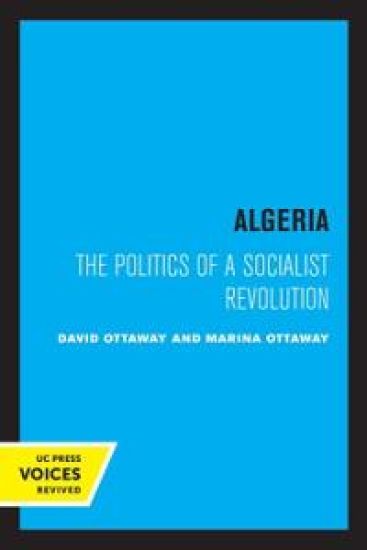
Algeria

Algeria

David Ottaway; Marina Ottaway

University of California Press
2022
pokkari
In 1962 when Algeria finally obtained its independence from France after an eight-year guerilla war, it immediately embarked upon a second revolution aimed at destroying the colonial economic and social order. While the nationalist leaders struggled for power in the first hours of independence, peasants seized French farms and workers the factories, thus setting Algeria on the road toward a new socialist order. This book is a study of the Algerian socialist revolution, of those who made it and those who gained by it. The primary focus is on political behavior, on those aspects of the struggle among Algerian leader which vitally affected the character of the new order. The authors find that even though Algeria acquired all the trappings of a socialist state and economy, politics remained almost exclusively a question of personal relations, alliances, and rivalries among a small group of leaders--what the authors call, borrowing a concept from the fourteenth-century Arab historian Ibn Khaldun, the politics of assabiya. Algeria's first President, Ahmed Ben Bella, tried to integrate the new and old political groups into a modern political system, but he failed. His overthrow by the army opened a second phase in the process of building stable political institutions and of overcoming the tradition of "palace conspiracies and rebellions of feudal lords." The authors trace in details this cyclical process during the first six years of Alergian independence. The work benefits from a wealth of first-hand information gathered during the authors' three-year stay in the country. The resulting picture is that of a new nation embarked upon a socialist "revolution" which owes little to Soviet or Chinese influences or, in some respects, even to the intentions of its leaders. This title is part of UC Press's Voices Revived program, which commemorates University of California Press's mission to seek out and cultivate the brightest minds and give them voice, reach, and impact. Drawing on a backlist dating to 1893, Voices Revived makes high-quality, peer-reviewed scholarship accessible once again using print-on-demand technology. This title was originally published in 1970.

A Tale of Four Worlds

A Tale of Four Worlds

Marina Ottaway; David Ottaway

C Hurst Co Publishers Ltd
2019
sidottu
First came the disintegration of the Ottoman Empire following World War I; then, in the 1950s and '60s, the Nasser-inspired wave of Arab nationalism and socialism. The Arab world's third great political cataclysm of the past 100 years has also brought permanent changes, but not as its activists had hoped: the 2011 uprisings. Their consequences have differed greatly from area to area, splintering the Arab region into four different worlds. The Levant states have disintegrated, possibly irreversibly. The Gulf monarchies have embarked on far- reaching plans of economic and social change to stave off discontent. Egypt has retreated into military authoritarianism and a war on Islamists, threatening its future stability. Only the Maghreb countries, which have started integrating Islamists into their political systems, offer some hope for progress toward democracy. Marina and David Ottaway have brought together fifty years of experience observing the Arab world, and a wealth of first-hand information gathered from living and travelling extensively in the region. A Tale of Four Worlds is an indispensable analysis of the profound upheavals that have shaken--and continue to transform--Arab and global politics.