Kirjojen hintavertailu. Mukana 12 390 323 kirjaa ja 12 kauppaa.

Kirjailija

David P. Redlawsk

Kirjat ja teokset yhdessä paikassa: 6 kirjaa, julkaisuja vuosilta 2006-2020, suosituimpien joukossa A Citizen’s Guide to the Political Psychology of Voting. Vertaile teosten hintoja ja tarkista saatavuus suomalaisista kirjakaupoista.

6 kirjaa

Kirjojen julkaisuhaarukka 2006-2020.

A Citizen’s Guide to the Political Psychology of Voting

A Citizen’s Guide to the Political Psychology of Voting

David P. Redlawsk; Michael W. Habegger

Routledge
2020
sidottu
In the run-up to a contentious 2020 presidential election, the much-maligned American voter may indeed be wondering, “How did we get here?” A Citizen’s Guide to the Political Psychology of Voting offers a way of thinking about how voters make decisions that provides both hope and concern. In many ways, voters may be able to effectively process vast amounts of information in order to decide which candidates to vote for in concert with their ideas, values, and priorities. But human limitations in information processing must give us pause. While we all might think we want to be rational information processors, political psychologists recognize that most of the time we do not have the time or the motivation to do so. The question is, can voters do a “good enough” job even if they fail to account for everything during the campaign? Evidence suggests that they can, but it isn’t easy. Here, Redlawsk and Habegger portray a wide variety of voter styles and approaches—from the most motivated and engaged to the farthest removed and disenchanted—in vignettes that connect the long tradition of voter survey research to real life voting challenges. They explore how voters search for political information and make use of it in evaluating candidates and their positions. Ultimately, they find that American voters are reasonably competent in making well-enough informed vote choices efficiently and responsibly. For citizen voters as well as students and scholars, these results should encourage regular turnout for elections now and in the future.
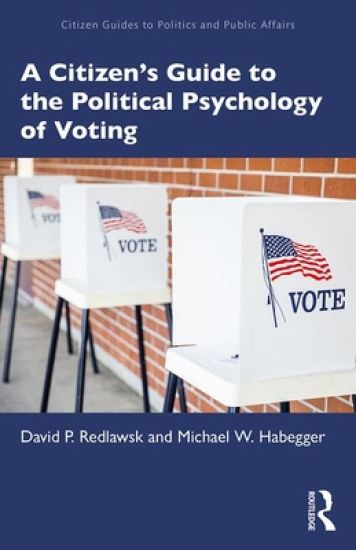
A Citizen’s Guide to the Political Psychology of Voting

A Citizen’s Guide to the Political Psychology of Voting

David P. Redlawsk; Michael W. Habegger

Routledge
2020
nidottu
In the run-up to a contentious 2020 presidential election, the much-maligned American voter may indeed be wondering, “How did we get here?” A Citizen’s Guide to the Political Psychology of Voting offers a way of thinking about how voters make decisions that provides both hope and concern. In many ways, voters may be able to effectively process vast amounts of information in order to decide which candidates to vote for in concert with their ideas, values, and priorities. But human limitations in information processing must give us pause. While we all might think we want to be rational information processors, political psychologists recognize that most of the time we do not have the time or the motivation to do so. The question is, can voters do a “good enough” job even if they fail to account for everything during the campaign? Evidence suggests that they can, but it isn’t easy. Here, Redlawsk and Habegger portray a wide variety of voter styles and approaches—from the most motivated and engaged to the farthest removed and disenchanted—in vignettes that connect the long tradition of voter survey research to real life voting challenges. They explore how voters search for political information and make use of it in evaluating candidates and their positions. Ultimately, they find that American voters are reasonably competent in making well-enough informed vote choices efficiently and responsibly. For citizen voters as well as students and scholars, these results should encourage regular turnout for elections now and in the future.
The Positive Case for Negative Campaigning

The Positive Case for Negative Campaigning

Kyle Mattes; David P. Redlawsk

University of Chicago Press
2015
nidottu
Turn on the television or sign in to social media during election season and chances are you'll see plenty of negative campaigning. For decades, conventional wisdom has held that Americans hate negativity in political advertising, and some have even argued that its pervasiveness in recent seasons has helped to drive down voter turnout. Arguing against this commonly held view, Kyle Mattes and David P. Redlawsk show not only that some negativity is accepted by voters as part of the political process, but that negative advertising is necessary to convey valuable information that would not otherwise be revealed. The most comprehensive treatment of negative campaigning to date, The Positive Case for Negative Campaigning uses models, surveys, and experiments to show that much of the seeming dislike of negative campaigning can be explained by the way survey questions have been worded. By failing to distinguish between baseless and credible attacks, surveys fail to capture differences in voters' receptivity. Voters' responses, the authors argue, vary greatly and can be better explained by the content and believability of the ads than by whether the ads are negative. Mattes and Red-lawsk go on to establish how voters make use of negative information and why it is necessary. Many voters are politically naive and unlikely to make inferences about candidates' positions or traits, so the ability of candidates to go on the attack and focus explicitly on information that would not otherwise be available is crucial to voter education.
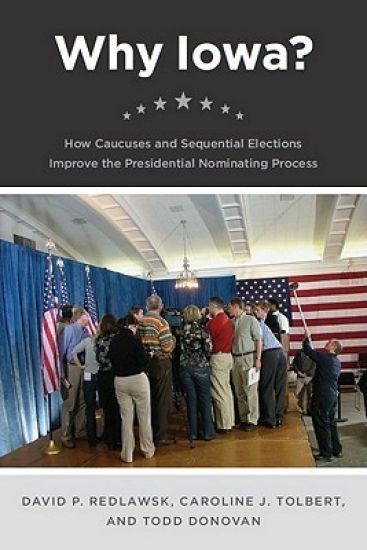
Why Iowa?

Why Iowa?

David P. Redlawsk; Caroline J. Tolbert; Todd Donovan

University of Chicago Press
2010
nidottu
If Barack Obama had not won in Iowa, most commentators believe that he would not have been able to go on to capture the Democratic nomination for president. "Why Iowa?" offers the definitive account of those early weeks of the campaign season: from how the Iowa caucuses work and what motivates the candidates' campaigns, to participation and turnout, as well as the lingering effects that the campaigning had on Iowa voters. Demonstrating how 'what happens in Iowa' truly reverberates throughout the country, five-time Iowa precinct caucus chair David P. Redlawsk and his coauthors take us on an inside tour of one of the most media-saturated and speculated-about campaign events in American politics. Considering whether a sequential primary system, in which early, smaller states such as Iowa and New Hampshire have such a tremendous impact, is fair or beneficial to the country as a whole, the authors here demonstrate that not only is the impact warranted, but it also reveals a great deal about informational elements of the campaigns. Contrary to conventional wisdom, this sequential system does confer huge benefits on the nominating process, while Iowa's particularly well-designed caucus system - extensively explored here for the first time - brings candidates' arguments, strengths, and weaknesses into the open and under the media's lens.
How Voters Decide

How Voters Decide

Richard R. Lau; David P. Redlawsk

Cambridge University Press
2006
pokkari
This book attempts to redirect the field of voting behavior research by proposing a paradigm-shifting framework for studying voter decision making. An innovative experimental methodology is presented for getting 'inside the heads' of citizens as they confront the overwhelming rush of information from modern presidential election campaigns. Four broad theoretically-defined types of decision strategies that voters employ to help decide which candidate to support are described and operationally-defined. Individual and campaign-related factors that lead voters to adopt one or another of these strategies are examined. Most importantly, this research proposes a new normative focus for the scientific study of voting behavior: we should care about not just which candidate received the most votes, but also how many citizens voted correctly - that is, in accordance with their own fully-informed preferences.
How Voters Decide

How Voters Decide

Richard R. Lau; David P. Redlawsk

Cambridge University Press
2006
sidottu
This book attempts to redirect the field of voting behavior research by proposing a paradigm-shifting framework for studying voter decision making. An innovative experimental methodology is presented for getting 'inside the heads' of citizens as they confront the overwhelming rush of information from modern presidential election campaigns. Four broad theoretically-defined types of decision strategies that voters employ to help decide which candidate to support are described and operationally-defined. Individual and campaign-related factors that lead voters to adopt one or another of these strategies are examined. Most importantly, this research proposes a new normative focus for the scientific study of voting behavior: we should care about not just which candidate received the most votes, but also how many citizens voted correctly - that is, in accordance with their own fully-informed preferences.