Kirjojen hintavertailu. Mukana 12 595 353 kirjaa ja 12 kauppaa.

Kirjailija

David Pellauer

Kirjat ja teokset yhdessä paikassa: 4 kirjaa, julkaisuja vuosilta 2003-2011, suosituimpien joukossa Memory, History, Forgetting. Vertaile teosten hintoja ja tarkista saatavuus suomalaisista kirjakaupoista.

4 kirjaa

Kirjojen julkaisuhaarukka 2003-2011.

Reflections on the Just [Standard Large Print 16 Pt Edition]

Reflections on the Just [Standard Large Print 16 Pt Edition]

Paul Ricoeur; David Pellauer

Readhowyouwant
2011
pokkari
At the time of his death in 2005, French philosopher Paul Ricoeur was regarded as one of the great thinkers of his generation. In more than half a century of writing about the essential questions of human life, Ricoeur's thought encompassed a vast range of wisdom and experience, and he made landmark contributions that would go on to influence later scholars in such areas as phenomenology, hermeneutics, structuralis, and theology. Consisting of fifteen thematically organized essays, Reflections on the Just continues and expands on the work Ricoeur began in his ''little ethics'' in Oneself as Another and The Just. In the preface, he considers what revisions he would make were he to start over and how that is reflected in these essays. The opening part brings phenomenology to bear on ethics; the second group of essays comprises shorter, occasional pieces considering the concept of justice int he works of other philosophers, including Max Weber and Charles Taylor. The final part turns to the specific domains of medicine and the law, examining how concepts of right and justice operate in those realms.
Ricoeur: A Guide for the Perplexed

Ricoeur: A Guide for the Perplexed

David Pellauer

Continuum International Publishing Group Ltd.
2007
nidottu
Paul Ricoeur was one of the giants of contemporary Continental philosophy. He also knew and drew upon the Analytic tradition. Over a long life, he pursued questions of philosophical anthropology as they relate to a good life, lived with and for others in just institutions. His work has been translated into numerous languages and widely discussed by legal theorists, historians, literary critics, and theologians as well as philosophers. Ricoeur: A Guide for the Perplexed is the ideal text to support anyone trying to reach a firm understanding of this important contemporary philosopher. The guide locates Ricoeur's output in its historical and intellectual context, provides an overview ofRicoeur's central ideas and defines carefully the key terms in his philosophical writing. Close attention is paid to each of Ricoeur's major works, including The Conflict of Interpretations and From Text to Action. Ricoeur's importance for particular disciplines - including literary criticism, social theory, political philosophy and theology - is explained and explored. Above all, this Guide for the Perplexed offers constructive and illuminating suggestions for how to read Ricoeur. A major contribution to Ricoeur scholarship in its own right, it is also an invaluable companion to be read alongside Ricoeur's own works.
Memory, History, Forgetting

Memory, History, Forgetting

Paul Ricoeur; Kathleen Blamey; David Pellauer

University of Chicago Press
2006
nidottu
A landmark work, "Memory, History, Forgetting" examines the reciprocal relationship between remembering and forgetting, revealing how this symbiosis influences both the perception of historical experience and the production of historical narrative. A momentous achievement in Ricoeur's career, this book provides the crucial link between his "Time and Narrative" and "Oneself as Another", and his recent reflections on ethics and the problems of responsibility and representation.
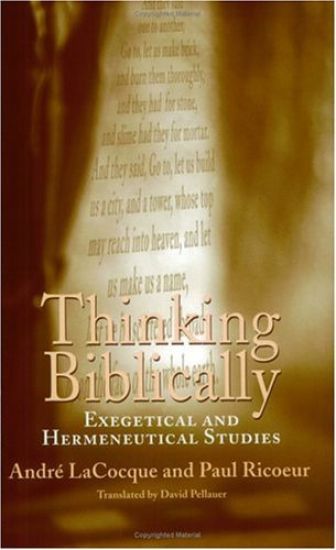
Thinking Biblically – Exegetical and Hermeneutical Studies

Thinking Biblically – Exegetical and Hermeneutical Studies

André Lacocque; Paul Ricoeur; David Pellauer

University of Chicago Press
2003
nidottu
This study discusses six crucial passages from the Old Testament, offering a commentary and new insights into their meaning. Employing a historical-critical method, the text takes account of archaeological, philological and historical research. This method is expanded to include the dynamic tradition of reading Scripture, including developments subsequent to the production of the original literary text. Also taken into account is the relation between the texts and the historical communities who read and interpreted them, together with philosophical speculation. The commentaries highlight the metaphorical structure of the passages and how they have served as catalysts for philosophical thinking from the Greeks to the modern age. Reading the Bible through different but complementary perspectives, the book seeks to reveal the familiar texts as vibrant, philosophically consequential and endlessly absorbing. The passages discussed are: the story of Adam and Eve; the commandment "thou shalt not kill"; "the valley of dry bones" passage from Ezekiel; Psalm 22; the "Song of Songs"; and the naming of God in Exodus 3;14.