Kirjojen hintavertailu. Mukana 12 595 353 kirjaa ja 12 kauppaa.

Kirjailija

David Ramsay Steele

Kirjat ja teokset yhdessä paikassa: 7 kirjaa, julkaisuja vuosilta 1999-2024, suosituimpien joukossa From Marx to Mises. Vertaile teosten hintoja ja tarkista saatavuus suomalaisista kirjakaupoista.

7 kirjaa

Kirjojen julkaisuhaarukka 1999-2024.

The Conquistador with His Pants Down

The Conquistador with His Pants Down

David Ramsay Steele

ST AUGUSTINE'S PRESS
2024
nidottu
The Conquistador with His Pants Down: David Ramsay Steele’s Legendary Lost Lectures assembles fourteen of the penetrating, provocative presentations by this controversial libertarian speaker and writer. The targets of Steele’s acerbic and witty criticisms include Scott Adams, Mattias Desmet, Sigmund Freud, Sam Harris, Karl Marx, George Orwell, Jordan Peterson, Ayn Rand, and all things conventionally Wokish. Steele’s heroes encompass Immanuel Kant, Robert Michels, Ludwig von Mises, Dexter Morgan, Karl Popper, and all who, howsoever confusedly, come down on the side of liberty, truth, and unsocial justice. “Why Do We See Lysenko-Type Mass Delusions in Western Democracies?” We’ve learned enough to know that Global Warming Catastrophism and the mass homicide of the Covid “vaccines” are totalitarian insanities. But can Mattias Desmet’s theory fully account for these recurring outbreaks of mass psychosis? “Here’s Why There Can Never Be a Marxist Revolution” There are two irrefutable reasons why genuine Marxism can never succeed. But failed fake Marxism is a real threat to all of us, especially the working class. “The Five Times George Orwell Changed His Mind” We can best understand George Orwell’s thinking by looking at the five occasions when he underwent a major change in his political outlook. “The Most Evil Man in History” Ayn Rand and her slavish worshipers depict Immanuel Kant as the Fountainhead of Evil. But in point of fact, Kant was a far greater friend of liberty and objective truth than the muddleheaded Miss Rand could ever be. “Sam Harris and How to Spot Dangerous Ideas” Sam Harris made his fame and his fortune by claiming that suicide bombings occur because of what the Quran tells Muslims. But the truth is that suicide bombings—by Muslims, atheists, and, yes, Christians—occur because they are the most cost-effective means for militarily weak populations to hit back against oppressive foreign occupation. “Dexter the Busy Bee” The serial killer Dexter Morgan confers a huge social benefit by deleting bad guys, illustrating the point made by Dr. Bernard Mandeville, that viciously-motivated behavior may give us a valuable public outcome. “The Conquistador with His Pants Down” Dr. Sigmund Freud, who likened himself to a conquistador, marketed a deceptive story about what his patients had told him. This false tale has been thoroughly exposed, and the slippery doctor doesn’t come out smelling like a rose. “Dr. Peterson! Clean Up Your Theory!” Jordan Peterson is a teller of stories and of stories about stories. But his stories about stories are provably false, and his interpretations of the stories are no more than Rorschach patterns for his own subjective fantasies. “Is It a Fact that Facts Don’t Matter?” Scott Adams denigrates truth, yet he continually appeals to facts. And the fact is that truth is a powerful influence in human affairs. “An Inconceivably Humble Defense of the Inconceivably Holy Book” In the year 112,075, humankind has recovered from the latest Ice Age and founded a new religion based on an ancient book. You’ll be surprised what our future descendants make of this charming tale recovered from our time. “Some Second Thoughts on Atheism” The author of Atheism Explained comes back to look again at this messy topic and mop up some of the mess. David Ramsay Steele is the author of The Mystery of Fascism: David Ramsay Steele’s Greatest Hits (2019), Orwell Your Orwell: A Worldview on the Slab (2017), Therapy Breakthrough: Why Some Psychotherapies Work Better than Others (with Michael R. Edelstein and Richard K. Kujoth, 2013), Atheism Explained: From Folly to Philosophy (2008), Three Minute Therapy: Change Your Thinking, Change Your Life (with Michael R. Edelstein, 1997), and From Marx to Mises: Post-Capitalist Society and the Challenge of Economic Calculation (1992).Rave Reviews of Dr. Steele’s earlier books: The Mystery of Fascism “From Mussolini to The Matrix, from vegetarianism to mental illness, Steele’s relentless logic jolts us awake.” —Thomas E. Woods, author of The Politically Incorrect Guide to American History Orwell Your Orwell “an absolutely dazzling book on Orwell, casting a brilliant new light, not just on Orwell himself, but on the entire intellectual history of our time.” —Yuri Maltsev, editor of Requiem for Marx Therapy Breakthrough “Prepare to embark upon a rollicking yet highly informative journey through the intense world of psychotherapy!” —Debbie Joffe Ellis, author of How to Hug a Porcupine Atheism Explained “Covers essentially all the arguments for and against God, in science, philosophy, and theology, with sympathy for the believer’s views even as they are shown to be untenable,” —Victor J. Stenger, author of God and the Atom Three Minute Therapy “Of all the books that explain REBT in simple, clear, and highly usable form, Three Minute Therapy is one of the very best.” —Albert Ellis, founder of REBT From Marx to Mises “a well written and tightly argued defense of Mises’s position that does much to dispel the ‘mystery’ of the socialist calculation debate.” —Mark Blaug, Economic Journal

The Mystery of Fascism – David Ramsay Steele`s Greatest Hits
David Ramsay Steele, PhD, is a libertarian writer with a powerful underground reputation for producing caustic, entertaining, knowledgeable, and surprising arguments, often violently at odds with conventional thinking. For the first time, some of Dr. Steele’s “greatest hits” have been brought together in an anthology of provocative essays on a wide range of topics. The essays are divided into two parts, “More Popular than Scholarly” and “More Scholarly than Popular.”“Scott Adams and the Pinocchio Fallacy,” Steele’s 2018 refutation of the popular claim that we might be living in a “simulated reality,” has been hailed as a totally irresistible debunking of that fallacy as promoted by The Matrix movie and by Scott Adams (among many pundits). “What Follows from the Non-Existence of Mental Illness?” (2017) preserves the crucial insights of “psychiatric abolitionist” Thomas Szasz, while exposing Szasz’s major misconceptions. In “The Bigotry of the New Atheism” (2014), Steele, himself an atheist, brings out the intolerant quality of the “New Atheists.” Steele powerfully argues that while “enthusiastic belief systems” may give rise to enormous atrocities, the historical evidence goes against the theory (promoted by Harris, Dawkins, and Hitchens) that these appalling outcomes are more likely when those belief systems include belief in God.“Taking the JFK Assassination Conspiracy Seriously” (2003) has been reprinted many times, continues to be viewed online many thousands of times, and like many of Steele’s writings, keeps making converts. It is acknowledged to be the most persuasive brief popular statement of the Lone Nut theory.“The Mystery of Fascism” (2001), which gives this collection its title, is still continually viewed and cited, for its demonstration that fascism arose directly out of far-left revolutionary Marxism and revolutionary syndicalism. Conventional ideologues of both right and left have been provoked by this highly readable piece to start thinking outside the box.The earliest piece in this collection, “Alice in Wonderland” (1987) is a devastating critique of the Ayn Rand belief system and the Ayn Rand cult.“Gambling Is Productive and Rational” (1997), mercilessly strips away the loose thinking which favors intolerance and prohibition of gambling. Steele argues that gambling adds to human well-being and ought to be completely legalized everywhere.Other topics include the recovered memory witch hunt of the 1990s, the benefits of replacing democratic voting with selection of political positions by lottery, the unexpected results of research into the causes of human happiness, the reasons why Dexter (a TV show sympathetic to a psychotic serial killer) was politically “safe,” why economic growth can go on for ever, why the most popular moral argument against eating meat just doesn’t work, how Hillary Clinton could have won the presidency in 2016, why Friedrich Hayek is wrong about social evolution, the inevitable disappearance of market socialism, Robert Nozick’s muddled thinking about economics, and the proper way to view anti-consensus theories such as the Atkins Diet.
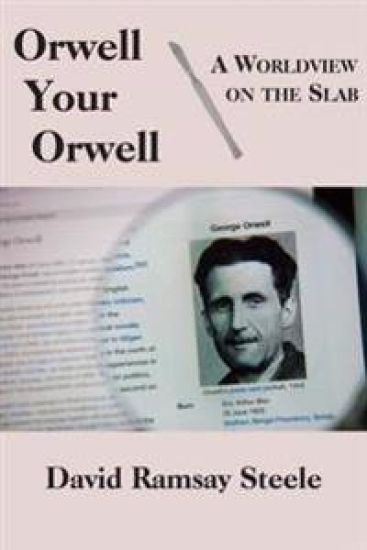
Orwell Your Orwell – A Worldview on the Slab

Orwell Your Orwell – A Worldview on the Slab

David Ramsay Steele

ST AUGUSTINE'S PRESS
2017
sidottu
To those who think they know what George Orwell is all about, this book unpacks surprise after surprise. Orwell Your Orwell reveals an Orwell very different from the one most people think of. It gives an unexpected yet convincing picture of Orwell’s beliefs, every key point precisely documented. Orwell adopted a habitual rhetoric in which he portrayed himself as a lone, embattled dissident. But objectively examined, his opinions broadly corresponded with those of conventional leftwing thinking. Far from being skeptical of prevailing orthodoxies, Orwell emerges as a True Believer in the orthodoxies of the 1930s Left, though a believer who sharply drew attention to some of the serious problems with these ideologies. In his short life, Orwell underwent several dramatic conversions – such as his overnight switch in August 1939 from being fiercely anti-war to enthusiastically pro-war – while cleaving to some fixed positions – such as his opposition to the British Empire, totalitarianism, and birth control. Dr. Steele identifies both the conversions and the continuities, as well as some aspects of his thought which gradually evolved. As well as recovering Orwell’s actual beliefs from the many accumulated misrepresentations, Dr. Steele also criticizes some of these beliefs, exposing the fallacies in Orwell’s thinking on such issues as the economics of imperialism, the dangers of hedonism, the significance of the Spanish Civil War, and the efficacy of mind control.Reviews: “This is an absolutely dazzling book on Orwell, casting a brilliant new light, not just on Orwell himself, but on the entire intellectual history of our time. It is a ‘must read’, not just for devotees of Orwell, but for anyone concerned with discussions of socialism and capitalism, totalitarianism and democracy, ideological passion and intellectual honesty. It will prove a superb teaching aid at both undergraduate and graduate levels.”—Yuri Maltsev, co-author of The Tea Party Explained and editor of Requiem for Marx “There has always been some mystery about how Orwell could give us the nightmare world of Ingsoc (English Socialism) while himself remaining an unrepentant English Socialist. This and other puzzles about Orwell are convincingly solved in Dr. Steele’s masterly account. If you want to know what made Orwell tick, you just have to read this eloquent, provocative, and hugely entertaining book.”—Barry Smith, Director of the National Center for Ontological Research and author of Austrian Philosophy
Therapy Breakthrough

Therapy Breakthrough

Michael R. Edelstein; Richard K. Kujoth; David Ramsay Steele

Cricket Books, a division of Carus Publishing Co
2013
pokkari
Like no other book you have ever read, Therapy Breakthrough explains clearly and vividly just what goes on in psychotherapy, why there are so many different systems of psychotherapy which disagree with one another, where these different schools of therapy came from, why psychotherapy is continually misrepresented in popular culture, and why, despite all this, psychotherapy gets good results, is improving all the time, and is superior to drugs in helping you solve your problems.
Atheism Explained

Atheism Explained

David Ramsay Steele

Open Court Publishing Co ,U.S.
2008
pokkari
Atheism Explained explores the claims made both for and against the existence of God. On the pro side: that the wonders of the world can only be explained by an intelligent creator; that the universe had to start somewhere; telepathy, out-of-body experiences, and other paranormal phenomena demonstrate the existence of a spirit world; and that those who experience God directly provide evidence as real as any physical finding. After disputing these arguments through calm, careful criticism, author David Ramsay Steele presents the reasons why God cannot exist: monstrous, appalling evils; the impossibility of omniscience; and the senseless concept that God is a thinking mind without a brain. He also explores controversial topics such as Intelligent Design, the power of prayer, religion without God, and whether a belief in God makes people happier and healthier. Steele’s rational, easy-to-understand prose helps readers form their own conclusions about this eternally thorny topic.
From Marx to Mises

From Marx to Mises

David Ramsay Steele

Open Court Publishing Co ,U.S.
1999
sidottu
This contribution to economic philosophy considers Marx's pronouncements on the organization of future society, and in this context re-examines the long-lasting debate triggered by Mises's argument that modern industrial production requires a system of spontaneously-formed market prices. In an undogmatic, non-technical treatment, Steele contends that both the Marxian conception of future society and the Misesian argument against its feasibility have frequently been misunderstood. The work scrutinizes the replies to Mises, and explores some of the wider issues raised by the economic calculation debate.
From Marx to Mises

From Marx to Mises

David Ramsay Steele

Open Court Publishing Co ,U.S.
1999
pokkari
This contribution to economic philosophy considers Marx's pronouncements on the organization of future society, and in this context re-examines the long-lasting debate triggered by Mises's argument that modern industrial production requires a system of spontaneously-formed market prices. In an undogmatic, non-technical treatment, Steele contends that both the Marxian conception of future society and the Misesian argument against its feasibility have frequently been misunderstood. The work scrutinizes the replies to Mises, and explores some of the wider issues raised by the economic calculation debate.