Kirjojen hintavertailu. Mukana 12 595 353 kirjaa ja 12 kauppaa.

Kirjailija

David Reay

Kirjat ja teokset yhdessä paikassa: 4 kirjaa, julkaisuja vuosilta 2013-2023, suosituimpien joukossa Heat Pipes. Vertaile teosten hintoja ja tarkista saatavuus suomalaisista kirjakaupoista.

4 kirjaa

Kirjojen julkaisuhaarukka 2013-2023.

Heat Pipes

Heat Pipes

Hussam Jouhara; David Reay; Ryan McGlen; Peter Kew; Jonathan McDonough

Butterworth-Heinemann Inc
2023
nidottu
Heat Pipes: Theory, Design and Applications, Seventh Edition, takes a highly practical approach to the design and selection of heat pipes, making it an essential guide for practicing engineers and an ideal text for postgraduate students. The expanded author team consolidate and update the theoretical background included in previous editions, and include new sections on recent developments in manufacturing methods, wick design and additional applications. The book serves as an introduction to the theory, design and application of the range of passive, two-phase, heat-transfer devices known as heat pipes, serving as an essential reference for those seeking a sound understanding of the principles of heat pipe technology. It provides an introduction to the basic principles of operation and design data which would permit the reader to design and fabricate a basic heat pipe. It also provides details of the various more complex configurations and designs currently available to assist in selecting such devices.This new edition has been fully updated to reflect the latest research and technologies and includes four brand new chapters on various types of heat pipe, theoretical principles of heat transfer and fluid mechanics, additive manufacturing and heat pipe heat exchangers.

Compact Heat Exchangers

Compact Heat Exchangers

J.E. Hesselgreaves; Richard Law; David Reay

Butterworth-Heinemann Ltd
2016
nidottu
Compact Heat Exchangers: Selection, Design, and Operation, Second Edition, is fully revised to present the most recent and fundamental ideas and industrial concepts in compact heat exchanger technology. This complete reference compiles all aspects of theory, design rules, operational issues, and the most recent developments and technological advancements in compact heat exchangers. New to this edition is the inclusion of micro, sintered, and porous passage description and data, electronic cooling, and an introduction to convective heat transfer fundamentals. New revised content provides up-to-date coverage of industrially available exchangers, recent fouling theories, and reactor types, with summaries of off-design performance and system effects and installations issues in, for example, automobiles and aircraft. Hesselgreaves covers previously neglected approaches, such as the Second Law (of Thermodynamics), pioneered by Bejan and co-workers. The justification for this is that there is increasing interest in life-cycle and sustainable approaches to industrial activity as a whole, often involving exergy (Second Law) analysis. Heat exchangers, being fundamental components of energy and process systems, are both savers and spenders of energy, according to interpretation.
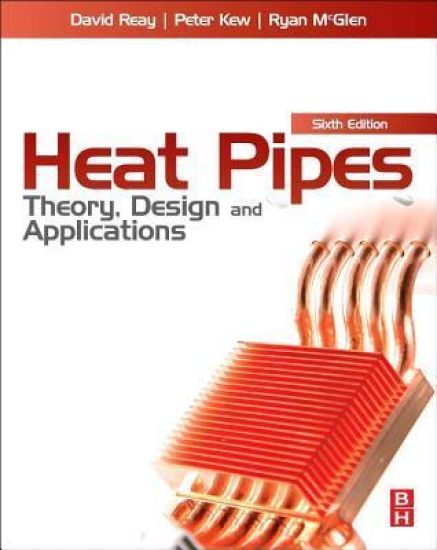
Heat Pipes

Heat Pipes

David Reay; Ryan McGlen; Peter Kew

Butterworth-Heinemann Ltd
2013
sidottu
Heat Pipes, Sixth Edition, takes a highly practical approach to the design and selection of heat pipes, making it an essential guide for practicing engineers and an ideal text for postgraduate students.This new edition has been revised to include new information on the underlying theory of heat pipes and heat transfer, and features fully updated applications, new data sections, and updated chapters on design and electronics cooling. The book is a useful reference for those with experience and an accessible introduction for those approaching the topic for the first time.
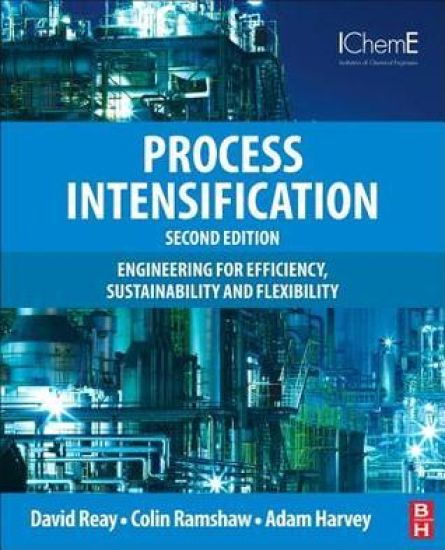
Process Intensification

Process Intensification

David Reay; Colin Ramshaw; Adam Harvey

Butterworth-Heinemann Ltd
2013
sidottu
Process Intensification: Engineering for Efficiency, Sustainability and Flexibility is the first book to provide a practical working guide to understanding process intensification (PI) and developing successful PI solutions and applications in chemical process, civil, environmental, energy, pharmaceutical, biological, and biochemical systems. Process intensification is a chemical and process design approach that leads to substantially smaller, cleaner, safer, and more energy efficient process technology. It improves process flexibility, product quality, speed to market and inherent safety, with a reduced environmental footprint. This book represents a valuable resource for engineers working with leading-edge process technologies, and those involved research and development of chemical, process, environmental, pharmaceutical, and bioscience systems.