Kirjojen hintavertailu. Mukana 12 595 353 kirjaa ja 12 kauppaa.

Kirjailija

David Ricks

Kirjat ja teokset yhdessä paikassa: 8 kirjaa, julkaisuja vuosilta 1989-2024, suosituimpien joukossa Byzantium and the Modern Greek Identity. Vertaile teosten hintoja ja tarkista saatavuus suomalaisista kirjakaupoista.

8 kirjaa

Kirjojen julkaisuhaarukka 1989-2024.

The Making of Modern Greece

The Making of Modern Greece

David Ricks

Routledge
2019
nidottu
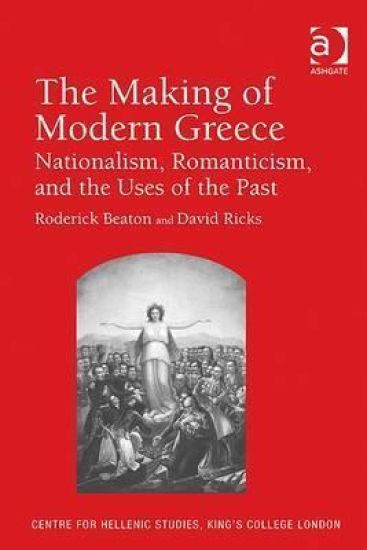
Every Greek and every friend of the country knows the date 1821, when the banner of revolution was raised against the empire of the Ottoman Turks, and the story of 'Modern Greece' is usually said to begin. Less well known, but of even greater importance, was the international recognition given to Greece as an independent state with full sovereign rights, as early as 1830. This places Greece in the vanguard among the new nation-states of Europe whose emergence would gather momentum through to the early twentieth century, a process whose repercussions continue to this day. Starting out from that perspective, which has been all but ignored until now, this book brings together the work of scholars from a variety of disciplines to explore the contribution of characteristically nineteenth-century European modes of thought to the 'making' of Greece as a modern nation. Closely linked to nationalism is romanticism, which exercised a formative role through imaginative literature, as is demonstrated in several chapters on poetry and fiction. Under the broad heading 'uses of the past', other chapters consider ways in which the legacies, first of ancient Greece, then later of Byzantium, came to be mobilized in the construction of a durable national identity at once 'Greek' and 'modern'. The Making of Modern Greece aims to situate the Greek experience, as never before, within the broad context of current theoretical and historical thinking about nations and nationalism in the modern world. The book spans the period from 1797, when Rigas Velestinlis published a constitution for an imaginary 'Hellenic Republic', at the cost of his life, to the establishment of the modern Olympic Games, in Athens in 1896, an occasion which sealed with international approval the hard-won self-image of 'Modern Greece' as it had become established over the previous century.
Digenes Akrites

Digenes Akrites

Roderick Beaton; David Ricks

Routledge
2016
nidottu
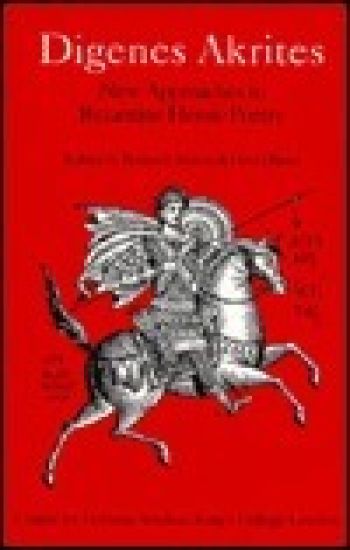
Called variously the ’Byzantine epic’, the ’epic of Modern Greece’, an ’epic-romance’ and ’romance’, the poem of Digenes Akrites has, since its rediscovery towards the end of the nineteenth century, exerted a tenacious hold on the imagination of scholars from a wide range of disciplines and from many countries of the world, as well as of writers and public figures in Greece. There are many reasons for this, not least among them the prestige accorded to ’national epics’ in the nineteenth century and for some time afterwards. Another reason must surely be the work’s uniqueness: there is nothing quite like Digenes Akrites in either Byzantine or Modern Greek literature. However, this uniqueness is not confined to its problematic place in the literary ’canon’ and literary history. As historical testimony, and in its complex relationship to later oral song and to older myth and story-telling, Digenes Akrites again has no close parallels of comparable length in Byzantine or Modern Greek culture. Whether as a literary text, a historical source, or a manifestation of an oral popular culture, Digenes Akrites remains, more than a century after its rediscovery, persistently enigmatic. This Byzantine ’epic’ or ’romance’ has now become the focus of new research across a range of disciplines since the publication in 1985 of a radically revised edition based on the Escorial text of the poem, by Stylianos Alexiou. The papers in this volume, derived from a conference held in May 1992 at King’s College London, seeks to present and discuss the results of this new research. Digenes Akrites: New Approaches to Byzantine Heroic Poetry is the second in the series published by Variorum for the Centre for Hellenic Studies, King’s College London.
The Making of Modern Greece

The Making of Modern Greece

David Ricks

Ashgate Publishing Limited
2009
sidottu
Every Greek and every friend of the country knows the date 1821, when the banner of revolution was raised against the empire of the Ottoman Turks, and the story of 'Modern Greece' is usually said to begin. Less well known, but of even greater importance, was the international recognition given to Greece as an independent state with full sovereign rights, as early as 1830. This places Greece in the vanguard among the new nation-states of Europe whose emergence would gather momentum through to the early twentieth century, a process whose repercussions continue to this day. Starting out from that perspective, which has been all but ignored until now, this book brings together the work of scholars from a variety of disciplines to explore the contribution of characteristically nineteenth-century European modes of thought to the 'making' of Greece as a modern nation. Closely linked to nationalism is romanticism, which exercised a formative role through imaginative literature, as is demonstrated in several chapters on poetry and fiction. Under the broad heading 'uses of the past', other chapters consider ways in which the legacies, first of ancient Greece, then later of Byzantium, came to be mobilized in the construction of a durable national identity at once 'Greek' and 'modern'. The Making of Modern Greece aims to situate the Greek experience, as never before, within the broad context of current theoretical and historical thinking about nations and nationalism in the modern world. The book spans the period from 1797, when Rigas Velestinlis published a constitution for an imaginary 'Hellenic Republic', at the cost of his life, to the establishment of the modern Olympic Games, in Athens in 1896, an occasion which sealed with international approval the hard-won self-image of 'Modern Greece' as it had become established over the previous century.

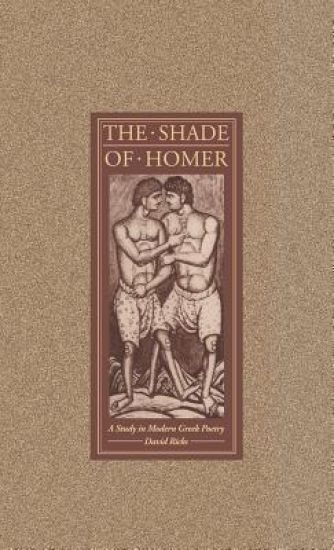
The Shade of Homer

The Shade of Homer

David Ricks

Cambridge University Press
2004
pokkari
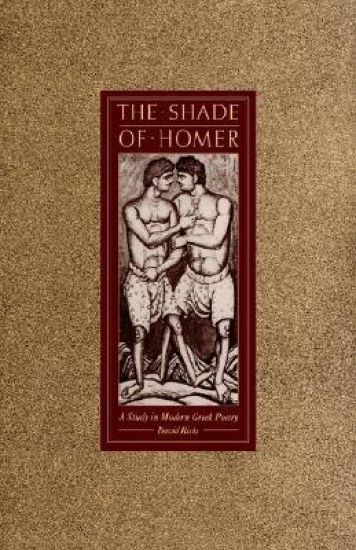
In exploring the significance of Homer for the poetry of modern Greece - benign shade or looming shadow? - Dr Ricks is tackling a theme that has implications for the study of poetic influence in general. He takes the work of Sikelianos, Cavafy and Seferis and subjects a selection of poems to a careful scrutiny. These poems are not imitations of Homer but fresh engagements with Homeric themes, and comparison of the modern versions with the original is found to be illuminating for the poets’ methods of composition. Dr Ricks does not lose sight of the larger significance of his subject, and modern poets from outside Greece - Eliot and Pound, in particular - find their way into the discussion. All Greek is translated and the reader has no need to be a specialist in modern or in ancient Greek to find this study absorbing and instructive.
Byzantium and the Modern Greek Identity

Byzantium and the Modern Greek Identity

David Ricks; Paul Magdalino

Ashgate Publishing Limited
1998
sidottu
Perhaps because of the fact that modern Greece is, through the Orthodox Church, inextricably linked with the Byzantine heritage, the precise meaning of this heritage, in its various aspects, has hitherto been surprisingly little discussed by scholars. This collection of specially commissioned essays aims to present an overview of some of the different, and often conflicting, tendencies manifested by modern Greek attitudes to Byzantium since the late eighteenth-century Enlightenment. The aim is to show just how formative views of Byzantium have been for modern Greek life and letters: for historiography and imaginative literature, on the one hand, and on the other, for language, law, and the definition of a culture. All Greek has been translated, and the volume is aimed at Byzantinists and Neohellenists alike.
Digenes Akrites

Digenes Akrites

Roderick Beaton; David Ricks

Variorum
1993
sidottu
Called variously the ’Byzantine epic’, the ’epic of Modern Greece’, an ’epic-romance’ and ’romance’, the poem of Digenes Akrites has, since its rediscovery towards the end of the nineteenth century, exerted a tenacious hold on the imagination of scholars from a wide range of disciplines and from many countries of the world, as well as of writers and public figures in Greece. There are many reasons for this, not least among them the prestige accorded to ’national epics’ in the nineteenth century and for some time afterwards. Another reason must surely be the work’s uniqueness: there is nothing quite like Digenes Akrites in either Byzantine or Modern Greek literature. However, this uniqueness is not confined to its problematic place in the literary ’canon’ and literary history. As historical testimony, and in its complex relationship to later oral song and to older myth and story-telling, Digenes Akrites again has no close parallels of comparable length in Byzantine or Modern Greek culture. Whether as a literary text, a historical source, or a manifestation of an oral popular culture, Digenes Akrites remains, more than a century after its rediscovery, persistently enigmatic. This Byzantine ’epic’ or ’romance’ has now become the focus of new research across a range of disciplines since the publication in 1985 of a radically revised edition based on the Escorial text of the poem, by Stylianos Alexiou. The papers in this volume, derived from a conference held in May 1992 at King’s College London, seeks to present and discuss the results of this new research. Digenes Akrites: New Approaches to Byzantine Heroic Poetry is the second in the series published by Variorum for the Centre for Hellenic Studies, King’s College London.
The Shade of Homer

The Shade of Homer

David Ricks

Cambridge University Press
1989
sidottu
In exploring the significance of Homer for the poetry of modern Greece - benign shade or looming shadow? - Dr Ricks is tackling a theme that has implications for the study of poetic influence in general. In this 1989 book, he takes the work of Sikelianos, Cavafy and Seferis and subjects a selection of poems to a careful scrutiny. These poems are not imitations of Homer but fresh engagements with Homeric themes, and comparison of the modern versions with the original is found to be illuminating for the poets' methods of composition. Dr Ricks does not lose sight of the larger significance of his subject, and modern poets from outside Greece - Eliot and Pound, in particular - find their way into the discussion. All Greek is translated and the reader has no need to be a specialist in modern or in ancient Greek to find this study absorbing and instructive.