

Kirjailija
David Russo
Kirjat ja teokset yhdessä paikassa: 16 kirjaa, julkaisuja vuosilta 1988-2022, suosituimpien joukossa My Teacher Is A Superhero. Vertaile teosten hintoja ja tarkista saatavuus suomalaisista kirjakaupoista.
16 kirjaa
Kirjojen julkaisuhaarukka 1988-2022.

Funny Patrol Comics started with characters and other artistic parts drawn by a ten and a half year old boy. His father used a special drawing technique where he held his son's hand for the first few years of his life and told him what to do. And they also did educational drawing exercises. The father and son liked to joke around a lot. So they decided to create a funny comic together as a father and son team.Thank you for being a Funny Patrol Comics Fan.David Russo and Griffin Russowww.funnypatrolcomics.com

I have found that being positive is healthier for me. That by thinking positively, I move towards the positive and I find it moves towards me. This book was written for you to benefit by incorporating positivity into your life. You can be a part of Positive Tunnel Vision, PTV movement and uplift the universe through your positivity.

Tokin' Of My Esteem: Hybrid Theory
David Russo
Createspace Independent Publishing Platform
2017
nidottu



Simulation in Pilot Training: A Guide for Instructors and Course Developers
David Russo
Createspace Independent Publishing Platform
2016
nidottu
A coherent guide to applying learning principles for developing complex integrated performance. The majority of the content of this text is the result of many years of observation and research by the US Air Force in pilot training. Intended as supplementary material for flight instructor training courses, the principles are widely applicable to other types of training that incorporate simulation.


Mr. Z The Zookeeper: Cover Color, Inside Color
David Russo
Createspace Independent Publishing Platform
2015
nidottu

Mr. Z The Zookeeper: Cover Color, Inside Black and White
David Russo
Createspace Independent Publishing Platform
2015
nidottu

Insightful, motivational, and spiritual are descriptions of what you will discover when you explore what it means to be "Me Only", or "You Only", or "Spiritual You and Me". They are identifiable in all aspects of your life. You will find out how these are affecting your world and what way is the best to take. It is very important to know yourself so that you can strive to have a happy life with less stress and more fulfillment. Labeling, categorizing and identifying provides introspection into who you are. To live a spiritual life while in the physical world may be a possibility. The light we give off can be of love, peace and joy. Life can potentially be more satisfying, enjoyable, and fun.

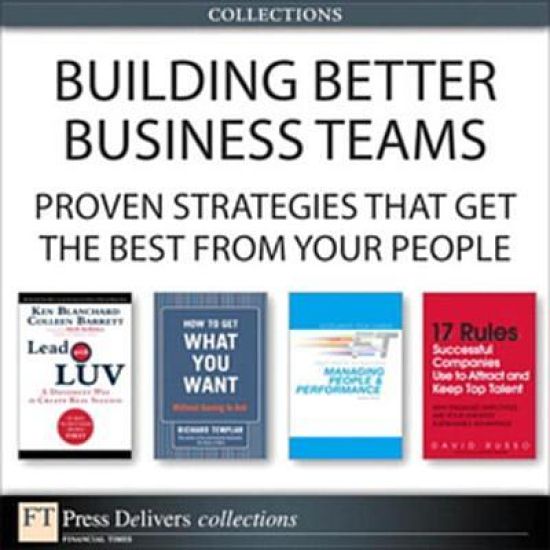
Building Better Business Teams
Colleen Barrett; Ken Blanchard; David Russo; David Ross; Richard Templar
Pearson
2012
muu
A brand new collection of powerful insights into business team-building… 4 pioneering books, now in a convenient e-format, at a great price! 4 remarkable eBooks help you create and inspire great teams to unprecedented levels of performance Your success is crucially dependent on your ability to create, lead, and inspire teams to achieve extraordinary results. The comprehensive resources in this 4 eBook package will help you do precisely that. In Lead with LUV: A Different Way to Create Real Success, the legendary Ken Blanchard ("The One Minute Manager") and former Southwest Airlines CEO Colleen Barrett help you achieve breakthrough performance by leading with love. They explain what "love" really means in the organizational context, why leading with love is not "soft" management, how to handle inappropriate behavior, how to make "servant leadership" work, and how to sustain leadership with love. Next, in 17 Rules Successful Companies Use to Attract and Keep Top Talent: Why Engaged Employees Are Your Greatest Sustainable Advantage, David Russo top workforce optimization consultant David Russo identifies exactly what great organizations do differently when it comes to managing people. Russo distills these differences into actionable rules covering everything from resourcing and compensation to leadership development, risk-taking to change management. You'll learn how to build genuine esprit de corps in any environment, ensuring that your employees' efforts, minds, and hearts stay focused on your mission, and stay committed to results and competitive advantage. In Managing People and Performance: Fast Track to Success, David Ross reveals how to get the best possible performance out of every member of your team, whatever their personality or skill set. Using Ross's breakthrough tools, techniques, checklists, and guidance, you'll master indispensable skills for creating, developing, and managing high performance teams--and, at the same time, accelerating your own career development. Finally, in How to Get What You Want...Without Having to Ask, international best-selling author Richard Templar brings his inimitable blend of originality, imagination, wisdom, and straight talk to the challenges of negotiation, persuasion, and influence. The world-renowned author of best-sellers like The Rules of Life, Templar offers up 100 clever, simple, pain-free ways to get people throughout your organization to happily say "yes" to you, and smooth your team's path to success! From world-renowned leaders and performance experts Ken Blanchard, Colleen Barrett, David Russo, David Ross, and Richard Templar

This study is the first interpretive text for the study of American exceptionalism and the first overall assessment of geographic, political, economic, social, and cultural aspects of the American past written from a global perspective. Russo argues that life in the United States can be better understood if it is examined from either a wider perspective-the English speaking world, the Western Hemisphere, Western Civilization-or a narrower perspective-regional and local variations. Even when the Americans were innovative-in their multi-ethnic and multi-racial society, in their egalitarian social beliefs, in their political democracy-their innovations were soon copied by others. Therefore, Russo argues, they are no longer distinctly American. Using nations as the basis for fields of study can both reveal and distort the historical record. When one considers different perspectives, America's uniqueness recedes in importance. American culture was a variant of a wider Western culture. The American economy was an extension of Western capitalism, whether agrarian, commercial, or industrial. American society was a Western society with racial castes and multi-ethnic additions to the population. American government functioned like other Western governments, even with innovative forms: Republican, then democratic. The American past is thus seen to be far less distinctive than previous syntheses have assumed.

Nations and other political entities are inadequate bases for studying the human past, because the other aspects of human life are not organized along the same lines as these political entities. All communities, including local ones, are amoeba-like, changing size and shape as we observe and probe them. Historians can improve the way they generalize about the past by tailoring their conclusions to the actual evidence they use. By using an array of historical questions of interest to scholars in all of the humanistically oriented disciplines, historians can offer more profound interpretations of their subjects, rather than confining themselves to an explanation of how and why human life evolves or persists through time and space. By doing so, historians can also significantly extend their influence among the general population.

Long before Americans were imbued with the sense of a national past, local antiquarians and amateur historians wrote about the people, places, and happenings that were closest to their hearts, creating in the process a historical record of incalculable value. This gold mine of information and commentary is often overlooked by today's scholars. Russo's book puts us in touch with the historical consciousness of the American people and the once-paramount concern for the particular, the concrete, and the familiar.