Kirjojen hintavertailu. Mukana 12 595 353 kirjaa ja 12 kauppaa.

Kirjailija

David Satter

Kirjat ja teokset yhdessä paikassa: 13 kirjaa, julkaisuja vuosilta 2001-2025, suosituimpien joukossa Judgment in Moscow. Vertaile teosten hintoja ja tarkista saatavuus suomalaisista kirjakaupoista.

13 kirjaa

Kirjojen julkaisuhaarukka 2001-2025.
Judgment in Moscow

Judgment in Moscow

Vladimir Bukovsky; David Satter

Ninth of November
2019
sidottu
Secret Communist Party of the Soviet Union documents stolen by the author, a famous dissident, reveal decades of Soviet infiltration of Western politics and confidential collaboration by Western leaders.
Judgment in Moscow

Judgment in Moscow

Vladimir Bukovsky; David Satter

Ninth of November
2019
pokkari
Secret Communist Party of the Soviet Union documents stolen by the author, a famous dissident, reveal decades of Soviet infiltration of Western politics and confidential collaboration by Western leaders. Contains translated excerpts from the Communist Party archives, and 400 fact-checked footnotes on events affected.
Russia and Modern Fascism

Russia and Modern Fascism

David Satter

ibidem-Verlag, Jessica Haunschild u Christian Schon
2025
nidottu
Russia seems to be hurtling toward fascism. Vladimir Putin and his allies—domestic and foreign—have obliterated and colonized Ukrainian cities in a “holy war,” committed tens of thousands of war crimes, introduced Draconian domestic crackdowns on free speech and political opposition, and rewritten the constitution to seize power in perpetuity. The state and its propagandists declare their intentions to destroy the Ukrainian state and commit genocide against the Ukrainian people, to overthrow the liberal international order, and to recreate the tsarist and Soviet empires. Meanwhile, the Russian population languishes in a militarizing culture in which civic life has been replaced by a cult of war, past and present. Each of these phenomena invites comparisons with past fascist regimes. This volume gathers leading experts in the first scholarly study of a new Russian fascism that draws on distinctly modern forms of control and violence as much as on historical precedents. An array of theoretical debates and case studies from across disciplines makes this a pioneering study of modern Russian politics. The volume’s contributors include Jaroslava Barbieri, Paul D’Anieri, Jolanta Darczewska, Maria Domanska, Alexander Etkind, Joanna Getka, Andreas Heinemann-Grüder, Vladislav Inozemtsev, Alexander J. Motyl, Andreas Umland, and Michal Wawrzonek.
Between Prison and Freedom

Between Prison and Freedom

Alexander Podrabinek; David Satter

UNIVERSITY OF NOTRE DAME PRESS
2025
sidottu
This thrilling memoir documents the early life of Russian journalist and human rights activist Alexander Podrabinek as he and other dissidents fearlessly fought against the Soviet Union. Between Prison and Freedom chronicles Alexander Podrabinek's deeply personal recollections of his early life fearlessly opposing the injustices of the Soviet Union. He vividly describes his turbulent journey from silently protesting at Pushkin Square as a teenager to his exile in a brutal prison camp for publishing Punitive Medicine. Between Prison and Freedom is a powerful tribute to the Russian dissidents, desperately loyal to their country and to each other, as they fought for freedom and justice, all while cunningly evading the KGB's nearly successful efforts to break—or kill—them. Through his personal experiences, the dissident reality unfolds as an onslaught of surveillance and false accusations, corrective labor camps and exile, and a consistent disregard for basic human freedoms. In this captivating story about standing against tyranny, Podrabinek captures the spirit of the dissident movement, the painful intersections between personal and political in a dissident's life, and the solidarity that kept the resistance moving forward.
Never Speak to Strangers and Other Writing from Russia and the Soviet Union

Never Speak to Strangers and Other Writing from Russia and the Soviet Union

David Satter

ibidem-Verlag, Jessica Haunschild u Christian Schon
2024
sidottu
David Satter is one of the world’s leading commentators on Russia. The two-volume book series Never Speak to Strangers is a collection of his articles and essays. Volume two includes articles about the Russia-Ukraine war and argues that this tragic conflict was preventable. David Satter’s writings and interviews describe the psychological roots of the conflict. Picking up where the first volume left off, the second volume of Never Speak to Strangers includes material on the historical and psychological roots of Russian aggression, the Yeltsin and Putin regimes, and, in particular, Russia’s war against Ukraine. David Satter shows that change could come to Russia in the wake of a defeat in Ukraine, but external events will not be enough to divert Russia permanently from foreingn aggression and internal repression. For that, what is required is something more fundamental, a recognition that world order must be based on universal moral values and a rejection once and for all of Russia’s “special way”.
Never Speak to Strangers and Other Writing from Russia and the Soviet Union, Volume 2

Never Speak to Strangers and Other Writing from Russia and the Soviet Union, Volume 2

David Satter

ibidem-Verlag, Jessica Haunschild u Christian Schon
2024
nidottu
David Satter is one of the world’s leading commentators on Russia. The two-volume book series Never Speak to Strangers is a collection of his articles and essays. Volume two includes articles about the Russia-Ukraine war and argues that this tragic conflict was preventable. David Satter’s writings and interviews describe the psychological roots of the conflict. Picking up where the first volume left off, the second volume of Never Speak to Strangers includes material on the historical and psychological roots of Russian aggression, the Yeltsin and Putin regimes, and, in particular, Russia’s war against Ukraine. David Satter shows that change could come to Russia in the wake of a defeat in Ukraine, but external events will not be enough to divert Russia permanently from foreingn aggression and internal repression. For that, what is required is something more fundamental, a recognition that world order must be based on universal moral values and a rejection once and for all of Russia’s “special way”.
Never Speak to Strangers and other writing from Russia and the Soviet Union

Never Speak to Strangers and other writing from Russia and the Soviet Union

David Satter

ibidem-Verlag, Jessica Haunschild u Christian Schon
2020
nidottu
David Satter arrived in the Soviet Union in June, 1976 as the correspondent of the Financial Times of London and entered a country that was a giant theater of the absurd. After 1982, he was banned from the Soviet Union but allowed back in 1990, and finally expelled in 2013 on the grounds that the secret police regarded his presence as undesirable. From 1976 to the present, he saw four different Russias, which differed from each other radically while remaining essentially the same. From 1976 to 1982, the Soviet Union was at the height of its world power and its people were in thrall to an absurd ideology. With the advent of Gorbachevs perestroika, the Soviet population was liberated from the ideology and the state hurtled to its inevitable collapse. When independent Russia emerged from the wreckage, the failure to replace the missing ideology with genuine moral values led to Russias complete criminalization. The articles in this unique collection are a chronicle of Russia from the day David Satter arrived in the Soviet Union until the present. Emigres from the states of the former Soviet Union often despair of their inability to convey the true character of their experiences to the West. Penetrating the veil of Russian mystification requires effort and the ability to understand that seeing is not always believing. The Russians have created an entire false world for our benefit. This collection reflects David Satters 40-year attempt to see them as they are.
Never Speak to Strangers and Other Writing from Russia and the Soviet Union

Never Speak to Strangers and Other Writing from Russia and the Soviet Union

David Satter

ibidem-Verlag, Jessica Haunschild u Christian Schon
2020
sidottu
David Satter arrived in the Soviet Union in June, 1976 as the correspondent of the Financial Times of London and entered a country that was a giant theatre of the absurd. After 1982, he was banned from the Soviet Union but allowed back in 1990, and finally expelled in 2013 on the grounds that the secret police regarded his presence as undesirable. From 1976 to the present, he saw four different Russias, which differed from each other radically while remaining essentially the same. From 1976 to 1982, the Soviet Union was at the height of its world power and its people were in thrall to an absurd ideology. With the advent of Gorbachevs perestroika, the Soviet population was liberated from the ideology and the state hurtled to its inevitable collapse. When independent Russia emerged from the wreckage, the failure to replace the missing ideology with genuine moral values led to Russias complete criminalization. The articles in this unique collection are a chronicle of Russia from the day David Satter arrived in the Soviet Union until the present. Emigres from the states of the former Soviet Union often despair of their inability to convey the true character of their experiences to the West. Penetrating the veil of Russian mystification requires effort and the ability to understand that seeing is not always believing. The Russians have created an entire false world for our benefit. This collection reflects David Satters 40-year attempt to see them as they are.
The Less You Know, the Better You Sleep

The Less You Know, the Better You Sleep

David Satter

Yale University Press
2017
pokkari
Once you accept that the impossible is really possible, what happens in Russia makes perfect sense “A few pages into David Satter’s truly terrifying book, one realizes that his title is smack-on accurate: modern Russia is a frightening member of the world community to an extent of which most persons are blissfully unaware.”—Joseph C. Goulden, Washington Times “Satter . . . persuasively supplies evidence for his claim that a series of residential bombings in 1999 were part of an elaborate conspiracy orchestrated by Vladimir Putin, who used them as a smoke screen to invade Chechnya and catapult himself to the presidency.”—Publisher’s Weekly In December 2013, David Satter became the first American journalist to be expelled from Russia since the Cold War. The Moscow Times said it was not surprising he was expelled, “it was surprising it took so long.” Satter is known in Russia for having written that the apartment bombings in 1999, which were blamed on Chechens and brought Putin to power, were actually carried out by the Russian FSB security police. In this book, Satter tells the story of the apartment bombings and how Boris Yeltsin presided over the criminalization of Russia, why Vladimir Putin was chosen as his successor, and how Putin has suppressed all opposition while retaining the appearance of a pluralist state. As the threat represented by Russia becomes increasingly clear, Satter’s description of where Russia is and how it got there will be of vital interest to anyone concerned about the dangers facing the world today.
It Was a Long Time Ago, and It Never Happened Anyway
A veteran writer on Russia and the Soviet Union explains why Russia refuses to draw from the lessons of its past and what this portends for the future Russia today is haunted by deeds that have not been examined and words that have been left unsaid. A serious attempt to understand the meaning of the Communist experience has not been undertaken, and millions of victims of Soviet Communism are all but forgotten. In this book David Satter, a former Moscow correspondent and longtime writer on Russia and the Soviet Union, presents a striking new interpretation of Russia's great historical tragedy, locating its source in Russia's failure fully to appreciate the value of the individual in comparison with the objectives of the state. Satter explores the moral and spiritual crisis of Russian society. He shows how it is possible for a government to deny the inherent value of its citizens and for the population to agree, and why so many Russians actually mourn the passing of the Soviet regime that denied them fundamental rights. Through a wide-ranging consideration of attitudes toward the living and the dead, the past and the present, the state and the individual, Satter arrives at a distinctive and important new way of understanding the Russian experience.
Darkness at Dawn

Darkness at Dawn

David Satter

Yale University Press
2004
pokkari
Anticipating a new dawn of freedom after the disintegration of the Soviet Union, Russians could hardly have foreseen the reality of their future a decade later: a country impoverished and controlled at every level by organized crime. This riveting book views the 1990s reform period through the experiences of individual citizens, revealing the changes that have swept Russia and their effect on Russia’s age-old ways of thinking. “The Russia that Satter depicts in this brave, engaging book cannot be ignored. Darkness at Dawn should be required reading for anyone interested in the post-Soviet state.”—Christian Caryl, Newsweek “Satter must be commended for saying what a great many people only dare to think.”—Matthew Brzezinski, Toronto Globe and Mail“Humane and articulate.”—Raymond Asquith, Spectator“Vivid, impeccably researched and truly frightening. . . . Western policy-makers, especially in Washington, would do well to study these pages.”—Martin Sieff, United Press International
Age of Delirium

Age of Delirium

David Satter

Yale University Press
2001
pokkari
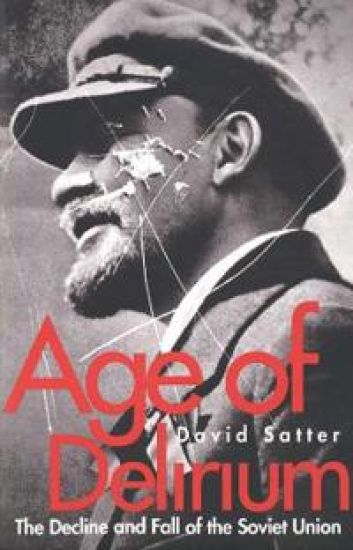
The first state in history to be based explicitly on atheism, the Soviet Union endowed itself with the attributes of God. In this book, David Satter shows through individual stories what it meant to construct an entire state on the basis of a false idea, how people were forced to act out this fictitious reality, and the tragic human cost of the Soviet attempt to remake reality by force.“I had almost given up hope that any American could depict the true face of Russia and Soviet rule. In David Satter’s Age of Delirium, the world has received a chronicle of the calvary of the Russian people under communism that will last for generations.”—Vladimir Voinovich, author of The Life and Extraordinary Adventures of Private Ivan Chonkin“Spellbinding. . . . Gives one a visceral feel for what it was like to be trapped by the communist system.”—Jack Matlock, Washington Post“Satter deserves our gratitude. . . . He is an astute observer of people, with an eye for essential detail and for human behavior in a universe wholly different from his own experience in America.”—Walter Laqueur, Wall Street Journal “Every page of this splendid and eloquent and impassioned book reflects an extraordinarily acute understanding of the Soviet system.”—Jacob Heilbrunn, Washington Times