Kirjojen hintavertailu. Mukana 12 595 353 kirjaa ja 12 kauppaa.

Kirjailija

David Schlosberg

Kirjat ja teokset yhdessä paikassa: 11 kirjaa, julkaisuja vuosilta 1999-2025, suosituimpien joukossa Institutionalising Multispecies Justice. Vertaile teosten hintoja ja tarkista saatavuus suomalaisista kirjakaupoista.

11 kirjaa

Kirjojen julkaisuhaarukka 1999-2025.

Institutionalising Multispecies Justice

Institutionalising Multispecies Justice

Danielle Celermajer; Anthony Burke; Stefanie Fishel; Erin Fitz-Henry; Nicole Rogers; David Schlosberg; Christine Winter

Cambridge University Press
2025
sidottu
Multispecies Justice (MSJ) is a theory and practice seeking to correct the defects making dominant theories of justice incapable of responding to current and emerging planetary disruptions and extinctions. Multispecies Justice starts with the assumption that justice is not limited to humans but includes all Earth others, and the relationships that enable their functioning and flourishing. This Element describes and imagines a set of institutions, across all scales and in different spheres, that respect, revere, and care for the relationships that make life on Earth possible and allow all natural entities, humans included, to flourish. It draws attention to the prefigurative work happening within societies otherwise dominated by institutions characterised by Multispecies Injustice, demonstrating historical and ongoing practices of MSJ in different contexts. It then sketches speculative possibilities that expand on existing institutional reforms and are more fundamentally transformational. This title is also available as Open Access on Cambridge Core.
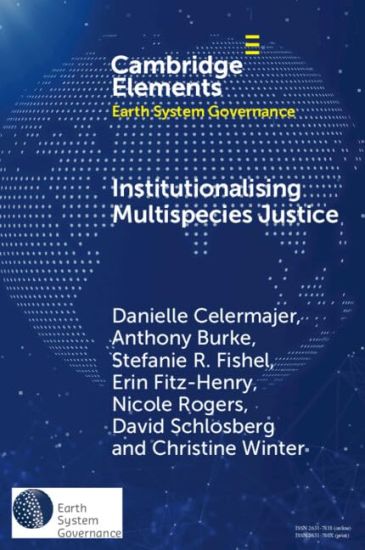
Institutionalising Multispecies Justice

Institutionalising Multispecies Justice

Danielle Celermajer; Anthony Burke; Stefanie Fishel; Erin Fitz-Henry; Nicole Rogers; David Schlosberg; Christine Winter

Cambridge University Press
2025
pokkari
Multispecies Justice (MSJ) is a theory and practice seeking to correct the defects making dominant theories of justice incapable of responding to current and emerging planetary disruptions and extinctions. Multispecies Justice starts with the assumption that justice is not limited to humans but includes all Earth others, and the relationships that enable their functioning and flourishing. This Element describes and imagines a set of institutions, across all scales and in different spheres, that respect, revere, and care for the relationships that make life on Earth possible and allow all natural entities, humans included, to flourish. It draws attention to the prefigurative work happening within societies otherwise dominated by institutions characterised by Multispecies Injustice, demonstrating historical and ongoing practices of MSJ in different contexts. It then sketches speculative possibilities that expand on existing institutional reforms and are more fundamentally transformational. This title is also available as Open Access on Cambridge Core.

Sustainable Materialism

Sustainable Materialism

David Schlosberg; Luke Craven

Oxford University Press
2022
nidottu
A growing number of environmental groups focus on more sustainable practices in everyday life, from the development of new food systems, to community solar, to more sustainable fashion. No longer willing to take part in unsustainable practices and institutions, and not satisfied with either purely individualistic and consumer responses or standard political processes and movement tactics, many activists and groups are increasingly focusing on restructuring everyday practices of the circulation of the basic needs of everyday life. This work labels such action sustainable materialism, and examines the political and social motivations of activists and movement groups involved in this growing and expanding practice. The central argument is that these movements are motivated by four key factors: frustration with the lack of accomplishments on broader environmental policies, a desire for environmental and social justice, an active and material resistance to the power of traditional industries, and a form of sustainability that is attentive to the flow of materials through bodies, communities, economies, and environments. In addition to these motivations, these movements demonstrate such material action as political action, in contrast to existing critiques of new materialism as apolitical or post-political. Overall, sustainable materialism is explored as a set of movements with unique qualities, based in collective rather than individual action, a dedication to local and prefigurative politics, and a demand that sustainability be practiced in everyday life - starting with the materials and flows that provide food, power, clothing, and other basic needs.
Sustainable Materialism

Sustainable Materialism

David Schlosberg; Luke Craven

Oxford University Press
2019
sidottu
A growing number of environmental groups focus on more sustainable practices in everyday life, from the development of new food systems, to community solar, to more sustainable fashion. No longer willing to take part in unsustainable practices and institutions, and not satisfied with either purely individualistic and consumer responses or standard political processes and movement tactics, many activists and groups are increasingly focusing on restructuring everyday practices of the circulation of the basic needs of everyday life. This work labels such action sustainable materialism, and examines the political and social motivations of activists and movement groups involved in this growing and expanding practice. The central argument is that these movements are motivated by four key factors: frustration with the lack of accomplishments on broader environmental policies, a desire for environmental and social justice, an active and material resistance to the power of traditional industries, and a form of sustainability that is attentive to the flow of materials through bodies, communities, economies, and environments. In addition to these motivations, these movements demonstrate such material action as political action, in contrast to existing critiques of new materialism as apolitical or post-political. Overall, sustainable materialism is explored as a set of movements with unique qualities, based in collective rather than individual action, a dedication to local and prefigurative politics, and a demand that sustainability be practiced in everyday life - starting with the materials and flows that provide food, power, clothing, and other basic needs.
Climate-Challenged Society

Climate-Challenged Society

John S. Dryzek; Richard B. Norgaard; David Schlosberg

Oxford University Press
2013
sidottu
This book is an original, accessible, and thought-provoking introduction to the severe and broad-ranging challenges that climate change presents and how societies can respond. It synthesizes and deploys cutting-edge scholarship on the range of social, economic, political, and philosophical issues surrounding climate change. The treatment is introductory, but the book is written "with attitude", for nobody has yet charted in coherent, integrative, and effective fashion a way to move societies beyond their current paralysis as they face the challenges of climate change. The coverage begins with an examination of science, public opinion, and policy making, with special attention to organized climate change denial. The book then moves to economic analysis and its limits; different kinds of policies; climate justice; governance at all levels from the local to the global; and the challenge of an emerging "Anthropocene" in which the mostly unintended consequences of human action drive the earth system into a more chaotic and unstable era. The conclusion considers the prospects for fundamental transition in ideas, movements, economics, and governance.
Climate-Challenged Society

Climate-Challenged Society

John S. Dryzek; Richard B. Norgaard; David Schlosberg

Oxford University Press
2013
nidottu
This book is an original, accessible, and thought-provoking introduction to the severe and broad-ranging challenges that climate change presents and how societies can respond. It synthesizes and deploys cutting-edge scholarship on the range of social, economic, political, and philosophical issues surrounding climate change. The treatment is introductory, but the book is written "with attitude", for nobody has yet charted in coherent, integrative, and effective fashion a way to move societies beyond their current paralysis as they face the challenges of climate change. The coverage begins with an examination of science, public opinion, and policy making, with special attention to organized climate change denial. The book then moves to economic analysis and its limits; different kinds of policies; climate justice; governance at all levels from the local to the global; and the challenge of an emerging "Anthropocene" in which the mostly unintended consequences of human action drive the earth system into a more chaotic and unstable era. The conclusion considers the prospects for fundamental transition in ideas, movements, economics, and governance.
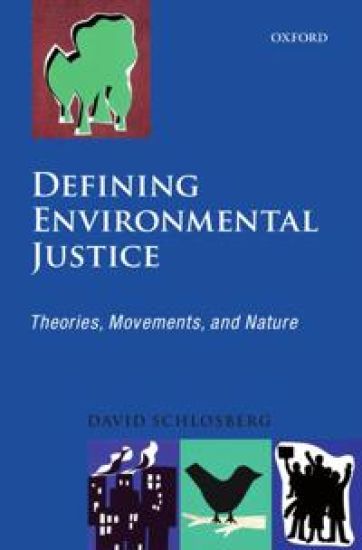
Defining Environmental Justice

Defining Environmental Justice

David Schlosberg

Oxford University Press
2009
nidottu
This book will appeal to anyone interested in environmental politics, environmental movements, and justice theory. The basic task of this book is to explore what, exactly, is meant by 'justice' in definitions of environmental and ecological justice. It examines how the term is used in both self-described environmental justice movements and in theories of environmental and ecological justice. The central argument is that a theory and practice of environmental justice necessarily includes distributive conceptions of justice, but must also embrace notions of justice based in recognition, capabilities, and participation. Throughout, the goal is the development of a broad, multi-faceted, yet integrated notion of justice that can be applied to both relations regarding environmental risks in human populations and relations between human communities and non-human nature.
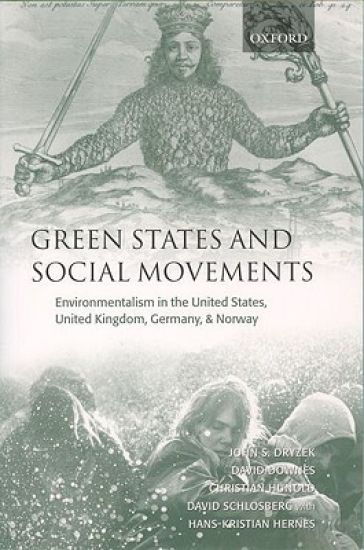
Green States and Social Movements

Green States and Social Movements

John S. Dryzek; David Downes; Christian Hunold; David Schlosberg; Hans-Kristian Hernes

Oxford University Press
2003
nidottu
Social movements take shape in relation to the kind of state they face, while over time states are transformed by the movements that they both incorporate and resist. This is a comparative study of the environmental movement's successes and failures in four very different states: the USA, UK, Germany and Norway. The history covers the entire sweep of the modern environmental era that began in 1970. The end in view is a green transformation of the state and society on a par with earlier transformations that gave us first the liberal capitalist state and then the welfare state. The authors explain why such a transformation is now most likely in Germany, and why it is least likely in the United States, which has lost the status of environmental pioneer that it gained in the early 1970s. Their comparative analysis also explains the role played by social movements in making modern societies more deeply democratic, and yields insights into the strategic choices of environmental movements as they decide on what terms to engage, enter or resist the state.
Green States and Social Movements

Green States and Social Movements

John S. Dryzek; David Downes; Christian Hunold; David Schlosberg; Hans-Kristian Hernes

Oxford University Press
2003
sidottu
Social movements take shape in relation to the kind of state they face, while over time states are transformed by the movements that they both incorporate and resist. Green States and Social Movements is a comparative study of the environmental movement's successes and failures in four very different states: the USA, UK, Germany and Norway. The history covers the entire sweep of the modern environmental era that begins in 1970. The end in view is a green transformation of the state and society on a par with earlier transformations that gave us first the liberal capitalist state and then the welfare state. The authors explain why such a transformation is now most likely in Germany, and why it is least likely in the United States, which has lost the status of environmental pioneer that it gained in the early 1970s. Their comparative analysis also explains the role played by social movements in making modern societies more deeply democratic, and yields insights into the strategic choices of environmental movements as they decide on what terms to engage, enter or resist the state. Sometimes it makes sense for a movement to act conventionally, as a green party or set of interest groups. But sometimes inclusion can mean co-optation, in which case a movement can instead emphasize action in and through civil society.
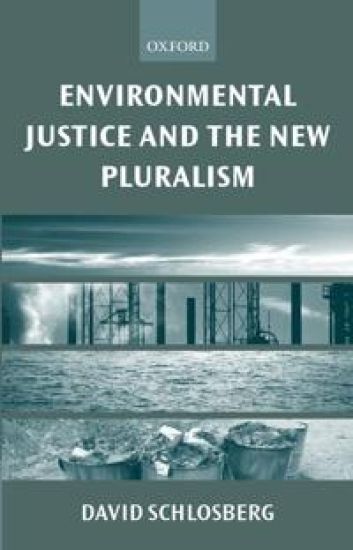
Environmental Justice and the New Pluralism

Environmental Justice and the New Pluralism

David Schlosberg

Oxford University Press
2002
nidottu
In the first ever theoretical treatment of the environmental justice movement, David Schlosberg demonstrates the development of a new form of 'critical' pluralism, in both theory and practice. Taking into account the evolution of environmentalism and pluralism over the course of the century, the author argues that the environmental justice movement and new pluralist theories now represent a considerable challenge to both conventional pluralist thought and the practices of the major groups in the US environmental movement. Much of recent political theory has been aimed at how to acknowledge and recognize, rather than deny, the diversity inherent in contemporary life. In practice, the myriad ways people define and experience the 'environment' has given credence to a form of environmentalism that takes difference seriously. The environmental justice movement, with its base in diversity, its networked structure, and its communicative practices and demands, exemplifies the attempt to design political practices beyond those one would expect from a standard interest group in the conventional pluralist model.
Environmental Justice and the New Pluralism

Environmental Justice and the New Pluralism

David Schlosberg

Oxford University Press
1999
sidottu
In the first ever theoretical treatment of the environmental justice movement, David Schlosberg demonstrates the development of a new form of `critical' pluralism, in both theory and practice. Taking into account the evolution of environmentalism and pluralism over the course of the century, the author argues that the environmental justice movement and new pluralist theories now represent a considerable challenge to both conventional pluralist thought and the practices of the major groups in the US environmental movement. Much of recent political theory has been aimed at how to acknowledge and recognize, rather than deny, the diversity inherent in contemporary life. In practice, the myriad ways people define and experience the `environment' has given credence to a form of environmentalism that takes difference seriously. The environmental justice movement, with its base in diversity, its networked structure, and its communicative practices and demands, exemplifies the attempt to design political practices beyond those one would expect from a standard interest group in the conventional pluralist model.